

Protein bars are now an inseparable part of quick, healthy snacking. We often carry them with us to work, to sport or on trips, but are they really as healthy as they seem? In this article you will find out when to eat them, what to watch out for when choosing and which compositions are better walked past.
Are protein bars healthy?
Yes, protein bars can be healthy, but by no means all of them. As with other processed foods, with protein bars too you will find plenty on the market whose composition is worse than the composition of ordinary sweets. That is why it matters to read the bar’s ingredient list really carefully.
What is a protein bar and what is it for?
A protein bar is simply a sweet bar (sweetened with refined or natural sugar or with sweeteners) that has a higher amount of protein and usually a lower amount of fat and carbohydrate than classic sweet bars. Animal or plant proteins are added to a protein bar.
The job of the bar is to help you reach your daily protein intake, which is why it is particularly useful for people who keep an eye on their calorie intake and on the amount of macronutrients they get. Protein contributes to the growth and maintenance of muscle mass, which is why it matters when you are working on your shape or keeping to a healthy lifestyle (carbohydrates and fats are just as important, do not forget that).
Protein bars are popular as a sweet snack alongside a healthy diet, or as functional nutrition or a meal replacement in situations where you would otherwise not manage to eat.

The composition is what decides
If a protein bar contains a lot of sugar, sweeteners, artificial flavours, fillers and palm fat… then its composition is not exactly the healthiest. Do not forget to look at the amounts of the individual macronutrients either. Some bars have such an unbalanced ratio of protein, sugar and fat that you might as well have an ordinary chocolate wafer bar and the effect will be the same.
Healthy protein bars are the ones that contain quality ingredients, do not have an overly long list of ingredients, are ideally sweetened with natural (unrefined) sugars and contain quality protein. For example, like ours, the Powerlogy protein bars. They contain quality whey protein, quality dark chocolate, prebiotic fibre and some of them also premium collagen. And we also have protein bars for vegans.
Sugar-free does not always mean better
At first glance it may look as though sugar-free protein bars are the healthier choice. Bars in which the sensation of sweetness is supplied by sweeteners may in the end be even less healthy than those with sugar. Why is that?
Sweeteners such as maltitol, sorbitol or xylitol can cause digestive discomfort in more sensitive people. And maltitol, for example, has the same glycaemic index as ordinary sugar, so it raises blood sugar just as quickly.
What else the bar contains matters too. If it has sweeteners in it, no fibre, and plenty of artificial ingredients instead of good ones, then such a bar certainly will not be a healthy one.
Sugar-free protein bars can, however, be a practical option for people who have to keep an eye on their intake of simple sugars. Here too, though, it is worth checking the overall composition of the bar.
How protein bars affect our brain
The fact that a protein bar carries labels such as ,,fit”, ,,healthy”, ,,no sugar” and the like does not mean that it really is. Those labels are only there to convince you that you do not have to think so much about what you are eating when you eat it.
But every sweet food, and a protein bar is one, can trigger the same response in the brain as any other sweet. And that is how problems with emotional eating, rewarding yourself with food and eating out of boredom can arise.
Dose your protein bars the same way you dose sweets. Ideally once a day, best after training, and above all not when you are bored or need to push away bad feelings.

How to choose a good protein bar
Choosing a protein bar so that it does what you want from it, is good quality and tastes good is not that hard. Just watch a few basic things:
- protein quality: the best option is whey protein, then collagenand plant proteins; with all of the options the important thing is to choose a genuinely good protein,
- sugar or sweeteners: look at how much sugar and sweetener there is in the bar and also at which sugars and which sweeteners it contains,
- fats and fibre: notice too what fats the bar contains and how much of them, and the same goes for fibre,
- the overall impression: if a bar has more than 20 g of protein, a good (and short) ingredient list and little sugar, it will probably be the right choice.
The quality of Powerlogy protein bars
For a genuinely good source of protein, collagen and fibre, try our protein bars. We have several versions in the range so that absolutely everyone finds their favourite.
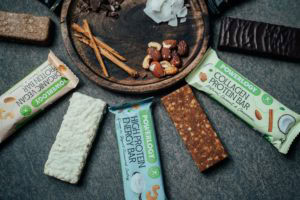
For example, one Powerlogy Upgraded Collagen Bar contains a daily 10 g portion of premium collagen, 12.5 g of prebiotic chicory fibre, only 7.2 g of sugar (sweetened with stevia) and MCT coconut oil. Or taste the Powerlogy Collagen Protein Bar, which contains as much as 8 g of fibre, 20 % of its composition is hydrolysed collagen, it has 17 g of protein and a very low sugar content, only 2.2 g.
One Powerlogy Upgraded Whey Protein Barcontains 11 g of pure whey protein, 9 g of chicory fibre, MCT oils and as much as 22 grams of protein. And it is coated in quality, clean dark chocolate.
If you need to give your body a really large amount of protein, reach for the Powerlogy High Protein Bar. One bar contains as much as 32 % whey protein (34 g of protein), 13 % of its composition is hydrolysed bovine collagen and it contains 14 g of sugar. It is high in fibre, with 8.2 g.
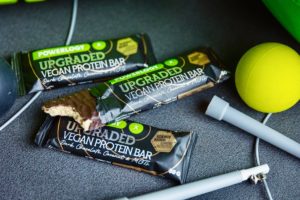
If you prefer plant-based food or you have an intolerance to milk protein, try the Powerlogy Upgraded Vegan Protein Bar. One bar contains 10 g of plant protein (primarily rice), 10 g of chicory fibre, MCT oils and quality dark chocolate. Thanks to this bar you take in as much as 20 g of protein. Or try the Powerlogy Organic Vegan Protein Bar, our certified organic and vegan bar, which contains organic nuts and organic oat flakes and has 10 g of protein.
So is a protein bar healthy?
It is, if you choose one with a good composition, made from quality ingredients, and one that suits your needs. Do not be lured in by interesting words on the wrapper and always look at the composition and the overall quality of the product, and at online reviews too if you can.
Remember as well that a protein bar is not meant to replace a full meal and you should not be eating them by the ton every day. As everywhere, here too everything is best in moderation.


Comments
There are no comments yet.