
Vitamin C (L-ascorbic acid) is a water-soluble vitamin that humans obtain through the diet, mainly from fruits and vegetables. Humans cannot synthesise vitamin C because during evolution they lost the function of L-gulonolactone oxidase, the terminal enzyme of its biosynthetic pathway. In the body it acts as an enzyme cofactor and is part of the antioxidant network.[1][2][3]
At a glance
- Vitamin C is a water-soluble vitamin that humans cannot synthesise and obtain through the diet, mainly from fruits and vegetables.
- EFSA has set the population reference intake of vitamin C at 110 mg per day for men and 95 mg per day for women.
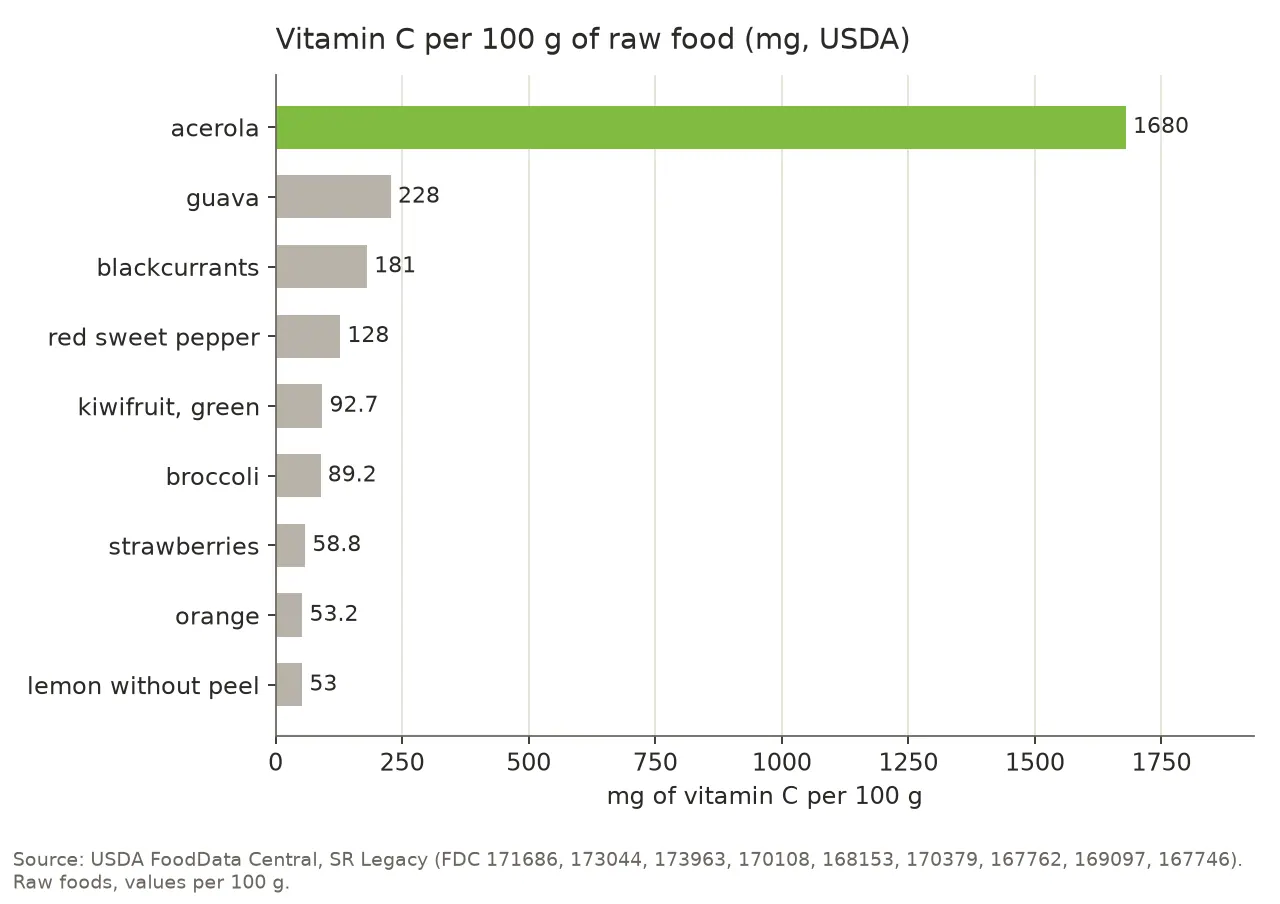
- According to the USDA database, 100 g of raw acerola contains 1,680 mg of vitamin C, blackcurrants 181 mg and red sweet pepper 128 mg.
- A 2013 Cochrane review reports that regular supplementation did not reduce the incidence of colds in the general population; with it, the duration of colds in adults was 8 % shorter.
- The data are insufficient to establish a tolerable upper intake level; at 3 to 4 g per day gastrointestinal effects may occur.
Ascorbic acid: functions, absorption and scurvy
According to EFSA, vitamin C is a cofactor for enzyme reactions catalysed by monooxygenases, dioxygenases and mixed function oxygenases. It plays a role in the biosynthesis of collagen, is essential for the synthesis of carnitine and catecholamines and is involved in the metabolism of cholesterol to bile acids. In aqueous solution it scavenges reactive oxygen and nitrogen species.[3]
It belongs to the water-soluble vitamins. In this it differs from vitamin D, whose forms D2 and D3 are fat-soluble.[1][3]
At an intake of about 100 mg per day, about 80 % is absorbed in the gastrointestinal tract. Plasma carries it as the free anion ascorbate to all tissues. Absorption takes place mainly through the sodium-dependent vitamin C transporter SVCT-1, which is rapidly saturated, so absorption from a single serving is relatively limited, although vitamin C is well absorbed in small quantities.[3][4]
Absorption depends on the dose. A study in which 7 healthy volunteers were hospitalised for 4 to 6 months assessed seven daily doses from 30 to 2,500 mg; a single dose of 200 mg was completely absorbed. At single doses of 500 mg and higher, bioavailability declined and the absorbed amount was excreted in the urine; plasma was completely saturated at 1,000 mg per day. According to EFSA, the plasma concentration reaches a plateau of 70 to 80 µmol/l that can be maintained only by chronic intakes above 200 mg per day.[5][3]
EFSA assesses vitamin C status by the plasma ascorbate concentration; a value of 50 µmol/l indicates adequate status. Scurvy is characterised by symptoms related to connective tissue defects. In adults it occurs at a plasma concentration below 10 µmol/l and a body pool below 300 mg, and according to EFSA an intake of 10 mg of vitamin C per day prevents it.[3]
Vitamin C content of foods: acerola, blackcurrants and red sweet pepper
The main sources of vitamin C for adults are fruits, vegetables, their juices and potatoes. Average intake from food alone in European countries is 69 to 130 mg per day in men and 65 to 138 mg per day in women.[3]
The USDA FoodData Central database gives 1,680 mg of vitamin C per 100 g of raw acerola, 228 mg for guava, 181 mg for blackcurrants and 128 mg for red sweet pepper.[6]
| Food (raw) | Vitamin C (mg per 100 g) | % NRV per 100 g |
|---|---|---|
| acerola | 1,680 | 2,100 % |
| guava | 228 | 285 % |
| blackcurrants | 181 | 226 % |
| red sweet pepper | 128 | 160 % |
| kiwifruit, green | 92.7 | 116 % |
| broccoli | 89.2 | 112 % |
| strawberries | 58.8 | 74 % |
| orange | 53.2 | 67 % |
| lemon without peel | 53.0 | 66 % |
| potatoes with skin | 19.7 | 25 % |
EFSA reference intake and the higher requirement of smokers
EFSA derived the average requirement (AR) from the intake that balances metabolic losses of vitamin C and maintains a fasting plasma concentration of about 50 µmol/l. For men the AR is 90 mg per day and the population reference intake (PRI) is 110 mg per day. For women the AR was derived by extrapolation on the basis of body weight as 80 mg per day, and the PRI as 95 mg per day.[3]
For children and adolescents the PRI ranges from 20 mg per day at 1 to 3 years to 100 mg for boys and 90 mg for girls aged 15 to 17 years.[3]
| Group | PRI (mg per day) |
|---|---|
| men | 110 |
| women | 95 |
| pregnant women | 105 |
| women fully breastfeeding, first 6 months | 155 |
| infants 7 to 11 months | 20 |
| children 1 to 3 years | 20 |
| boys 15 to 17 years | 100 |
| girls 15 to 17 years | 90 |
Multiple studies have found lower vitamin C status and a higher prevalence of deficiency in smokers than in non-smokers. The difference persisted after dietary intake was taken into account, and in one study vitamin C turnover in smokers was more than 40 % higher.[4]
Some international regulatory authorities therefore recommend an additional 20 to 80 mg per day for smokers. The authors of the review consider these additions likely to be insufficient. Vitamin C status increases after smoking cessation.[4]
Fifteen authorised health claims on vitamin C
Regulation (EU) No 432/2012 lists fifteen authorised health claims for vitamin C; the table gives their official English wording. Fourteen of them may be used only for food which is at least a source of vitamin C as referred to in the Annex to Regulation (EC) No 1924/2006.[8]
Under the Annex to Regulation (EC) No 1924/2006, a claim that a food is a source of a vitamin may only be made where the product contains at least a significant amount. Annex XIII of Regulation (EU) No 1169/2011 sets an NRV of 80 mg for vitamin C. As a rule, a significant amount is 15 % of the NRV supplied by 100 g or 100 ml. For vitamin C this is 12 mg (calculation: 0.15 × 80).[9][7]
The claim on the immune system during and after intense physical exercise has a specific condition. The food must provide a daily intake of 200 mg of vitamin C, and the consumer must be informed that the beneficial effect is obtained with a daily intake of 200 mg in addition to the recommended daily intake. The claim on iron absorption is based on EFSA opinion 2009;7(9):1226; in the column for the relationship with health, the EU register gives the absorption of non-haem iron. The claim that vitamin C is necessary to maintain energy and general vitality is listed in the register as non-authorised.[8][10]
| Claim | Condition of use |
|---|---|
| Vitamin C contributes to normal collagen formation for the normal function of blood vessels. | food is at least a source of vitamin C |
| Vitamin C contributes to normal collagen formation for the normal function of bones. | food is at least a source of vitamin C |
| Vitamin C contributes to normal collagen formation for the normal function of cartilage. | food is at least a source of vitamin C |
| Vitamin C contributes to normal collagen formation for the normal function of gums. | food is at least a source of vitamin C |
| Vitamin C contributes to normal collagen formation for the normal function of skin. | food is at least a source of vitamin C |
| Vitamin C contributes to normal collagen formation for the normal function of teeth. | food is at least a source of vitamin C |
| Vitamin C contributes to normal energy-yielding metabolism. | food is at least a source of vitamin C |
| Vitamin C contributes to normal functioning of the nervous system. | food is at least a source of vitamin C |
| Vitamin C contributes to normal psychological function. | food is at least a source of vitamin C |
| Vitamin C contributes to the normal function of the immune system. | food is at least a source of vitamin C |
| Vitamin C contributes to maintain the normal function of the immune system during and after intense physical exercise. | food provides a daily intake of 200 mg of vitamin C; information that the beneficial effect is obtained with a daily intake of 200 mg in addition to the recommended daily intake |
| Vitamin C contributes to the protection of cells from oxidative stress. | food is at least a source of vitamin C |
| Vitamin C contributes to the reduction of tiredness and fatigue. | food is at least a source of vitamin C |
| Vitamin C contributes to the regeneration of the reduced form of vitamin E. | food is at least a source of vitamin C |
| Vitamin C increases iron absorption. | food is at least a source of vitamin C |
Ascorbates and liposomal vitamin C
Food supplements with vitamin C contain L-ascorbic acid or its salts, the ascorbates. In a human study, the bioavailability of a product with calcium ascorbate did not differ significantly from that of ascorbic acid; people sensitive to acidic foods tolerated it better.[1]
Synthetic and food-derived vitamin C are chemically identical. Fruit and vegetables, however, also contain other vitamins, minerals, dietary fibre and phytochemicals that may affect bioavailability. Of these substances, interactions with bioflavonoids have been studied most intensively. All steady state comparative studies in humans have found no difference between synthetic and natural vitamin C.[1]
Liposomal vitamin C is the vitamin encapsulated within lipids. A 2025 review included 10 studies that compared the liposomal and non-liposomal forms; seven of them had a randomised crossover design. The studies were small, with 5 to 27 participants.[2]
Nine studies found a higher bioavailability of the liposomal form: according to the summary of the review, the maximum plasma concentration was 1.2 to 5.4 times higher and the area under the curve 1.3 to 7.2 times higher. In the table of the review, one study with 8 men and a dose of 150 mg reports 5.6 times the maximum concentration and 5.9 times the area under the curve. The participants in this study had a very low vitamin C level at baseline; according to the author, baseline status may explain part of the differences between studies. None of the studies assessed the elimination of ascorbate, and only two assessed biological effects. All studies had industry funding or authors employed by companies. In the earlier of the two studies that assessed biological effects, both forms provided comparable protection against lipid oxidation. In the more recent one, an approximately 50 % higher uptake of the liposomal form did not translate into better protection of cells or nucleic acids against oxidation. The author of the review considers the clinical significance of the small percentage differences in that study uncertain and likely to be minimal.[2]
The common cold: the 2013 Cochrane review
A 2013 Cochrane systematic review assessed both regular daily supplementation with vitamin C and its use at the onset of cold symptoms; it included only placebo-controlled trials with a dose of at least 0.2 g per day. The incidence of colds with regular supplementation was assessed in 29 comparisons with 11,306 participants. In the general community trials (10,708 participants) the pooled risk ratio was 0.97 (95 % confidence interval 0.94 to 1.00). In five trials with 598 marathon runners, skiers and soldiers on subarctic exercises the risk ratio was 0.48 (95 % confidence interval 0.35 to 0.64).[11]
The duration of colds was assessed in 31 comparisons with 9,745 episodes. With regular supplementation it was 8 % shorter in adults (95 % confidence interval 3 to 12 %) and 14 % shorter in children (7 to 21 %). Regular supplementation also reduced the severity of colds. Seven comparisons of vitamin C taken after the onset of symptoms, with 3,249 episodes, showed no consistent effect on the duration or severity of colds.[11]
The authors conclude that because regular supplementation did not reduce the incidence of colds in the general population, routine vitamin C supplementation is not justified. According to the authors, vitamin C may, however, be useful for people exposed to brief periods of severe physical exercise. They point to the consistent effect of regular supplementation on the duration and severity of colds, its low cost and its safety. On that basis they consider it worthwhile for people with a cold to test individually whether vitamin C taken after the onset of symptoms is beneficial for them. They consider further randomised trials of vitamin C taken after the onset of symptoms warranted.[11]
High doses: digestive complaints, oxalate and kidney stones
In its 2004 opinion EFSA states that, according to the limited data available, vitamin C has a low acute toxicity, and that few controlled studies have specifically investigated adverse effects. It regards acute gastrointestinal intolerance as the most clearly defined adverse effect of high intakes: abdominal distension, flatulence, diarrhoea and transient colic. According to the available data, supplemental doses up to about 1 g per day in addition to the normal diet are not associated with gastrointestinal effects; at 3 to 4 g per day such effects may occur.[12]
The data are insufficient to establish a tolerable upper intake level (UL). The safety of long-term use of high doses has not been systematically assessed.[12]
In a study with 7 volunteers, urinary excretion of oxalate and urate was higher at 1,000 mg of vitamin C per day than at lower doses. EFSA notes uncertainty as to whether high intakes increase oxalate excretion and thereby the risk of kidney stones. No increased risk was found at habitual intakes of 1.5 g per day.[5][12]
A prospective analysis of three US cohorts included 156,735 women and 40,536 men. In women, total vitamin C intake was not associated with risk. In men, the hazard ratio at a total intake of 1,000 mg per day or more was 1.43 (95 % confidence interval 1.15 to 1.79) compared with an intake below 90 mg. For supplements of 1,000 mg per day or more the hazard ratio in men was 1.19 (95 % confidence interval 1.01 to 1.40) compared with no supplement use. Dietary vitamin C was not associated with risk in either men or women, although few participants had dietary intakes above 700 mg per day. It is an observational cohort analysis that shows an association, not a cause. Intake was assessed by questionnaires, and stone composition was not known for all cases.[13]
Related products
Browse the products in the category: Vitamin C.
Sources
- Carr AC, Vissers MCM (2013). Synthetic or Food-Derived Vitamin C: Are They Equally Bioavailable? Nutrients 5(11):4284. https://doi.org/10.3390/nu5114284
- Carr AC (2025). Do Liposomal Vitamin C Formulations Have Improved Bioavailability? A Scoping Review Identifying Future Research Directions. Basic Clin Pharmacol Toxicol 137(1):e70067. https://doi.org/10.1111/bcpt.70067
- EFSA (2017). Dietary Reference Values for nutrients: Summary report (chapter 5.11 Vitamin C, summary of the opinion EFSA Journal 2013;11(11):3418). EFSA Supporting Publication 2017:e15121. https://www.efsa.europa.eu/sites/default/files/2017_09_DRVs_summary_report.pdf
- Carr AC, Rowe S (2020). Factors Affecting Vitamin C Status and Prevalence of Deficiency: A Global Health Perspective. Nutrients 12(7):1963. https://doi.org/10.3390/nu12071963
- Levine M, Conry-Cantilena C, Wang Y et al. (1996). Vitamin C pharmacokinetics in healthy volunteers: evidence for a recommended dietary allowance. Proc Natl Acad Sci U S A 93(8):3704. https://doi.org/10.1073/pnas.93.8.3704
- U.S. Department of Agriculture (2019). FoodData Central, SR Legacy: Acerola raw (171686); Guavas common raw (173044); Currants european black raw (173963); Peppers sweet red raw (170108); Kiwifruit green raw (168153); Broccoli raw (170379); Strawberries raw (167762); Oranges raw (169097); Lemons raw without peel (167746); Potatoes flesh and skin raw (170026). USDA Agricultural Research Service. https://fdc.nal.usda.gov/
- European Parliament and Council (2011). Regulation (EU) No 1169/2011 on the provision of food information to consumers, Annex XIII Part A and Article 53. Official Journal of the European Union L 304. https://eur-lex.europa.eu/legal-content/EN/TXT/?uri=CELEX:32011R1169
- European Commission (2012). Commission Regulation (EU) No 432/2012 establishing a list of permitted health claims made on foods (consolidated version of 20 August 2025), Annex, entries Vitamin C. Official Journal of the European Union L 136. https://eur-lex.europa.eu/legal-content/EN/TXT/?uri=CELEX:02012R0432-20250820
- European Parliament and Council (2006). Regulation (EC) No 1924/2006 on nutrition and health claims made on foods, Annex (claims SOURCE OF and HIGH for vitamins). Official Journal of the European Union L 404. https://eur-lex.europa.eu/legal-content/EN/TXT/?uri=CELEX:32006R1924
- European Commission (2012). EU Register on nutrition and health claims (Regulation (EU) No 432/2012). Food and Feed Information Portal. https://ec.europa.eu/food/food-feed-portal/backend/claims/files/euregister.pdf
- Hemilä H, Chalker E (2013). Vitamin C for preventing and treating the common cold. Cochrane Database Syst Rev 2013;(1):CD000980. https://doi.org/10.1002/14651858.CD000980.pub4
- EFSA, Scientific Committee on Food (2006). Tolerable upper intake levels for vitamins and minerals (chapter Vitamin C, opinion of the NDA Panel adopted on 28 April 2004). EFSA. https://www.efsa.europa.eu/sites/default/files/efsa_rep/blobserver_assets/ndatolerableuil.pdf
- Ferraro PM, Curhan GC, Gambaro G, Taylor EN (2016). Total, Dietary, and Supplemental Vitamin C Intake and Risk of Incident Kidney Stones. Am J Kidney Dis 67(3):400. https://doi.org/10.1053/j.ajkd.2015.09.005