
Vitamin D is the generic term for ergocalciferol (vitamin D2) and cholecalciferol (vitamin D3), which are formed from their provitamins, ergosterol and 7-dehydrocholesterol, under ultraviolet B radiation and subsequent thermal isomerisation. Vitamin D3 is also synthesised in human skin after exposure to UV-B radiation. In the summer months synthesis in the skin can be the main source of vitamin D; when UV-B radiation is insufficient, dietary intake becomes essential.[1][2]
At a glance
- Vitamin D3 is synthesised in the skin after exposure to UV-B radiation; according to a review, synthesis above 40° N is nearly impossible from October to March.
- EFSA has set an adequate intake of vitamin D of 15 µg, that is 600 IU, per day for adults and for children from 1 year.
- Fatty fish, fish oil and egg yolks are rich in vitamin D3; vitamin D2 is found, for example, in some mushrooms.
- According to a 2012 meta-analysis, vitamin D3 raises the 25(OH)D concentration more efficaciously than D2; with daily dosing the difference was not statistically significant.
- According to EFSA, the upper intake level is 100 µg per day for adults and adolescents from 11 years and 50 µg per day for children from 1 to 10 years.
The body’s supply is assessed by the concentration of 25-hydroxyvitamin D (25(OH)D) in blood serum. The European Food Safety Authority (EFSA) has set an adequate intake of 15 µg per day for adults and for children from 1 year. The upper intake level is 100 µg per day for persons from 11 years.[1][2]
Vitamin D2, vitamin D3 and supplement forms
Vitamin D2 (ergocalciferol) and vitamin D3 (cholecalciferol) are fat-soluble and occur in foods and in food supplements. Vitamin D3 is found in foods of animal origin. Vitamin D2 is formed in mushrooms by the action of UV-B radiation on provitamin D2; its content depends on the radiation dose and the length of exposure. According to EFSA, about 80 % of the vitamin D in a usual diet is absorbed on average.[1][2]
For the purpose of the upper limit, EFSA expresses them as vitamin D equivalents, at 1 µg D3 = 1 µg D2 = 40 IU. A 2012 meta-analysis of randomised trials concludes that vitamin D3 raises the serum 25(OH)D concentration more efficaciously than vitamin D2. The difference was statistically significant with single or infrequent high (bolus) doses. With daily dosing it was smaller, 4.83 nmol/l in favour of D3, and did not reach statistical significance.[2][3]
Vitamin D food supplements are sold as drops in vegetable oil, oil capsules, tablets or sprays. For comparison, the decisive figure is the vitamin D content of one serving in µg or IU. The volume of a drop or the size of a capsule is not decisive. According to EFSA, only limited data are available on the effect of the carrier, that is oil, tablet or food, on absorption. The choice between drops and capsules is therefore a question of dosing, not of a documented difference in absorption.[1]
EFSA assessed calcidiol monohydrate as a novel food for use in food supplements at up to 10 µg per day for individuals from 11 years. For labelling purposes it proposed a conversion factor of 2.5, which applies to doses up to 10 µg per day.[2]
Synthesis in the skin above 40° N and vitamin D in fish, eggs and mushrooms
According to EFSA, the synthesis of vitamin D3 in the skin is affected by latitude, season, the ozone layer and cloud cover, and by reflection of UV-B radiation from the surface. Further factors are time spent outdoors, the use of sunscreen, clothing, skin colour and age. In a 1988 experiment, samples of human skin or a solution of 7-dehydrocholesterol were exposed to sunlight on cloudless days. In Boston (42.2° N) no previtamin D3 was formed in them from November to February. In Edmonton (52° N according to the study) this ineffective period lasted from October to March. Slovakia lies at roughly 47.7° to 49.6° N, that is, at a latitude between these two cities.[1][4]
A 2014 review of Central Europe states that vitamin D synthesis from solar UV-B radiation is nearly impossible from October to March above 40° N. Conversely, when synthesis in the skin takes place, the dietary requirement for vitamin D is lower or, according to EFSA, may even be zero. Long exposure to the sun does not lead to toxicity, because synthesis in the skin is downregulated under continued UV-B radiation.[5][1][2]
According to EFSA, fatty fish, fish offal, fish oil and egg yolks are rich in vitamin D3. Vitamin D2 is found mostly in sources of plant origin, including some mushrooms, in which it is formed under UV-B radiation.[2]
The 25(OH)D level: biomarker and thresholds according to EFSA, the IOM and other sources
Vitamin D taken in or formed in the skin is first hydroxylated in the liver to 25(OH)D and then, mainly in the kidneys, to the biologically active 1,25(OH)2D. 25(OH)D is the major circulating form, with a half-life of about 13 to 15 days.[1]
The serum 25(OH)D concentration reflects the amount of vitamin D obtained both from synthesis in the skin and from the diet. EFSA therefore regards it as the biomarker of status in adults and in children. According to EFSA, vitamin D deficiency leads to impaired bone mineralisation through inefficient absorption of calcium and phosphorus from the diet. It is associated with a raised concentration of parathyroid hormone (PTH).[1]
There is no single threshold of a sufficient level; individual institutions use different values. EFSA considers it established that below 50 nmol/l 25(OH)D adults, infants and children have an increased risk of adverse musculoskeletal outcomes. It therefore chose 50 nmol/l as the target value for all age groups. In 2011 the American Institute of Medicine (IOM) derived recommended dietary allowances of 600 IU per day up to 70 years and 800 IU from 71 years. They correspond to a level of at least 20 ng/ml (50 nmol/l). The IOM committee found no compelling evidence that higher levels or higher intakes bring greater benefit for bone or other outcomes.[1][6]
A 2016 standardised European study uses a value below 30 nmol/l as deficiency and a value below 50 nmol/l as an alternative definition.[7]
| Source | Value | Meaning |
|---|---|---|
| EFSA (2016) | 50 nmol/l (20 ng/ml) | target value for setting the dietary reference values |
| Institute of Medicine (2011) | at least 20 ng/ml (50 nmol/l) | level to which the recommended allowance of 600 IU corresponds |
| Cashman et al. (2016) | below 30 nmol/l (12 ng/ml) | deficiency in the standardised European study |
| Endocrine Society (as cited by Cashman 2016) | above 75 nmol/l (30 ng/ml) | level proposed to maximise the effect on calcium, bone and muscle metabolism; below 50 nmol/l deficiency |
| Pludowski et al. (2014) | 30 to 50 ng/ml (75 to 125 nmol/l) | range described in the review as optimal |
Vitamin D status in Europe, Slovakia and the Czech Republic
Standardised measurement of 25(OH)D in 55,844 Europeans showed that 13.0 % of them had a value below 30 nmol/l on average over the year.[7]
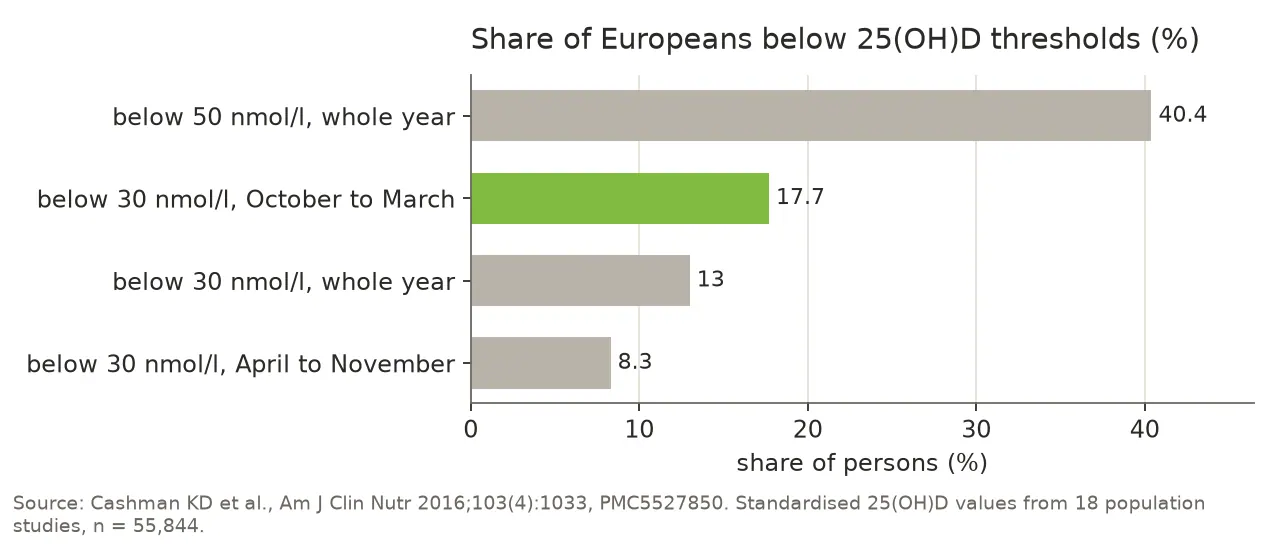
A review of studies from Central Europe states that mean 25(OH)D concentrations in the region are below 30 ng/ml. The extent of deficiency is similar to Western Europe.[5]
From Slovakia the review cites a 2007 measurement in 162 healthy women with a mean age of 34 years. In October the mean value was 33 ± 13 ng/ml. In Pilsen, in October and November 2008, the mean value in 560 adults with a mean age of 53 years was 25 ± 4 ng/ml.[5]
Intake of 15 µg, the 100 µg upper limit and hypercalciuria
EFSA could not set an average requirement or a population reference intake and therefore set an adequate intake (AI) in 2016. For adults it is 15 µg per day. At this intake the majority of adults reach a 25(OH)D level close to or above the target value of 50 nmol/l. The values for adults and children are based on data collected under conditions of assumed minimal synthesis in the skin.[1]
In 2023 EFSA confirmed the tolerable upper intake level (UL) at 100 µg per day for adults, including pregnant and lactating women, and for adolescents from 11 years. The upper limit refers to the total chronic daily intake of vitamin D from all sources.[2]
| Group | AI (µg per day) | AI (IU per day) | UL (µg per day) | UL (IU per day) |
|---|---|---|---|---|
| Infants 7 to 11 months | 10 | 400 | 35 | 1,400 |
| Children 1 to 10 years | 15 | 600 | 50 | 2,000 |
| Adolescents 11 to 17 years | 15 | 600 | 100 | 4,000 |
| Adults | 15 | 600 | 100 | 4,000 |
| Pregnant and lactating women | 15 | 600 | 100 | 4,000 |
Labels state the content in micrograms (µg) or in international units (IU). According to EFSA, 1 µg = 40 IU and 0.025 µg = 1 IU. A capsule with 2,000 IU contains 50 µg, half of the upper limit for adults (calculation).[1][2]
According to EFSA, the critical endpoint for setting the upper limit is persistent hypercalciuria, an increased excretion of calcium in urine. It may be an earlier sign of excess than persistent hypercalcaemia, a raised level of calcium in the blood. The LOAEL, the dose from which an adverse effect was observed in two randomised trials, was 250 µg per day. As no dose without an observed adverse effect (NOAEL) was available, EFSA applied an uncertainty factor of 2.5, which gives the UL of 100 µg per day. These trials gave 250 µg per day together with calcium for one and three years. The risk of persistent hypercalciuria was about three times that at doses of 10 to 15 µg per day.[2]
According to EFSA, hypercalcaemia rarely arises from dietary calcium alone. It can be induced by high doses of calcium supplements, especially together with vitamin D supplements, which increase calcium absorption. On the basis of intake data, European populations are unlikely to exceed the upper limit. The exception is regular users of supplements with high doses of vitamin D.[2]
Twelve authorised vitamin D claims in four regulations
Regulation (EU) No 432/2012, in the consolidated version of 20 August 2025, lists seven authorised claims for vitamin D under Article 13. They may be used only for a food which is at least a source of vitamin D.[8]
Under Article 14 of Regulation (EC) No 1924/2006, claims on children’s development and health are also authorised for vitamin D.[9][10]
Regulation (EU) No 1228/2014 authorised two reduction of disease risk claims, both only for food supplements. For reduction of disease risk claims, Regulation (EC) No 1924/2006 requires the labelling also to state that the disease has multiple risk factors and that altering one of them may or may not have a beneficial effect.[11][12]
The EU register (2013 snapshot) lists the claim on vitamin D and thyroid function as non-authorised, because the claimed effect was not substantiated.[13]
| Claim | Legal basis | Condition |
|---|---|---|
| Vitamin D contributes to normal absorption/utilisation of calcium and phosphorus | Regulation (EU) No 432/2012, Article 13 | food which is at least a source of vitamin D |
| Vitamin D contributes to normal blood calcium levels | Regulation (EU) No 432/2012, Article 13 | food which is at least a source of vitamin D |
| Vitamin D contributes to the maintenance of normal bones. Vitamin D contributes to the maintenance of normal teeth | Regulation (EU) No 432/2012, Article 13 | food which is at least a source of vitamin D |
| Vitamin D contributes to the maintenance of normal muscle function | Regulation (EU) No 432/2012, Article 13 | food which is at least a source of vitamin D |
| Vitamin D contributes to the normal function of the immune system | Regulation (EU) No 432/2012, Article 13 | food which is at least a source of vitamin D |
| Vitamin D has a role in the process of cell division | Regulation (EU) No 432/2012, Article 13 | food which is at least a source of vitamin D |
| Vitamin D is needed for normal growth and development of bone in children | Regulation (EC) No 983/2009, Article 14(1)(b) | food which is at least a source of vitamin D |
| Calcium and vitamin D are needed for normal growth and development of bone in children | Regulation (EC) No 983/2009, Article 14(1)(b) | food which is at least a source of calcium and vitamin D |
| Vitamin D contributes to the normal function of the immune system in children. | Regulation (EU) 2016/1389, Article 14(1)(b) | food which is at least a source of vitamin D |
| Vitamin D helps to reduce the risk of falling associated with postural instability and muscle weakness. Falling is a risk factor for bone fractures among men and women 60 years of age and older. | Regulation (EU) No 1228/2014, Article 14(1)(a) | only food supplements which provide at least 15 μg of vitamin D per daily portion, targeting men and women 60 years and older; information that the beneficial effect is obtained with a daily intake of 20 μg of vitamin D from all sources |
| Calcium and vitamin D help to reduce the loss of bone mineral in post-menopausal women. Low bone mineral density is a risk factor for osteoporotic bone fractures | Regulation (EU) No 1228/2014, Article 14(1)(a) | only food supplements which provide at least 400 mg of calcium and 15 μg of vitamin D per daily portion, targeting women 50 years and older; information on a daily intake of at least 1 200 mg of calcium and 20 μg of vitamin D from all sources |
Combination with vitamin K2: what is documented and what is not
Vitamin K2 (menaquinone) is transported to tissues outside the liver, for example to bone and the vessel wall. There it governs the activity of matrix Gla protein (MGP) and osteocalcin. Vitamin D promotes the production of vitamin K-dependent proteins.[14]
A 2017 review article states that most clinical trials of the combination of vitamins D and K examined bone in postmenopausal women. Trials with cardiovascular outcomes are few. The authors conclude that joint supplementation might be more effective than supplementation with either substance alone; they leave the wording in the conditional.[14]
Regulation (EU) No 432/2012 lists no claim on the combination of vitamins D and K. For vitamin K the authorised claims are that vitamin K contributes to normal blood clotting and that vitamin K contributes to the maintenance of normal bones. The claim on bones is therefore authorised for each substance separately. In its conclusion, the same 2017 review states that vitamin D and calcium supplementation along with vitamin K deficiency might contribute in the long term to soft tissue calcification and cardiovascular disease, particularly in users of vitamin K antagonists. The authors therefore advise caution with high doses of vitamin D. The authors also state that further clinical data on the interplay of vitamins D and K are urgently needed. EFSA does not take vitamin K into account when setting the upper limit for vitamin D.[8][14][2]
Related products
Browse the products in the category: Vitamin D.
Sources
- EFSA (2017). Dietary Reference Values for nutrients: Summary report (chapter 5.12 Vitamin D, opinion EFSA Journal 2016;14(10):4547). EFSA Supporting Publication 2017:e15121. https://www.efsa.europa.eu/sites/default/files/2017_09_DRVs_summary_report.pdf
- EFSA NDA Panel (2023). Scientific opinion on the tolerable upper intake level for vitamin D, including the derivation of a conversion factor for calcidiol monohydrate. EFSA Journal 21(8):8145. https://doi.org/10.2903/j.efsa.2023.8145
- Tripkovic L, Lambert H, Hart K et al. (2012). Comparison of vitamin D2 and vitamin D3 supplementation in raising serum 25-hydroxyvitamin D status: a systematic review and meta-analysis. Am J Clin Nutr 95(6):1357. https://doi.org/10.3945/ajcn.111.031070
- Webb AR, Kline L, Holick MF (1988). Influence of season and latitude on the cutaneous synthesis of vitamin D3: exposure to winter sunlight in Boston and Edmonton will not promote vitamin D3 synthesis in human skin. J Clin Endocrinol Metab 67(2):373. https://pubmed.ncbi.nlm.nih.gov/2839537/
- Pludowski P, Grant WB, Bhattoa HP et al. (2014). Vitamin D status in Central Europe. Int J Endocrinol 2014:589587. https://doi.org/10.1155/2014/589587
- Ross AC, Manson JE, Abrams SA et al. (2011). The 2011 report on dietary reference intakes for calcium and vitamin D from the Institute of Medicine: what clinicians need to know. J Clin Endocrinol Metab 96(1):53. https://doi.org/10.1210/jc.2010-2704
- Cashman KD, Dowling KG, Škrabáková Z et al. (2016). Vitamin D deficiency in Europe: pandemic? Am J Clin Nutr 103(4):1033. https://doi.org/10.3945/ajcn.115.120873
- European Commission (2012). Commission Regulation (EU) No 432/2012 of 16 May 2012 establishing a list of permitted health claims made on foods, other than those referring to the reduction of disease risk and to children’s development and health (consolidated version of 20 August 2025), Annex, entries Vitamin D and Vitamin K. Official Journal of the European Union L 136. https://eur-lex.europa.eu/legal-content/EN/TXT/?uri=CELEX:02012R0432-20250820
- Commission of the European Communities (2009). Commission Regulation (EC) No 983/2009 of 21 October 2009 on the authorisation and refusal of authorisation of certain health claims made on food and referring to the reduction of disease risk and to children’s development and health (consolidated version of 11 July 2014), Annex I. Official Journal of the European Union L 277. https://eur-lex.europa.eu/legal-content/EN/TXT/?uri=CELEX:02009R0983-20140711
- European Commission (2016). Commission Regulation (EU) 2016/1389 of 17 August 2016 authorising a health claim made on foods and referring to children's development and health, Annex. Official Journal of the European Union L 223. https://eur-lex.europa.eu/legal-content/EN/TXT/?uri=CELEX:32016R1389
- European Commission (2014). Commission Regulation (EU) No 1228/2014 of 17 November 2014 authorising and refusing to authorise certain health claims made on foods and referring to the reduction of disease risk, Annex I. Official Journal of the European Union L 331. https://eur-lex.europa.eu/legal-content/EN/TXT/?uri=CELEX:32014R1228
- European Parliament and Council (2006). Regulation (EC) No 1924/2006 of the European Parliament and of the Council of 20 December 2006 on nutrition and health claims made on foods, Article 14. Official Journal of the European Union L 404. https://eur-lex.europa.eu/legal-content/EN/TXT/?uri=CELEX:32006R1924
- European Commission (2013). EU Register on nutrition and health claims, snapshot generated 14 February 2013 (non-authorised claims). Food and Feed Information Portal. https://ec.europa.eu/food/food-feed-portal/backend/claims/files/euregister.pdf
- van Ballegooijen AJ, Pilz S, Tomaschitz A, Grübler MR, Verheyen N (2017). The Synergistic Interplay between Vitamins D and K for Bone and Cardiovascular Health: A Narrative Review. Int J Endocrinol 2017:7454376. https://doi.org/10.1155/2017/7454376