
Omega-3 fatty acids are a group of polyunsaturated fatty acids. The group is made up of the plant-derived alpha-linolenic acid (ALA) and the acids derived from it, eicosapentaenoic acid (EPA) and docosahexaenoic acid (DHA). The body cannot make ALA, which is therefore an essential fatty acid. The body can synthesise EPA and DHA from ALA, but the conversion is limited. In trade, the term omega 3 also refers to food supplements containing fish, krill or algal oil.[1][2]
At a glance
- Omega-3 fatty acids are made up of the plant-derived alpha-linolenic acid (ALA) and the EPA and DHA derived from it, which the body synthesises from ALA only to a limited extent.
- EFSA has set an adequate intake of 250 mg of EPA and DHA a day for adults and 0.5 % of energy for ALA.
- Mackerel, herring and trout contain sufficient amounts of EPA and DHA because of their high fat content; plant foods contain ALA.
- A 2022 meta-analysis estimated a fall in systolic pressure of 2.61 mm Hg at 2 to 3 g of EPA and DHA a day compared with a zero dose.
- According to EFSA, supplemental intakes of EPA and DHA combined of up to 5 g a day do not raise safety concerns for adults.
Conversion of ALA to EPA and DHA in the body
Alpha-linolenic acid (ALA, 18:3 n-3) is a plant omega-3 fatty acid and the precursor of the longer-chain acids EPA (20:5 n-3), DPA (22:5 n-3) and DHA (22:6 n-3). In healthy adults on a Western diet, supplemental ALA raises EPA and DPA levels in blood and in breast milk. ALA and EPA both have little effect on blood DHA levels; DHA levels rise with an intake of preformed DHA.[3]
Stable isotope studies show that ALA is converted to EPA, but in men the conversion is limited. Further conversion to DHA is very low. The proportion of ALA converted is higher in women, which may be linked to the regulatory effect of oestrogen.[2]
| Acid | Abbreviation | Main source | Conversion in the body |
|---|---|---|---|
| alpha-linolenic (18:3 n-3) | ALA | plant oils and seeds | essential; the body cannot make it |
| eicosapentaenoic (20:5 n-3) | EPA | marine fish, fish and krill oil | formed from ALA to a limited extent |
| docosahexaenoic (22:6 n-3) | DHA | marine fish, fish and algal oil | formed from ALA to a very low extent; blood levels rise with preformed DHA |
EFSA recommended intake for adults, pregnant women and children
In its 2010 opinion on dietary reference values for fats, EFSA could not derive an average requirement or a population reference intake for ALA. It therefore set an adequate intake (AI) of 0.5 % of energy. The value is based on the lowest average intake in European populations without signs of deficiency. It set no upper level for ALA because it found no convincing evidence of adverse effects.[1]
For EPA and DHA combined, EFSA set an adequate intake of 250 mg a day for adults on cardiovascular considerations. The 2012 opinion states that recommendations for European adults range between 250 and 500 mg a day. EFSA did not set a ratio of omega-3 to omega-6 in its 2010 opinion on fats. It proposed not to define specific values, because the data are insufficient to recommend a ratio independent of absolute intake.[1][4]
| Group | ALA | EPA + DHA | Additional DHA |
|---|---|---|---|
| Infants from 7 months and young children up to 24 months | 0.5 % of energy | 100 mg DHA | |
| Children from 2 years and adolescents | 0.5 % of energy | 250 mg | |
| Adults | 0.5 % of energy | 250 mg | |
| Pregnant and lactating women | 0.5 % of energy | 250 mg | 100 to 200 mg DHA |
For children aged 2 to 18 years EFSA could not derive an age-specific value. Advice for children should be consistent with advice for adults, that is 1 to 2 fatty fish meals a week or about 250 mg of EPA and DHA a day. According to EFSA, 100 to 200 mg of preformed DHA should be added to the intake of 250 mg of EPA and DHA during pregnancy and lactation. This amount compensates for oxidative losses of maternal DHA and for DHA accumulation in the body fat of the foetus and the infant. In older infants, a DHA intake of 50 to 100 mg a day has been shown to be effective for visual function during the complementary feeding period. The proportion of ALA converted to longer-chain omega-3 fatty acids is higher in women than in men; according to a 2005 review, this capacity may be important for meeting the DHA needs of the foetus and the newborn.[1][2]
Authorised omega-3 health claims in the EU
The EU Register of nutrition and health claims lists authorised claims for omega-3 fatty acids under Regulations (EU) No 432/2012, No 440/2011, No 536/2013 and (EC) No 983/2009. The register states that EPA and DHA contribute to the normal function of the heart. The condition is that the food is a source of omega-3 fatty acids and that the consumer is informed of a daily intake of 250 mg of EPA and DHA.[5]
Commission Regulation (EU) No 536/2013 added three claims with higher doses. DHA and EPA contribute to the maintenance of normal blood pressure, with a daily intake of 3 g of EPA and DHA. DHA and EPA contribute to the maintenance of normal blood triglyceride levels, with a daily intake of 2 g of EPA and DHA. DHA contributes to the maintenance of normal blood triglyceride levels, with a daily intake of 2 g of DHA in combination with EPA. On food supplements and fortified foods the consumer must be informed not to exceed a supplemental daily intake of 5 g of EPA and DHA combined. The three claims shall not be used for foods targeting children.[6]
| Substance | Claim in the official wording | Conditions of use | Status |
|---|---|---|---|
| EPA and DHA | EPA and DHA contribute to the normal function of the heart | food which is at least a source of EPA and DHA (SOURCE OF OMEGA-3 FATTY ACIDS); beneficial effect with a daily intake of 250 mg of EPA and DHA | authorised, 432/2012 |
| DHA | DHA contributes to maintenance of normal brain function | at least 40 mg of DHA per 100 g and per 100 kcal; beneficial effect with a daily intake of 250 mg of DHA | authorised, 432/2012 |
| DHA | DHA contributes to the maintenance of normal vision | at least 40 mg of DHA per 100 g and per 100 kcal; beneficial effect with a daily intake of 250 mg of DHA | authorised, 432/2012 |
| ALA | ALA contributes to the maintenance of normal blood cholesterol levels | food which is at least a source of ALA (SOURCE OF OMEGA-3 FATTY ACIDS); beneficial effect with a daily intake of 2 g of ALA | authorised, 432/2012 |
| DHA and EPA | DHA and EPA contribute to the maintenance of normal blood pressure | daily intake of 3 g of EPA and DHA; on food supplements and fortified foods, information not to exceed a supplemental daily intake of 5 g of EPA and DHA combined; not for foods targeting children | authorised, 536/2013 |
| DHA and EPA | DHA and EPA contribute to the maintenance of normal blood triglyceride levels | daily intake of 2 g of EPA and DHA; on food supplements and fortified foods, information not to exceed a supplemental daily intake of 5 g of EPA and DHA combined; not for foods targeting children | authorised, 536/2013 |
| DHA | DHA contributes to the maintenance of normal blood triglyceride levels | daily intake of 2 g of DHA in combination with EPA; on food supplements and fortified foods, information not to exceed a supplemental daily intake of 5 g of EPA and DHA combined; not for foods targeting children | authorised, 536/2013 |
| DHA (mother) | Docosahexaenoic acid (DHA) maternal intake contributes to the normal development of the eye of the foetus and breastfed infants. | daily intake of 200 mg of DHA in addition to 250 mg of DHA and EPA for adults; food provides at least 200 mg of DHA a day | authorised, 440/2011 |
| DHA (mother) | Docosahexaenoic acid (DHA) maternal intake contributes to the normal brain development of the foetus and breastfed infants. | daily intake of 200 mg of DHA in addition to 250 mg of DHA and EPA for adults; food provides at least 200 mg of DHA a day | authorised, 440/2011 |
| DHA (infants) | Docosahexaenoic acid (DHA) intake contributes to the normal visual development of infants up to 12 months of age. | beneficial effect with a daily intake of 100 mg of DHA; in follow-on formula at least 0.3 % of the total fatty acids as DHA | authorised, 440/2011 |
| ALA and linoleic acid | Essential fatty acids are needed for normal growth and development of children | beneficial effect with a daily intake of 2 g of α-linolenic acid (ALA) and 10 g of linoleic acid (LA) | authorised, 983/2009 |
| EPA and DHA | maintenance of joints; enhancement of mood | not authorised | |
| ALA | maintenance of normal blood pressure | not authorised |
The claims on joints (opinion 2009;7(9):1263) and on mood (2011;9(4):2078) for EPA and DHA and the claim on blood pressure for ALA (2009;7(9):1252) are listed in the register as not authorised.[5]
High doses: triglycerides, blood pressure and safety
A 2019 science advisory from the American Heart Association states that a 2002 statement recommended EPA and DHA at 2 to 4 g a day for persons with elevated triglycerides. In very high triglycerides, preparations with 4 g a day of EPA and DHA reduce triglycerides by 30 % or more, with a concurrent rise in LDL cholesterol. The authors conclude that prescription omega-3 medicines at 4 g a day (more than 3 g of EPA and DHA) are an effective and safe option for reducing triglycerides; these are doses of prescription medicines, not of food supplements.[10]
A meta-analysis from 2022 included 71 randomised trials with 4,973 persons; the median combined dose of DHA and EPA was 2.8 g a day. The estimated relationship between dose and blood pressure was J-shaped. According to the estimated dose and response curve, a dose of 2 g a day corresponded to a mean fall of 2.61 mm Hg in systolic and 1.64 mm Hg in diastolic pressure. A dose of 3 g a day corresponded to 2.61 and 1.80 mm Hg, each compared with a zero dose. In persons with hypertension, with hyperlipidaemia and in older persons, the relationship was stronger and approximately linear. The authors conclude that the optimal combined intake is likely between 2 and 3 g a day.[11]
In 2012, EFSA concluded that the available data are insufficient to set a tolerable upper intake level for long-chain omega-3 fatty acids for any population group. At the observed levels of intake, no adverse effects were identified in healthy children or adults. According to EFSA, long-term supplemental intakes of EPA and DHA combined of up to about 5 g a day do not appear to increase the risk of spontaneous bleeding episodes or bleeding complications. They also do not appear to affect glucose homeostasis, immune function or lipid peroxidation, provided the oxidative stability of the oil is ensured.[4]
EPA and DHA combined at 2 to 6 g a day and DHA at 2 to 4 g a day increase LDL cholesterol concentrations by about 3 %. According to EFSA this may not have an adverse effect on cardiovascular risk; EPA at up to 4 g a day has no significant effect on LDL cholesterol. Supplemental intakes of EPA and DHA combined of up to 5 g a day and of EPA alone at up to 1.8 g a day do not raise safety concerns for adults. DHA alone at up to about 1 g a day does not raise safety concerns for the general population.[4]
Fish, krill and algal oil: forms and absorption
In fish, fatty acids are stored mainly as triacylglycerols (triglycerides); in krill, 30 to 65 % of the fatty acids are bound in phospholipids. Concentrated fish oil preparations are produced as ethyl esters or as re-esterified triglycerides. A 2010 study with 72 volunteers compared five forms, each at about 3.3 g of EPA and DHA a day, and placebo over 2 weeks. Bioavailability from re-esterified triglycerides was 124 % relative to natural fish oil, from ethyl esters 73 % and from free fatty acids 91 %; the last difference was not statistically significant.[12][13]
In a randomised study from 2011 with 113 evaluated persons, 36 persons received krill oil at 3.0 g a day with 543 mg of EPA and DHA for 7 weeks. Another 40 received fish oil at 1.8 g a day with 864 mg of EPA and DHA. A control group of 37 persons received no supplement. Krill oil raised plasma EPA and DHA to the same extent as fish oil. The study therefore compared two different doses, not the same dose in two forms.[12]
Algal oil is a source of DHA without fish. In a randomised open study from 2008, 32 healthy adults received 600 mg of DHA a day for 2 weeks from algal oil capsules or from cooked salmon. DHA rose by about 80 % in plasma phospholipids and by 25 % in erythrocytes in both groups; algal oil and salmon were equivalent.[14]
| Form | Typical source | Absorption data |
|---|---|---|
| Natural triglycerides | fish oil | reference form in the 2010 study (100 %) |
| Re-esterified triglycerides | concentrated fish oil | 124 % relative to natural fish oil (2010) |
| Ethyl esters | concentrated fish oil | 73 % relative to natural fish oil (2010) |
| Free fatty acids | concentrated fish oil | 91 %, no significant difference from triglycerides (2010) |
| Phospholipids | krill oil | 543 mg EPA and DHA raised plasma levels as much as 864 mg from fish oil (2011) |
| Triglycerides from algae | algal oil (DHA) | 600 mg DHA equivalent to cooked salmon (2008) |
Oil oxidation and assessing a product: PV, AV and TOTOX
Omega-3 fatty acids are subject to oxidation. The peroxide value (PV) expresses the primary oxidation products (lipid peroxides), the anisidine value (AV) the secondary products (aldehydes and ketones). Together they are used to estimate the total oxidation value TOTOX. TOTOX is calculated with the formula 2 × PV + AV. International recommendations, including the GOED monograph, give limits of PV below 5, AV below 20 and TOTOX below 26. These standards are based on sensory properties, because data for limits based on health effects are insufficient. Adding antioxidants slows oxidation but does not stop it.[15]
In a 2015 survey of fish oils on the New Zealand market, only 3 of 32 products contained as much EPA and DHA as stated on the label. In 69 % of products the content was below 67 % of the declared amount. The PV limit was exceeded by 83 % of products, AV by 25 % and TOTOX by 50 %; 8 % met all three limits. All products were within their date of minimum durability. The remaining shelf life was 270 days or more.[15]
- EPA and DHA content per serving as stated on the label, not the weight of the oil; the adequate intake is 250 mg a day, the triglyceride and blood pressure claims require 2 g and 3 g.[1][6]
- Chemical form: re-esterified triglycerides showed higher bioavailability than natural fish oil, ethyl esters lower.[13]
- The oxidation values PV, AV and TOTOX in the certificate of analysis compared with the limits of 5, 20 and 26.[15]
- Origin of the oil: fish, krill (phospholipids) or algae (DHA without fish) according to dietary restrictions.[12][14]
EPA and DHA content of fish
A survey of 123 fish samples from the German market from 2012 reports that mackerel, herring and trout contain sufficient amounts of EPA and DHA because of their high fat content. Tuna, saithe and Alaska pollock contribute to intake despite a lower fat content. Farmed salmon had 12.3 % fat compared with 2.1 % in wild salmon. The fat and fatty acid content of fish varies with feed, fishing ground, season, water temperature, age and size of the fish. According to EFSA, fatty fish, fish offal and fish oil are also rich sources of vitamin D3.[16][17]
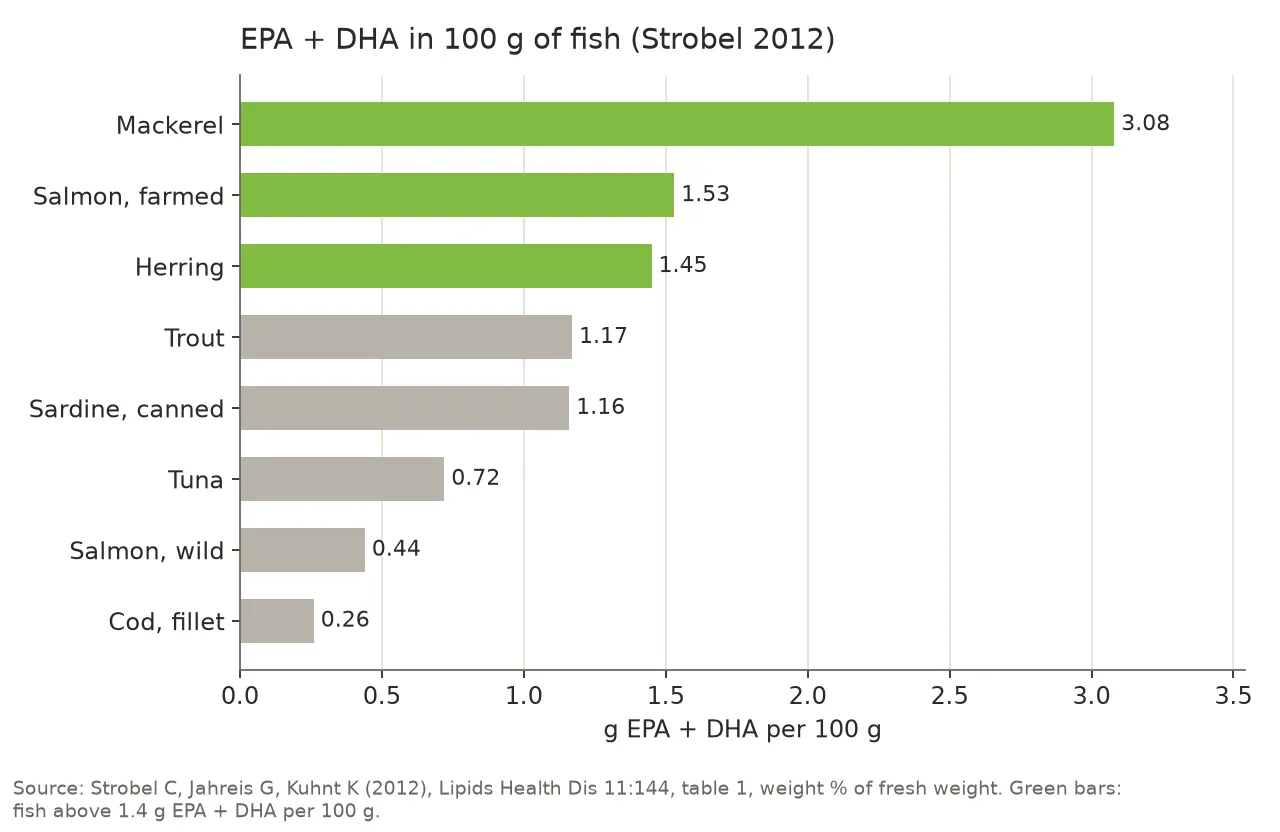
| Fish | Fat | EPA + DHA per 100 g |
|---|---|---|
| Mackerel | 20.6 g | 3.08 g |
| Salmon, farmed | 12.3 g | 1.53 g |
| Herring | 12.7 g | 1.45 g |
| Trout | 7.9 g | 1.17 g |
| Sardine, canned | 10.2 g | 1.16 g |
| Tuna | 2.3 g | 0.72 g |
| Salmon, wild | 2.1 g | 0.44 g |
| Cod, fillet | 0.6 g | 0.26 g |
| Cod liver | 40.4 g | 6.94 g |
The adequate intake of 250 mg of EPA and DHA a day corresponds to about 8 g of mackerel, 16 g of farmed salmon or 96 g of cod. This is a calculation from the mean values in the table and the EFSA AI. Given the wide spread of values between samples, the calculation is only indicative. Plant foods contain ALA; the cited sources do not quantify its content in individual foods.[1][16][3][2]
Related products
Browse the products in the category: Omega-3.
Sources
- EFSA (2017). Dietary Reference Values for nutrients: Summary report (section on fats, restating the 2010 opinion on Dietary Reference Values for fats, EFSA Journal 2010;8(3):1461). EFSA Supporting Publication 2017:e15121. https://www.efsa.europa.eu/sites/default/files/2017_09_DRVs_summary_report.pdf
- Burdge GC, Calder PC (2005). Conversion of alpha-linolenic acid to longer-chain polyunsaturated fatty acids in human adults. Reprod Nutr Dev 45(5):581. https://pubmed.ncbi.nlm.nih.gov/16188209/
- Brenna JT, Salem N Jr, Sinclair AJ, Cunnane SC; ISSFAL (2009). alpha-Linolenic acid supplementation and conversion to n-3 long-chain polyunsaturated fatty acids in humans. Prostaglandins Leukot Essent Fatty Acids 80(2-3):85. https://pubmed.ncbi.nlm.nih.gov/19269799/
- EFSA NDA Panel (2012). Scientific Opinion on the Tolerable Upper Intake Level of eicosapentaenoic acid (EPA), docosahexaenoic acid (DHA) and docosapentaenoic acid (DPA). EFSA Journal 10(7):2815. https://doi.org/10.2903/j.efsa.2012.2815
- European Commission (2012). EU Register on nutrition and health claims (Regulation (EU) No 432/2012 and No 440/2011). Food and Feed Information Portal. https://ec.europa.eu/food/food-feed-portal/backend/claims/files/euregister.pdf
- European Commission (2013). Commission Regulation (EU) No 536/2013 of 11 June 2013 amending Regulation (EU) No 432/2012 (health claims on DHA and EPA, triglycerides and blood pressure). Official Journal of the EU L 160, 12.6.2013. https://eur-lex.europa.eu/legal-content/EN/TXT/?uri=CELEX:32013R0536
- European Commission (2011). Commission Regulation (EU) No 440/2011 of 6 May 2011 on the authorisation and refusal of authorisation of certain health claims made on foods and referring to children’s development and health, Annex I (DHA entries). Official Journal of the European Union L 119, 7.5.2011. https://eur-lex.europa.eu/legal-content/EN/TXT/?uri=CELEX:32011R0440
- European Commission (2012). Commission Regulation (EU) No 432/2012 of 16 May 2012 establishing a list of permitted health claims made on foods, other than those referring to the reduction of disease risk and to children’s development and health (consolidated version of 20 August 2025), Annex, entries EPA/DHA, ALA and DHA. Official Journal of the European Union L 136. https://eur-lex.europa.eu/legal-content/EN/TXT/?uri=CELEX:02012R0432-20250820
- Commission of the European Communities (2009). Commission Regulation (EC) No 983/2009 of 21 October 2009 on the authorisation and refusal of authorisation of certain health claims made on food and referring to the reduction of disease risk and to children’s development and health (consolidated version of 11 July 2014), Annex I, entry α-linolenic acid & linoleic acid. Official Journal of the European Union L 277. https://eur-lex.europa.eu/legal-content/EN/TXT/?uri=CELEX:02009R0983-20140711
- Skulas-Ray AC, Wilson PWF, Harris WS et al.; American Heart Association (2019). Omega-3 Fatty Acids for the Management of Hypertriglyceridemia: A Science Advisory From the American Heart Association. Circulation 140(12):e673. https://pubmed.ncbi.nlm.nih.gov/31422671/
- Zhang X, Ritonja JA, Zhou N, Chen BE, Li X (2022). Omega-3 Polyunsaturated Fatty Acids Intake and Blood Pressure: A Dose-Response Meta-Analysis of Randomized Controlled Trials. J Am Heart Assoc 11(11):e025071. https://doi.org/10.1161/JAHA.121.025071
- Ulven SM, Kirkhus B, Lamglait A et al. (2011). Metabolic effects of krill oil are essentially similar to those of fish oil but at lower dose of EPA and DHA, in healthy volunteers. Lipids 46(1):37. https://doi.org/10.1007/s11745-010-3490-4
- Dyerberg J, Madsen P, Møller JM, Aardestrup I, Schmidt EB (2010). Bioavailability of marine n-3 fatty acid formulations. Prostaglandins Leukot Essent Fatty Acids 83(3):137. https://pubmed.ncbi.nlm.nih.gov/20638827/
- Arterburn LM, Oken HA, Bailey Hall E, Hamersley J, Kuratko CN, Hoffman JP (2008). Algal-oil capsules and cooked salmon: nutritionally equivalent sources of docosahexaenoic acid. J Am Diet Assoc 108(7):1204. https://pubmed.ncbi.nlm.nih.gov/18589030/
- Albert BB, Derraik JG, Cameron-Smith D et al. (2015). Fish oil supplements in New Zealand are highly oxidised and do not meet label content of n-3 PUFA. Sci Rep 5:7928. https://doi.org/10.1038/srep07928
- Strobel C, Jahreis G, Kuhnt K (2012). Survey of n-3 and n-6 polyunsaturated fatty acids in fish and fish products. Lipids Health Dis 11:144. https://doi.org/10.1186/1476-511X-11-144
- EFSA NDA Panel (2023). Scientific opinion on the tolerable upper intake level for vitamin D, including the derivation of a conversion factor for calcidiol monohydrate. EFSA Journal 21(8):e08145. https://doi.org/10.2903/j.efsa.2023.8145