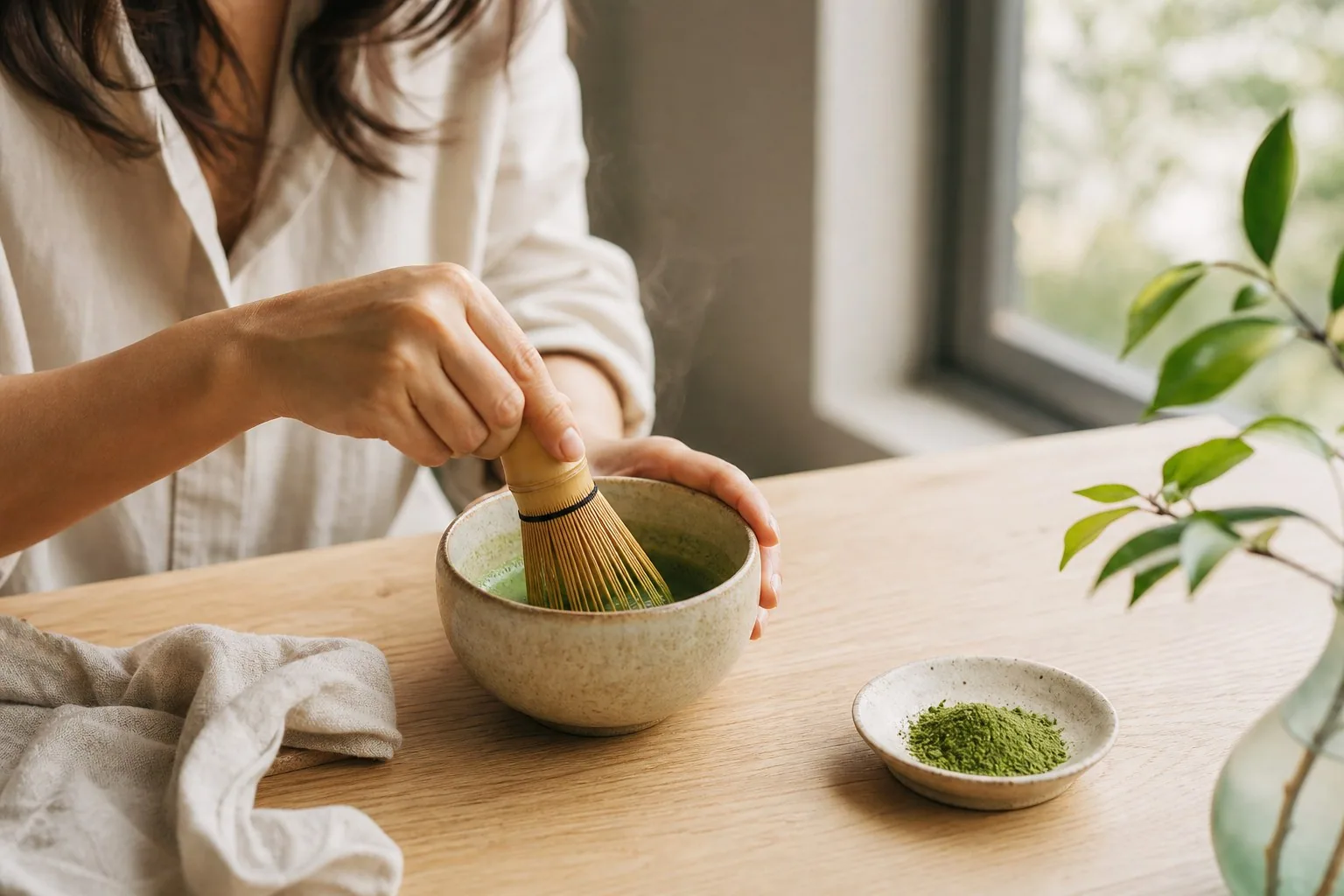
Matcha is a powdered green tea of Japanese origin, made from the tea plant Camellia sinensis processed as tencha. Unlike loose-leaf tea, the leaf is not steeped and removed but ground to a fine powder and drunk whole. For several weeks before harvest the bushes are shaded with mats, which changes the chemical composition of the leaf: the content of amino acids, including L-theanine, rises, as does the chlorophyll content, and the content of catechins falls.[1][2]
At a glance
- Matcha is a powdered Japanese green tea made from tencha leaves, which are shaded before harvest, and the whole ground leaf is drunk.
- According to one analysis, matcha contains 18.9 to 44.4 mg of caffeine per gram, so a 2 g serving corresponds by calculation to roughly 38 to 89 mg.
- A 2023 critical review concludes that the evidence on the effect of matcha on cognitive function and cardiometabolic parameters is so far limited.
- Regulation (EU) No 432/2012 lists no permitted health claim for caffeine, L-theanine, the tea plant or matcha.
- According to EFSA, a daily intake of up to 400 mg of caffeine from all sources does not raise safety concerns in healthy adults, with the exception of pregnant women.
Tencha: shading, composition and the difference from loose-leaf tea
Tencha is produced from young shoots that are shaded for at least 20 days before harvest. Shading raises the amino acid content and lowers the catechin content; the result is a pronounced umami taste with little bitterness and astringency. The first difference is in the manner of consumption: with matcha the whole ground leaf is drunk, with loose-leaf tea only the infusion. The second difference is chemical and results from shading. A 2020 review reports a chlorophyll content of 5.65 mg/g in tencha leaves against 4.33 mg/g in ordinary green tea. A reanalysis of matcha samples sold in 2017 compared three groups of three samples each. The three samples sold in Japan with the highest theanine content had 41.4 mg/g on average, the three Japanese samples with the lowest content 8.5 mg/g and three samples sold abroad with a median content 8.7 mg/g. The median values from abroad were thus comparable to the Japanese samples with the lowest content. According to the authors, samples with a high theanine content were very rare outside Japan. Polyphenols account for as much as 30 % of the dry matter of green tea.[2][1]
| Tea and samples | Theanine (mg/g) | Shading before harvest |
|---|---|---|
| Matcha sold in Japan, 3 samples with the highest theanine content | 41.4 | not stated |
| Matcha sold in Japan, 3 samples with the lowest theanine content | 8.5 | not stated |
| Matcha sold abroad, 3 samples with a median theanine content | 8.7 | not stated |
| Gyokuro | roughly 20 | more than 20 days |
| Sencha | roughly 10 | no |
| Bancha | roughly 5 | no |
Ceremonial and culinary grades and the theanine content of samples
A binding legal definition of matcha grades is not given in the sources cited. A 2026 review of Japanese green teas distinguishes authentic (ceremonial) matcha from first-harvest leaves shaded for more than 20 days and processed (food-grade) matcha from leaves shaded for a shorter time. According to that review, food-grade matcha is often sold as matcha although it comes from lower-quality, insufficiently shaded leaves or from later harvests. Another 2026 review describes ceremonial grade as matcha from the buds and first leaves of the spring harvest, which are more tender, and this directly affects the flavour profile. A later harvest gives older and larger leaves with a less delicate flavour, which is typical of culinary grade. The amino acid concentration falls with lower grade, which is linked to the ageing of the leaf.[2][3]
Ceremonial matcha is ground in traditional stone mills, a slow process; for lower grades faster milling methods are used. The green colour of matcha comes from chlorophyll, which is more abundant in shaded leaves. Higher grades usually contain more caffeine and amino acids, particularly L-theanine, while lower grades may contain more catechins. Food-grade matcha is commonly used in confectionery and drinks.[3][1][2]
Three measurable characteristics follow from the studies cited. The first is theanine content, which differed by place of sale. The authors of a 2018 study derived a threshold of 17 mg/g from a clinical experiment with 3 g of matcha a day. It was exceeded by 50 of 76 samples sold in Japan, but by only 6 of 67 samples sold abroad. The second is grade, which corresponds to the length of shading, the age of the leaf and the milling method. The third is caffeine content, which the producer may state and which for matcha ranges from 18.9 to 44.4 mg/g.[4][2][3][1]
Serving, preparation and caffeine compared with coffee
One serving usually uses roughly 2 g of powder and 90 to 100 ml of water. The water should be hot, roughly 70 °C, not boiling. According to a 2020 review, the caffeine content of green teas ranges from 11.3 to 24.67 mg/g, and of matcha from 18.9 to 44.4 mg/g; the range for matcha comes from a single analysis cited in the review. By comparison, most coffee beans contain 10 to 12 mg of caffeine per gram. For a 2 g serving of powder this corresponds to roughly 38 to 89 mg of caffeine (calculation). According to the same review, shading increases the synthesis and accumulation of caffeine in the leaf. The caffeine content may also be associated with the time of harvest and the age of the leaf; older leaves contain less caffeine. It also depends on the variety and on the weather during the growing season.[3][1]
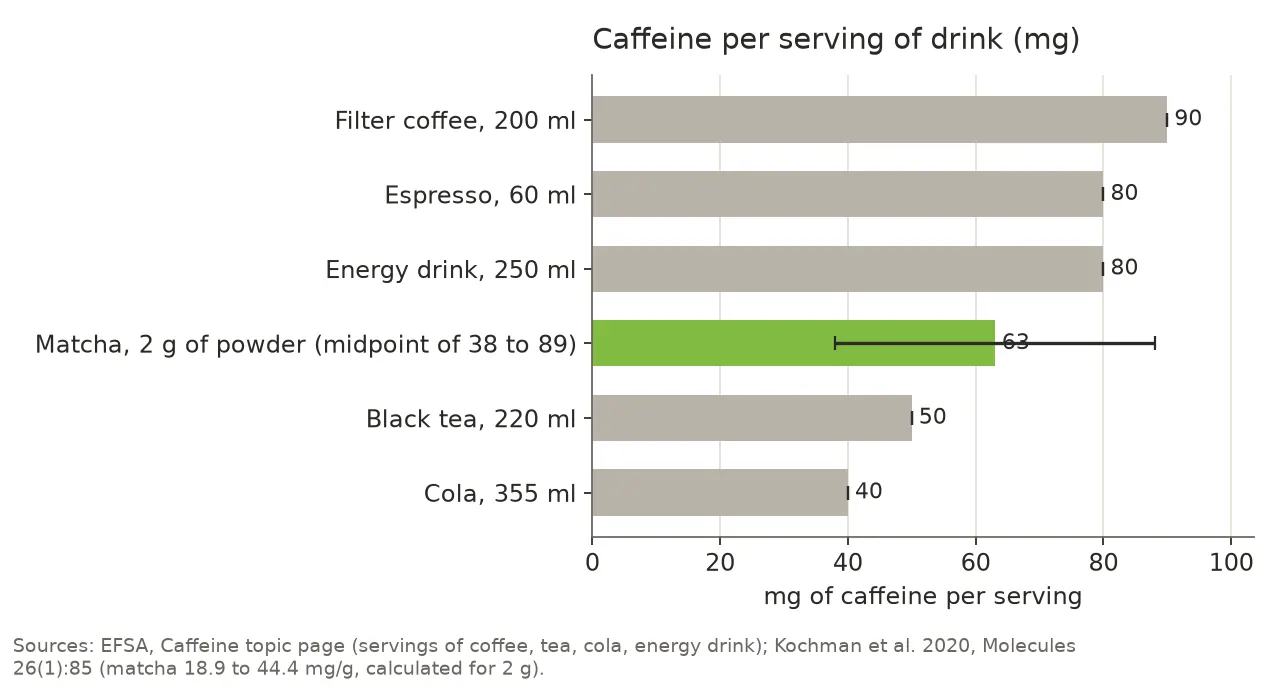
A serving of matcha from 2 g of powder thus contains anything from less caffeine than a can of cola (38 mg against 40 mg) to roughly the same amount as a cup of filter coffee (89 mg against 90 mg). This is a calculation, and the result depends on the caffeine content of the particular powder.[1][5]
Safe amounts of caffeine and catechins according to EFSA
In its 2015 opinion EFSA states that single doses of caffeine up to 200 mg (roughly 3 mg per kg of body mass) and a daily intake of up to 400 mg from all sources do not raise safety concerns in healthy adults, with the exception of pregnant women. The EFSA topic page states for pregnant and lactating women together that caffeine intakes from all sources of up to 200 mg per day do not raise safety concerns for the foetus. According to EFSA, the same single-dose value of 3 mg per kg of body mass as for adults can be applied to children and adolescents. A single dose of 100 mg may affect the duration and pattern of sleep in some adults, particularly shortly before bedtime.[5]
At the upper value of 44.4 mg/g, 400 mg of caffeine corresponds to nine grams of matcha, that is four to five servings of 2 g (calculation). Traditional consumption is one to two servings a day of 1.75 to 2 g.[1][5][3]
For catechins, EFSA stated in 2018 that doses of 800 mg of EGCG per day and above, taken as a food supplement, led in intervention studies to a statistically significant increase in serum transaminases. The average daily intake of EGCG from green tea infusions is 90 to 300 mg. According to EFSA, catechins from traditionally prepared green tea infusions and from drinks of the same composition are in general considered safe, provided that intake corresponds to the intakes reported in EU Member States. Rare cases of liver injury have, however, been reported after the consumption of green tea infusions, most probably as an individual (idiosyncratic) reaction.[6]
Matcha is not an infusion; the whole leaf is drunk. The reanalysis of the 2017 samples found mean values of 57.3 to 79.8 mg of EGCG per gram. A 2 g serving thus contains roughly 115 to 160 mg of EGCG, and two servings a day, which correspond to traditional consumption, roughly 230 to 320 mg (calculation). This lies in the upper part of the range of average EGCG intake from infusions or slightly above it. The value of 800 mg refers to EGCG in food supplements.[2][3][6]
Blue matcha from Clitoria ternatea flowers
The name matcha belongs to ground tencha tea from the tea plant Camellia sinensis. A 2026 review points out that not every powdered tea is matcha. For products sold under the name blue matcha, the composition is stated on the label. A blue colour is found, for example, in the flowers of the plant Clitoria ternatea (butterfly pea), which is a legume; it is due to anthocyanins called ternatins. The data on caffeine, theanine and catechins given above apply to matcha from the tea plant, not to products made from other plants.[1][2][7]
Health claims in the EU and the state of research
L-theanine is an amino acid of the tea plant. The EU register of health claims (version of February 2013) lists claims on L-theanine and cognitive function (EFSA opinion 2011;9(6):2238) as not authorised. It also lists as not authorised the claim on caffeine and increased physical performance during short-term high-intensity exercise (EFSA opinion 2011;9(4):2053). These claims therefore cannot be made on foods containing matcha.[8]
A 2023 critical review of human and animal studies concludes that the evidence on the effect of matcha on cognitive function, on cardiometabolic parameters and on tumour cells is so far limited and that no conclusions can be drawn. Regulation (EU) No 432/2012, in the consolidated version of 20 August 2025, lists no permitted health claim for caffeine, L-theanine, the tea plant or matcha.[9][10]
Related products
Browse the products in the category: Matcha.
Sources
- Kochman J, Jakubczyk K, Antoniewicz J, Mruk H, Janda K (2020). Health Benefits and Chemical Composition of Matcha Green Tea: A Review. Molecules 26(1):85. https://doi.org/10.3390/molecules26010085
- Unno K, Kameoka Y, Nakamura Y (2026). Compositional Diversity and Functional Interactions of Bioactive Compounds in Japanese Green Tea: Focus on Matcha, Sencha, and Gyokuro. Molecules 31(16):2934. https://doi.org/10.3390/molecules31162934
- Sławińska P, Raczkowska E (2026). Matcha as a Source of Bioactive Compounds: A Review of Health-Promoting Properties and Potential Applications. Nutrients 18(10):1613. https://doi.org/10.3390/nu18101613
- Unno K, Furushima D, Hamamoto S et al. (2018). Stress-Reducing Function of Matcha Green Tea in Animal Experiments and Clinical Trials. Nutrients 10(10):1468. https://doi.org/10.3390/nu10101468
- EFSA (2015). Caffeine (topic page summarising the Scientific Opinion on the safety of caffeine, EFSA Journal 13(5):4102). European Food Safety Authority. https://www.efsa.europa.eu/en/topics/topic/caffeine
- EFSA ANS Panel (2018). Scientific opinion on the safety of green tea catechins. EFSA Journal 16(4):5239. https://doi.org/10.2903/j.efsa.2018.5239
- Maia NMA, Andressa I, Cunha JS, Costa NdA, de Oliveira EB, Leite Júnior BRdC, Vieira ÉNR (2025). Clitoria ternatea: Perspectives on Its Application in Foods and Potential Health Benefits. Plants 14(21):3322. https://doi.org/10.3390/plants14213322
- European Commission (2013). EU Register on nutrition and health claims (PDF generated 14 February 2013). Food and Feed Information Portal. https://ec.europa.eu/food/food-feed-portal/backend/claims/files/euregister.pdf
- Sokary S, Al-Asmakh M, Zakaria Z, Bawadi H (2023). The therapeutic potential of matcha tea: A critical review on human and animal studies. Current Research in Food Science 6:100396. https://pubmed.ncbi.nlm.nih.gov/36582446/
- European Commission (2012). Commission Regulation (EU) No 432/2012 of 16 May 2012 establishing a list of permitted health claims made on foods, other than those referring to the reduction of disease risk and to children’s development and health (consolidated version of 20 August 2025). Official Journal of the European Union L 136. https://eur-lex.europa.eu/legal-content/EN/TXT/?uri=CELEX:02012R0432-20250820