Ashwagandha (Withania somnifera) is an evergreen branched shrub that has been used for centuries in Ayurveda, the traditional system of medicine in India. It belongs to the nightshade family, like the potato and the tomato. The root contains withanolides, a group of steroidal lactones by which the extracts in food supplements are usually standardised.[1][2][3]
At a glance
- Ashwagandha (Withania somnifera) is a shrub of the nightshade family whose root contains withanolides, by which extracts are usually standardised.
- No health claim is authorised for ashwagandha in the European Union; the submitted claims are awaiting a decision by the risk managers.
- Human studies usually administer 300 to 600 mg of standardised root extract per day containing approximately 5 % withanolides.
- A 2022 meta-analysis found lower scores on anxiety and stress scales compared with placebo, but the authors rate the certainty of evidence as low.
- Case reports describe liver injury; Denmark banned ashwagandha in foods, and the authorities of France and Germany advise pregnant women to avoid supplements containing it.
No health claim is authorised for ashwagandha in the European Union. The claims on ashwagandha submitted under Article 13 of Regulation (EC) No 1924/2006 were already “on hold” in 2013, meaning that their assessment was not completed. In the EFSA list they are still awaiting a decision by the risk managers.[4][5]
Root, withanolides and standardisation of the KSM-66 extract
The root, which is rich in withanolides, is considered the main part of the plant; the stem and leaves also contain biologically active substances. Human studies usually administer 300 to 600 mg of standardised root extract per day containing approximately 5 % withanolides. Commercial extracts differ in the extraction method, the part of the plant used and their composition.[1][3]
KSM-66 is the trade name of an aqueous extract made solely from the root and standardised to at least 5 % withanolides. In a 2026 systematic review it was used in 16 of 23 studies, mostly at a dose of 600 mg per day.[3]
| Extract | Part of the plant | Standardisation |
|---|---|---|
| KSM-66 | root, aqueous extract | at least 5 % withanolides |
| LongeFera | root | at least 2.5 % withanolides |
| ASVAMAN | root | 2.5 % withanolides |
| Zenroot, Agewel | root | 1.5 % withanolides |
| Shoden | root and leaves | 35 % withanolide glycosides |
The leaves contain approximately six times more withanone and more than twenty times more withaferin A than the root. Withanolides are often declared on labels as a single group, so the figure on the package does not show whether a preparation labelled as a root product also contains leaves.[2]
In resolution No 7/2020, citing the DTU assessment, the Polish authorities limited the daily intake to 3 g of powdered root with at most 10 mg of withanolides. A dose of 600 mg of extract standardised to at least 5 % withanolides contains at least 30 mg of withanolides (calculation: 600 × 0.05).[4][3]
Studies on stress, sleep and hormones
A 2022 systematic review with meta-analysis included 12 randomised studies with 1,002 participants aged 25 to 48 years. Compared with placebo, it found lower scores on anxiety and stress scales. The authors rate the certainty of evidence for both outcomes as low. In their view, further high-quality studies are needed for confirmation.[7]
A 2021 meta-analysis on sleep included 5 randomised studies with 400 participants. It found a small, statistically significant difference in overall sleep scores compared with placebo (standardised mean difference −0.59). The difference was larger in the subgroups of adults diagnosed with insomnia, with a dose of at least 600 mg per day and a duration of at least 8 weeks. All 5 studies were conducted in India and one was partly funded by a manufacturer.[1]
A randomised study from 2019 enrolled 60 adults with a perceived stress score (PSS) above 20. Participants received 125 mg or 300 mg of root extract or placebo twice daily for 8 weeks. The study was completed by 58 people. In both extract groups the PSS score and serum cortisol decreased, and sleep ratings were better than with placebo. The extract for the study was supplied by the manufacturer.[8]
Another study from 2019 gave 60 adults 240 mg of a standardised extract or placebo once daily for 60 days. The study was funded by the manufacturer of the product studied. The reduction on the Hamilton Anxiety Rating Scale was statistically significant compared with placebo, and only borderline on the DASS-21 scale. The authors state the need for larger and more diverse samples. In the study with a dose of 240 mg per day, morning cortisol and DHEA-S decreased more than with placebo. Testosterone in men rose during the study, but the difference from placebo was not statistically significant.[6]
A 2019 crossover study in overweight men with mild fatigue aged 40 to 70 years administered an extract with 21 mg of withanolide glycosides per day for 8 weeks. Of the 57 men enrolled, 43 completed the whole study. Salivary DHEA-S rose by 18 % and salivary testosterone by 14.7 % more than with placebo. Cortisol, estradiol, fatigue and vitality did not differ between the periods, and the authors state the need for larger studies. The study was funded by the manufacturer of the extract, which according to the authors was not involved in the design of the study, the analysis of the data or the writing of the report.[9]
A 2026 systematic review describes lower cortisol values as a recurring finding. The increase in testosterone remained within the physiological range.[3]
Extract doses and duration of use in studies
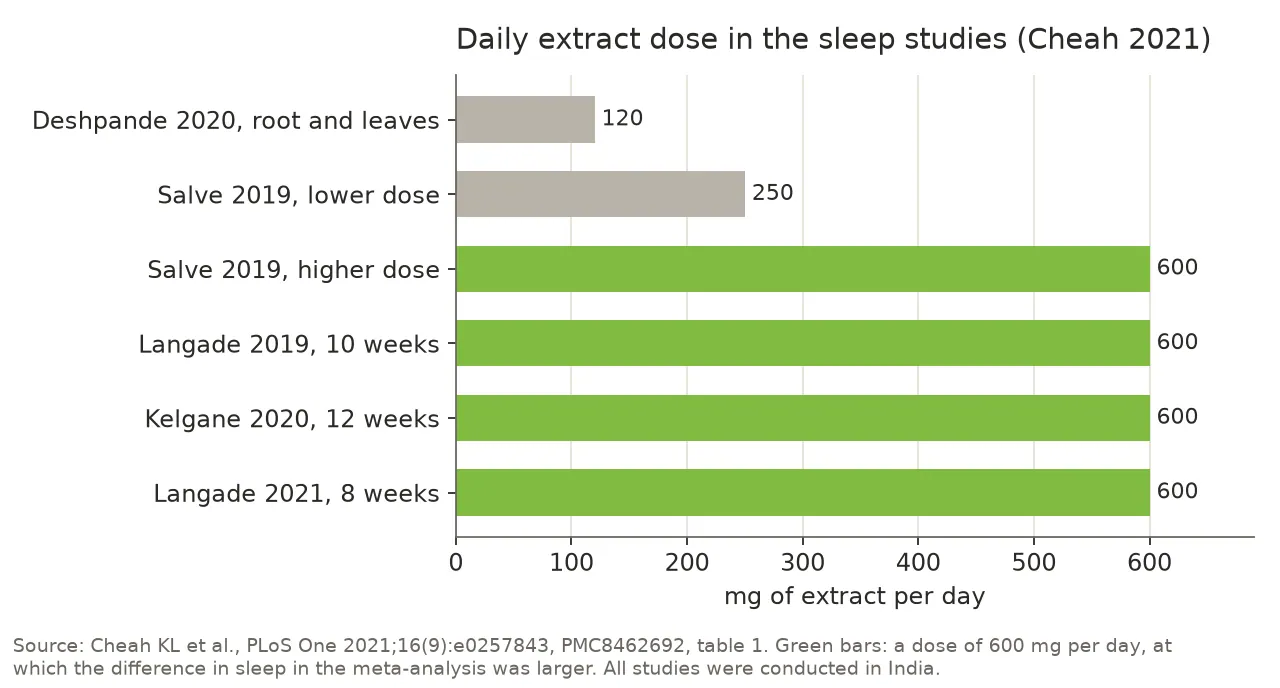
A 2026 systematic review of safety included 23 studies with 2,317 participants and doses of 125 to 600 mg per day, from a single dose to 180 days. A non-linear dose-response analysis in a 2022 meta-analysis indicated a favourable effect on stress at doses of 300 to 600 mg per day and on anxiety at doses of up to 12,000 mg per day. Data on administration longer than 180 days are limited.[3][7]
Safety: liver, thyroid, pregnancy and medicines
The 2026 systematic review included studies that administered a single-ingredient standardised extract made only from the root to generally healthy people. Liver, kidney, blood and hormonal parameters in these studies remained within the clinical reference ranges. No serious adverse events attributable to the extract were reported. Mild complaints such as digestive discomfort, headache and transient drowsiness were reported infrequently, in both the extract groups and the control groups. According to the authors, subtle or longer-term effects cannot be excluded. Two authors of the review report honoraria for consulting and speaking for companies in the supplement industry, including distributors of the extract studied. One of the included studies was written by a member of the review team; the review received no external funding. The authors of the sleep meta-analysis state that data on serious adverse effects are limited and that further data are needed to assess long-term use.[3][1]
Liver: a 2020 case series describes five cases of liver injury after supplements containing ashwagandha, three from Iceland from 2017 and 2018 and two from 2016 from the US DILIN network. All patients had jaundice after 2 to 12 weeks of use. The injury was cholestatic or mixed in pattern, no liver failure occurred, and in four patients the liver tests normalised within 1 to 5 months.[10]
A 2023 series from India identified 23 patients with liver injury after supplements containing ashwagandha from 2019 to 2022. The authors excluded 15 of them because of multi-ingredient preparations containing ashwagandha, concomitant use of other potentially toxic herbal preparations or other possible causes. They described in detail 8 patients who had taken a preparation containing only ashwagandha. Using the RUCAM score, they assessed the link with ashwagandha as probable in 6 and possible in 2 of them. Five of these 8 patients already had chronic liver disease before the injury; in three it was known beforehand, in two it was found only during the investigation. Three of these five presented with acute on chronic liver failure, and all three died during follow-up, after 30, 242 and 288 days. The authors link the high mortality to pre-existing liver disease. Chemical analysis of the preparations that could be retrieved found no adulterants or contamination. The authors of the 2026 systematic review state that the case reports concerned mainly non-standardised or multi-ingredient preparations. According to the inclusion criteria, however, the patients described in the Indian series took only preparations containing ashwagandha alone.[11][3]
Thyroid: a 2025 review states that the raw material may increase the levels of the hormones T3 and T4, and considers it contraindicated in increased thyroid function. Another 2026 review found four rare case reports in the literature that attributed increased thyroid function to ashwagandha use. According to the 2026 systematic review, TSH, T3 and T4 values did not change in two studies with 160 participants.[12][2][3]
Pregnancy and medicines: a 2025 review considers ashwagandha contraindicated in pregnancy and when planning a pregnancy, because high doses of root extract may lead to miscarriage. The extract may enhance the action of medicines for anxiety, sleep medicines, muscle relaxants and sedatives. Inhibition of the enzymes CYP3A4 and CYP2D6 may increase the concentration of antidepressants metabolised by them.[12]
| Authority | Year | Groups and reasons |
|---|---|---|
| ANSES (France) | 2024 | thyroid, liver or heart disease, hyperandrogenism, pregnant and breastfeeding women, people taking sedatives, children under 18 years |
| BfR (Germany) | 2024 | children, pregnant and breastfeeding women, people with liver disease; restraint for the rest of the population |
| RIVM (Netherlands) | 2024 | as a precaution advises all consumers, in particular pregnant women, not to use herbal preparations containing ashwagandha; the assessment names possible liver injury, thyrotoxicosis and suppression of adrenal function in sensitive people, while it is not known which people are sensitive |
Health claims in the EU: ashwagandha and other adaptogens “on hold”
For ashwagandha, the EFSA list includes claims on mental health and relaxation (No 2183), on the mental domain, stress and sleep (No 4194) and on adaptogenic properties (No 3251). All have the status “Pending Risk Managers’ decision”, meaning they are awaiting a decision by the risk managers.[5]
The entries on the heart and blood vessels (No 2503), energy, the respiratory tract, rejuvenation, reproduction and the skin (No 4195 to 4199) have the same status. According to a 2026 regulatory review, claims “on hold” may be used during the assessment under the transitional conditions of Article 28(5) of the Regulation. They are not authorised claims.[5][4][13]
The EFSA list also gives the status “Pending Risk Managers’ decision” to claims on other plants referred to as adaptogens, for example roseroot and eleuthero. Among mushrooms, the list includes claims on reishi (Ganoderma lucidum).[5]
Regulation of ashwagandha in European countries
In Slovakia, the use of ashwagandha in food supplements is not specifically regulated; ashwagandha may be used in supplements after notification to the authorities. In 2019 the Danish food authority commissioned a risk assessment from the DTU institute. The assessment raised concerns about an alleged traditional use to induce abortion and about possible effects on sex hormones and thyroid hormones. It also raised concerns about possible inhibition of acetylcholinesterase, possible effects on the immune system and five cases of liver injury associated with ashwagandha use. According to the assessment, a safe dose cannot be determined from the available data.[4]
| Country or body | Step |
|---|---|
| Slovakia | not specifically regulated, use in supplements after notification |
| Poland | resolution No 7/2020: at most 3 g of powdered root with at most 10 mg of withanolides per day |
| Denmark | ban in foods including supplements since 2023 |
| Netherlands | 2024: RIVM as a precaution advises consumers, in particular pregnant women, not to use herbal preparations containing ashwagandha; 2025: proposed amendment to the Commodities Act that, if enacted, would ban ashwagandha in food supplements |
| France (ANSES), Germany (BfR) | 2024: assessments and recommendations for named groups of people; BfR calls on the rest of the population to exercise restraint |
| Heads of national food safety agencies (HoA) | June 2024: recommendation to the Commission to open, as a priority, the procedure under Article 8 of Regulation (EC) No 1925/2006, which may lead to a ban on ashwagandha as an ingredient of food supplements |
On the basis of the DTU assessment, Denmark banned the use of ashwagandha in foods including food supplements in 2023. In June 2024 a working group of the heads of national food safety agencies recommended to the European Commission a priority procedure under Article 8 of Regulation (EC) No 1925/2006. If implemented, the procedure may lead to a ban on ashwagandha as an ingredient of food supplements. According to the authors of the review, the Commission first requested data on regulation and risk assessments from the Member States, so the opening of the procedure is not imminent. The authors of the regulatory review conclude that the positions of the national authorities are as inconsistent as the concerns and reports themselves.[4]
Label information on an ashwagandha product
- Part of the plant: extract solely from the root or from the root and leaves; the leaves contain more withanone and withaferin A.[2]
- Standardisation: declared withanolide content in percent; in studies 1.5 to 5 % withanolides, for the root and leaf extract 35 % withanolide glycosides.[3][6]
- Composition: single ingredient or multi-ingredient preparation; according to the 2026 review, the case reports of liver injury concerned mainly non-standardised or multi-ingredient preparations; in the 2023 Indian series the preparations contained only ashwagandha.[3][11]
- Label warnings for the groups that the authorities advise to avoid use.[4]
Related products
Browse the products in the category: Adaptogens.
Sources
- Cheah KL, Norhayati MN, Husniati Yaacob L, Abdul Rahman R (2021). Effect of Ashwagandha (Withania somnifera) extract on sleep: A systematic review and meta-analysis. PLoS One 16(9):e0257843. https://doi.org/10.1371/journal.pone.0257843
- Winther K (2026). The Clinical Implications of Ashwagandha (Withania somnifera L.) with a Special Reference to Side Effects: A Review. Nutrients 18(5):871. https://doi.org/10.3390/nu18050871
- Coope OC, Willems MET, Levington A et al. (2026). Back to the Roots: Safety and Tolerability of Standardised Ashwagandha (Withania somnifera) Root Extract in Healthy Adults: A Systematic Review of Biomarkers and Adverse Events. Pharmaceuticals (Basel) 19(5):725. https://doi.org/10.3390/ph19050725
- Brendler T, Al-Mondhiry R, Lang L et al. (2026). Ashwagandha: Is It Safe? Part 1: A Regulatory Review. Phytother Res 40(8):4845. https://doi.org/10.1002/ptr.70151
- EFSA (2021). Questions on hold: botanical claims (list of claims on botanical substances under Article 13 of Regulation (EC) No 1924/2006 awaiting a decision). European Food Safety Authority. https://www.efsa.europa.eu/sites/default/files/2021-06/questions-on-hold-botanical-claims.xlsx
- Lopresti AL, Smith SJ, Malvi H, Kodgule R (2019). An investigation into the stress-relieving and pharmacological actions of an ashwagandha (Withania somnifera) extract: A randomized, double-blind, placebo-controlled study. Medicine (Baltimore) 98(37):e17186. https://doi.org/10.1097/MD.0000000000017186
- Akhgarjand C, Asoudeh F, Bagheri A et al. (2022). Does Ashwagandha supplementation have a beneficial effect on the management of anxiety and stress? A systematic review and meta-analysis of randomized controlled trials. Phytother Res 36(11):4115. https://doi.org/10.1002/ptr.7598
- Salve J, Pate S, Debnath K, Langade D (2019). Adaptogenic and Anxiolytic Effects of Ashwagandha Root Extract in Healthy Adults: A Double-blind, Randomized, Placebo-controlled Clinical Study. Cureus 11(12):e6466. https://doi.org/10.7759/cureus.6466
- Lopresti AL, Drummond PD, Smith SJ (2019). A Randomized, Double-Blind, Placebo-Controlled, Crossover Study Examining the Hormonal and Vitality Effects of Ashwagandha (Withania somnifera) in Aging, Overweight Males. Am J Mens Health 13(2). https://doi.org/10.1177/1557988319835985
- Björnsson HK, Björnsson ES, Avula B et al. (2020). Ashwagandha-induced liver injury: A case series from Iceland and the US Drug-Induced Liver Injury Network. Liver Int 40(4):825. https://doi.org/10.1111/liv.14393
- Philips CA, Valsan A, Theruvath AH et al. (2023). Ashwagandha-induced liver injury: A case series from India and literature review. Hepatol Commun 7(10):e0270. https://doi.org/10.1097/HC9.0000000000000270
- Wiciński M, Fajkiel-Madajczyk A, Sławatycki J et al. (2025). Ashwagandha (Withania somnifera) and Its Effects on Well-Being: A Review. Nutrients 17(13):2143. https://doi.org/10.3390/nu17132143
- European Commission (2012). EU Register on nutrition and health claims (Regulation (EU) No 432/2012). Food and Feed Information Portal. https://ec.europa.eu/food/food-feed-portal/backend/claims/files/euregister.pdf