Iron is an essential trace element that the body needs for the transport and storage of oxygen and for many redox reactions. It is one of the dietary minerals and occurs in food as haem iron from animal tissues and as non-haem iron. The body has no active pathway for excreting iron, so the amount of iron in the body is controlled through absorption.[1][2][3]
At a glance
- Iron is an essential trace element that the body needs for the transport and storage of oxygen; the body has no active pathway for excreting it.
- EFSA has set a population reference intake of 11 mg per day for men and postmenopausal women and 16 mg per day for premenopausal women.
- According to EFSA, foods with relatively high iron concentrations include meat, fish, cereals, beans, nuts, egg yolks, dark green vegetables and potatoes.
- A larger proportion of haem iron from animal tissues is absorbed than of non-haem iron, whose absorption is reduced by phytate and polyphenols in tea and enhanced by ascorbic acid.
- EFSA did not set an upper intake level for iron but a safe level of intake of 40 mg per day for adults, which applies to total intake from all sources.
Iron in the body: haemoglobin, ferritin and iron deficiency anaemia
The adult human body contains 2.2 to 3.8 g of iron when iron supply is adequate. About 70 % of it is present in the haemoglobin of red blood cells, so the haemoglobin concentration closely reflects the amount of iron used in the organism. Other iron-containing components are myoglobin in muscle, ferritin in the liver and haem and non-haem enzymes.[1][2]
The serum ferritin concentration indicates the size of the body iron stores, except for high values caused by inflammation.[1]
Absorption takes place mainly in the duodenum. In healthy people, the transfer of iron across the mucosa decreases as the serum ferritin concentration rises and is controlled by the liver hormone hepcidin.[2]
When the iron supply does not cover requirements, the body first draws on its stores, and iron deficiency develops once they are exhausted. EFSA describes iron deficiency anaemia, in which the haemoglobin concentration is below normal, as the nutritional deficiency disorder with a higher prevalence than any other nutrient, found in all countries of the world.[2]
Haem and non-haem iron: absorption, inhibitors and enhancers
Haem iron comes only from animal tissues, where it is part of haem proteins, mainly myoglobin and haemoglobin. A larger proportion of haem iron is absorbed than of non-haem iron. Its absorption is less regulated and ranges from 15 % with adequate stores to 35 % with iron deficiency.[4][1]
A review from 2010 gives estimates of iron bioavailability of 14 to 18 % from mixed diets and 5 to 12 % from vegetarian diets in people with no iron stores, on which the dietary reference values are based.[3]
The absorption of non-haem iron is influenced mainly by the composition of the diet. Inhibitors include, for example, phytate, polyphenols in tea, coffee, cocoa, red wine and vegetables, as well as calcium and zinc; enhancers include, for example, ascorbic acid and animal muscle protein (meat).[4]
Depending on the ratio of enhancing and inhibiting substances, absorption from a single meal can vary by a factor of up to ten, while differences are smaller in longer studies. The diet has little influence on the absorption of haem iron, although calcium can reduce it.[1][3][4]
In a study with beverages and a bread meal, beverages with 20 to 50 mg of polyphenols per serving reduced iron absorption by 50 to 70 %, and beverages with 100 to 400 mg by 60 to 90 %. According to a review from 2010, iron status generally has a greater effect on absorption than the composition of the diet.[5][3]
Iron in foods: meat, liver, legumes and seeds
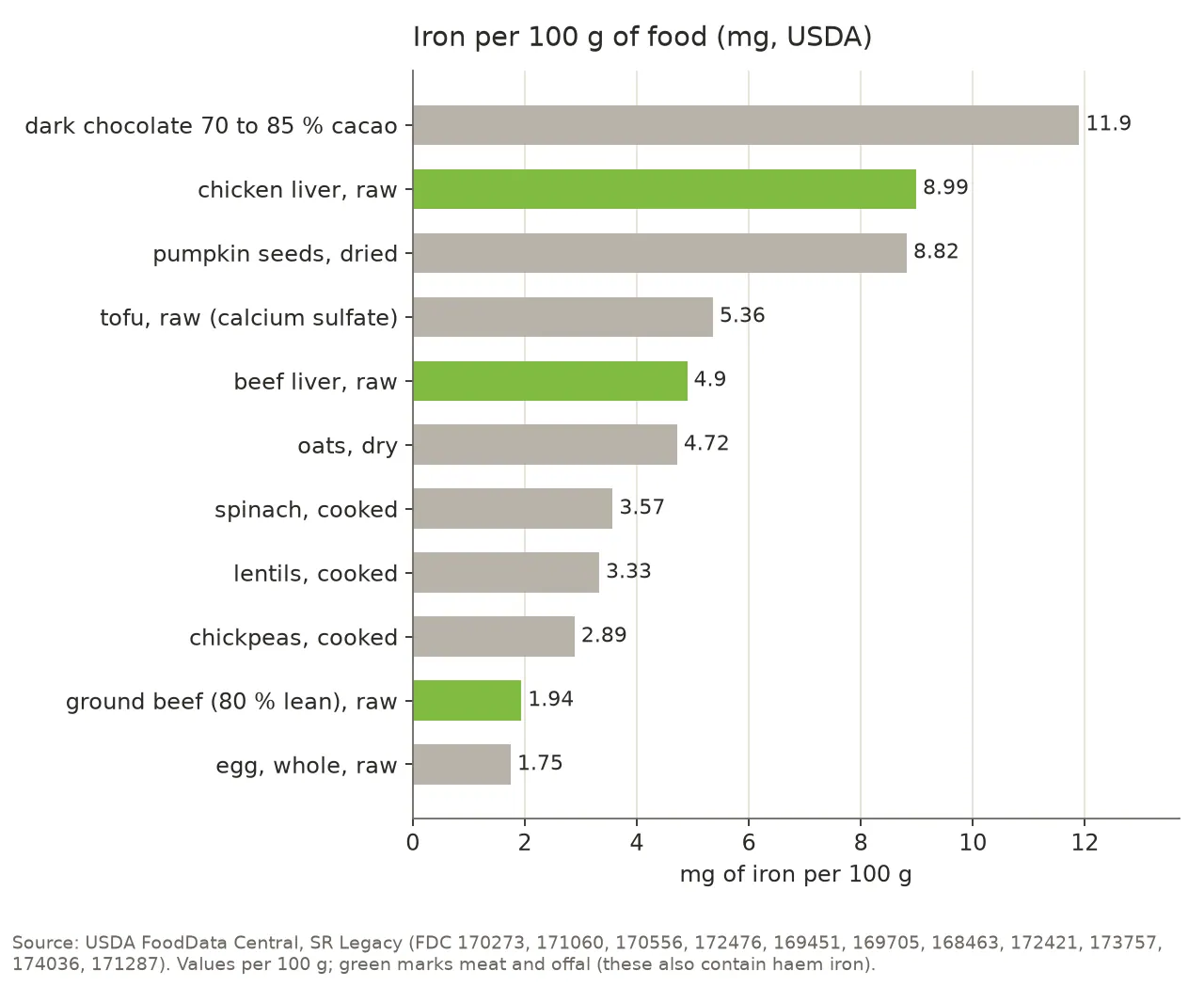
According to EFSA, foods with relatively high iron concentrations include meat, fish, cereals, beans, nuts, egg yolks, dark green vegetables, potatoes and fortified foods.[2]
The iron content does not determine how much of it is absorbed. In the beverage study, a cocoa beverage reduced the absorption of iron from a bread meal by 71 % compared with water; the study did not measure iron absorption from chocolate itself.[5]
| Food | Iron (mg per 100 g) | % NRV per 100 g |
|---|---|---|
| dark chocolate 70 to 85 % cacao | 11.9 | 85 % |
| chicken liver, raw | 8.99 | 64 % |
| pumpkin seeds, dried | 8.82 | 63 % |
| tofu, raw (prepared with calcium sulfate) | 5.36 | 38 % |
| beef liver, raw | 4.9 | 35 % |
| oats, dry | 4.72 | 34 % |
| spinach, cooked | 3.57 | 26 % |
| lentils, cooked | 3.33 | 24 % |
| chickpeas, cooked | 2.89 | 21 % |
| ground beef (80 % lean meat), raw | 1.94 | 14 % |
| egg, whole, raw | 1.75 | 13 % |
EFSA iron requirement: men, women, pregnancy and children
EFSA did not use health outcomes to derive the reference values because of uncertainties in intake measurements and the poor correlation between intake and iron status. For men it set an average requirement (AR) of 6 mg and a population reference intake (PRI) of 11 mg per day. For premenopausal women the AR is 7 mg and the PRI 16 mg per day. This PRI meets the requirement of 95 % of women of reproductive age.[2]
A singleton pregnancy requires a total of 835 mg of iron. Requirements rise during pregnancy, and at the same time the proportion of absorbed iron increases markedly. EFSA therefore considers that no additional iron is needed in pregnancy. The calculation assumes a serum ferritin concentration of 30 µg/L at conception, at which around 120 mg of stored iron can be mobilised for the pregnancy. EFSA also notes that the absorption data used, from single-meal studies in fasting women, may be an overestimate.[2]
For infants aged 7 to 11 months the PRI is 11 mg per day, for children aged 1 to 6 years 7 mg and aged 7 to 11 years 11 mg.[2]
| Group | PRI (mg per day) |
|---|---|
| men | 11 |
| postmenopausal women | 11 |
| premenopausal women | 16 |
| pregnant women (at serum ferritin of 30 µg/L at conception) | 16 |
| lactating women | 16 |
| infants 7 to 11 months | 11 |
| children 1 to 6 years | 7 |
| children 7 to 11 years | 11 |
| boys 12 to 17 years | 11 |
| girls 12 to 17 years | 13 |
According to EFSA, the groups most exposed to iron deficiency are people with high requirements for growth (infants, children, pregnant women) and people with high losses (women with heavy menstrual losses). People with impaired absorption, for example with infection or inflammation, are also exposed.[2]
EU health claims on iron and the source-of-iron condition
Regulation (EU) No 432/2012 lists seven authorised health claims for iron; the table gives their official English wording. All of them may be used only for food which is at least a source of iron as referred to in the Annex to Regulation (EC) No 1924/2006.[8]
A claim that a food is a source of a mineral requires at least a significant amount, and a claim of a high content requires at least twice that amount. Annex XIII of Regulation (EU) No 1169/2011, which replaced Directive 90/496/EEC, sets an NRV of 14 mg for iron. As a rule, a significant amount is 15 % of the NRV per 100 g or 100 ml, or 7.5 % of the NRV per 100 ml of a beverage. For a package with a single portion it is 15 % of the NRV per portion. For iron this is 2.1 mg per 100 g or 100 ml, 1.05 mg per 100 ml for beverages and 2.1 mg per portion for a single-portion package (calculation: 0.15 × 14 and 0.075 × 14).[9][7]
The register also contains claims on iron absorption that belong to other nutrients and foods. For vitamin C it gives the wording “Vitamin C increases iron absorption” on condition that the food is at least a source of vitamin C. The conditions of this claim are described in the entry Vitamin C. For meat or fish it gives the wording “Meat or fish contributes to the improvement of iron absorption when eaten with other foods containing iron”. The condition is at least 50 g of meat or fish in a single quantified portion.[8]
| Claim | Condition of use |
|---|---|
| Iron contributes to normal cognitive function. | food is at least a source of iron |
| Iron contributes to normal energy-yielding metabolism. | food is at least a source of iron |
| Iron contributes to normal formation of red blood cells and haemoglobin. | food is at least a source of iron |
| Iron contributes to normal oxygen transport in the body. | food is at least a source of iron |
| Iron contributes to the normal function of the immune system. | food is at least a source of iron |
| Iron contributes to the reduction of tiredness and fatigue. | food is at least a source of iron |
| Iron has a role in the process of cell division. | food is at least a source of iron |
Forms of iron in food supplements and gastrointestinal effects
The forms authorised in the EU for addition to foods and to food supplements include ferrous bisglycinate, ferrous carbonate, ferrous citrate, ferrous gluconate, ferrous fumarate, ferrous lactate and ferrous sulfate, as well as ferric diphosphate (ferric pyrophosphate).[4]
According to EFSA, iron from ferrous sulfate is generally absorbed better than from other authorised forms. Bioavailability, however, depends on the nutritional status of the person and on the other components of the diet. According to EFSA, the forms of iron therefore cannot be ranked accurately and uniformly by bioavailability.[4]
Gastrointestinal effects of oral iron include nausea, flatulence, abdominal pain, diarrhoea, constipation and black or tarry stools. A meta-analysis from 2015 included 43 randomised trials with 6 831 adults, 20 of them with a placebo arm. In these trials ferrous sulfate increased the occurrence of gastrointestinal effects compared with placebo, with an odds ratio of 2.32. Meta-regression did not confirm an association with the dose.[10]
EFSA states in 2024 that most studies found gastrointestinal effects at more than 50 mg of iron per day taken as a single dose in the form of ferrous sulfate, ferrous fumarate or ferrous bisglycinate. The proportion of people with such effects was highly variable and, according to EFSA, seemed not to be related to the dose in the range of 10 to 222 mg per day. According to the opinion from 2004, the effects increase with the dose and are fewer with slow-release preparations or when iron is taken with food.[4][1]
A meta-analysis from 2023 included 17 randomised trials that compared ferrous bisglycinate with other iron supplements at any dose and frequency for at least 4 weeks, so the doses were not matched. In 9 trials with pregnant women lasting 4 to 20 weeks, bisglycinate was associated with a higher haemoglobin concentration and fewer reported gastrointestinal effects (incidence rate ratio 0.36). In children (4 trials), no differences in haemoglobin or ferritin were found, and according to the authors further trials are needed for other groups.[11]
Safe level of intake of 40 mg per day, iron overload and haemochromatosis
EFSA did not set a tolerable upper intake level (UL) for iron in 2004 or in 2024. According to EFSA, systemic iron overload leads to organ toxicity. The only indicator with an identifiable dose relationship was black stools, which reflect large amounts of unabsorbed iron in the gut. According to EFSA, black stools are a conservative endpoint in the chain of events that may lead to systemic iron overload, but are not adverse in themselves.[1][4]
Instead of a UL, EFSA set in 2024 a safe level of intake of 40 mg per day for adults, including pregnant and lactating women. It is based on studies in which no black stools occurred with supplemental intakes of 20 to 25 mg per day in addition to 15 mg from the diet. For children and adolescents it ranges from 10 mg per day at 1 to 3 years to 35 mg per day at 15 to 17 years. The level applies to total intake from all sources, including fortified foods and food supplements. It does not apply to people who receive iron under medical supervision. The application of the safe level is more limited than that of a UL, because the intake at which the risk of adverse effects starts to increase is not defined.[4]
The likelihood of iron overload from the diet is negligible with normal intestinal function. According to EFSA, iron supplements in men and postmenopausal women may increase the proportion of people with biochemical indicators of high iron stores. Groups with poor iron status, such as menstruating women or children, may benefit from a higher intake. According to limited data, supplemental intakes of 30 mg or more of non-haem iron per day may be associated with indicators of high iron stores in older adults, such as elevated serum ferritin. The serum ferritin level at which the risk of adverse effects increases is not known. The WHO mentions taking supplements in connection with anaemia where a qualified health-care provider recommends them.[2][1][12]
Numerous cases of accidental poisoning with medicinal iron have been reported, especially in young children. A single dose of 60 mg of iron per kilogram of body weight can be lethal. Doses below about 10 to 20 mg per kilogram do not cause acute systemic toxicity.[1]
Mutations in the HFE gene can cause hereditary haemochromatosis, which mainly affects people of northern European descent. The disease is typically associated with homozygosity for the C282Y mutation, that is a change in both copies of the gene. In heterozygotes with one changed copy, iron concentrations in the blood and liver are usually only slightly increased, and haemochromatosis is rare. Haemochromatosis occurs in about 1 in 150 people of north-western European descent, or about 0.7 %. Homozygotes can accumulate iron even at normal dietary intakes. EFSA stated in 2004 that they should avoid iron supplements and highly iron-fortified foods and that most of them are unaware of their susceptibility. According to EFSA, there is no evidence of increased susceptibility to overload in heterozygotes. According to EFSA, patients with diagnosed haemochromatosis are particularly susceptible to systemic iron overload; they are managed through medical care, and the values set for the general population are not intended for them.[4][1][2]
Related products
Browse the products in the category: Iron.
Sources
- EFSA, Scientific Committee on Food (2006). Tolerable upper intake levels for vitamins and minerals (chapter Iron, opinion of the NDA Panel adopted on 19 October 2004). EFSA. https://www.efsa.europa.eu/sites/default/files/efsa_rep/blobserver_assets/ndatolerableuil.pdf
- EFSA (2017). Dietary Reference Values for nutrients: Summary report (chapter 4.6 Iron, summary of the opinion EFSA Journal 2015;13(10):4254). EFSA Supporting Publication 2017:e15121. https://www.efsa.europa.eu/sites/default/files/2017_09_DRVs_summary_report.pdf
- Hurrell R, Egli I (2010). Iron bioavailability and dietary reference values. Am J Clin Nutr 91(5):1461S. https://doi.org/10.3945/ajcn.2010.28674F
- EFSA Panel on Nutrition, Novel Foods and Food Allergens (NDA) (2024). Scientific opinion on the tolerable upper intake level for iron. EFSA Journal 22(6):e8819. https://doi.org/10.2903/j.efsa.2024.8819
- Hurrell RF, Reddy M, Cook JD (1999). Inhibition of non-haem iron absorption in man by polyphenolic-containing beverages. Br J Nutr 81(4):289. https://doi.org/10.1017/S0007114599000537
- U.S. Department of Agriculture (2019). FoodData Central, SR Legacy: Chocolate dark 70-85% cacao solids (170273); Chicken liver raw (171060); Pumpkin and squash seed kernels dried (170556); Tofu raw regular prepared with calcium sulfate (172476); Beef liver raw (169451); Oats (169705); Spinach cooked boiled drained (168463); Lentils cooked boiled (172421); Chickpeas cooked boiled (173757); Beef ground 80% lean raw (174036); Egg whole raw (171287). USDA Agricultural Research Service. https://fdc.nal.usda.gov/
- European Parliament and Council (2011). Regulation (EU) No 1169/2011 on the provision of food information to consumers, Annex XIII Part A and Article 53. Official Journal of the European Union L 304. https://eur-lex.europa.eu/legal-content/EN/TXT/?uri=CELEX:32011R1169
- European Commission (2012). Commission Regulation (EU) No 432/2012 establishing a list of permitted health claims made on foods (consolidated version of 20 August 2025), Annex, entries Iron, Meat or fish and Vitamin C (iron absorption). Official Journal of the European Union L 136. https://eur-lex.europa.eu/legal-content/EN/TXT/?uri=CELEX:02012R0432-20250820
- European Parliament and Council (2006). Regulation (EC) No 1924/2006 on nutrition and health claims made on foods, Annex (claims SOURCE OF and HIGH for vitamins and minerals). Official Journal of the European Union L 404. https://eur-lex.europa.eu/legal-content/EN/TXT/?uri=CELEX:32006R1924
- Tolkien Z, Stecher L, Mander AP, Pereira DIA, Powell JJ (2015). Ferrous Sulfate Supplementation Causes Significant Gastrointestinal Side-Effects in Adults: A Systematic Review and Meta-Analysis. PLoS One 10(2):e0117383. https://doi.org/10.1371/journal.pone.0117383
- Fischer JAJ, Cherian AM, Bone JN, Karakochuk CD (2023). The effects of oral ferrous bisglycinate supplementation on hemoglobin and ferritin concentrations in adults and children: a systematic review and meta-analysis of randomized controlled trials. Nutr Rev 81(8):904. https://doi.org/10.1093/nutrit/nuac106
- World Health Organization (2025). Anaemia: fact sheet. WHO. https://www.who.int/news-room/fact-sheets/detail/anaemia