Zinc is an essential trace element from the group of minerals that humans obtain through the diet. In biological systems it exists as the Zn2+ ion and is present in all tissues and body fluids; the adult body contains 2 to 4 g of zinc. It has a catalytic role in all six classes of enzymes.[1][2][3]
At a glance
- Zinc is an essential trace element; EFSA lists meat, legumes, eggs, fish, and grains and grain-based products as rich sources of zinc.
- According to EFSA, the population reference intake depends on phytate intake: 7.5 to 12.7 mg per day for women and 9.4 to 16.3 mg per day for men.
- According to a 2024 Cochrane review, with regular use the risk of developing a cold may be reduced only slightly or not at all, with low certainty of evidence.
- With use during a cold, its duration may be 2.37 days shorter, but the results of the studies varied widely and non-serious adverse events were probably more frequent.
- The Scientific Committee on Food set an upper intake level of 25 mg of zinc per day for adults; according to a 2015 paper, high doses may cause copper deficiency.
Zinc fingers, absorption and zinc deficiency
According to EFSA, the human transcriptome contains 2,500 zinc finger proteins. These proteins are involved in the control of transcription and translation of genetic information and in signal transduction within the cell. According to a 2020 review, approximately 2,800 human proteins are presumed to bind zinc.[3][1]
Most dietary zinc is absorbed in the upper small intestine. Most of the zinc in the body is in muscle and bone, and the body has no identified major storage site. Excess intakes result in reduced absorption and increased excretion of zinc.[3][2]
According to EFSA, plasma zinc concentration and other biomarkers are not useful for estimating reference values for zinc. Clinically defined zinc deficiency is rare in humans. It has been observed in total parenteral nutrition, with the use of penicillamine and in the inherited disorder acrodermatitis enteropathica. Its main clinical manifestations include diarrhoea, increased susceptibility to infections, dermatitis, growth retardation, behavioural changes, hair loss and delayed sexual maturation.[3][2]
Zinc content of foods: oysters, seeds and meat
EFSA lists meat, legumes, eggs, fish, and grains and grain-based products as rich sources of zinc. According to 12 dietary surveys in nine EU countries, the average intake of adults was 8.0 to 14.0 mg per day. The main food groups contributing to this intake were meat and meat products, grains and grain-based products, and milk and dairy products.[3]
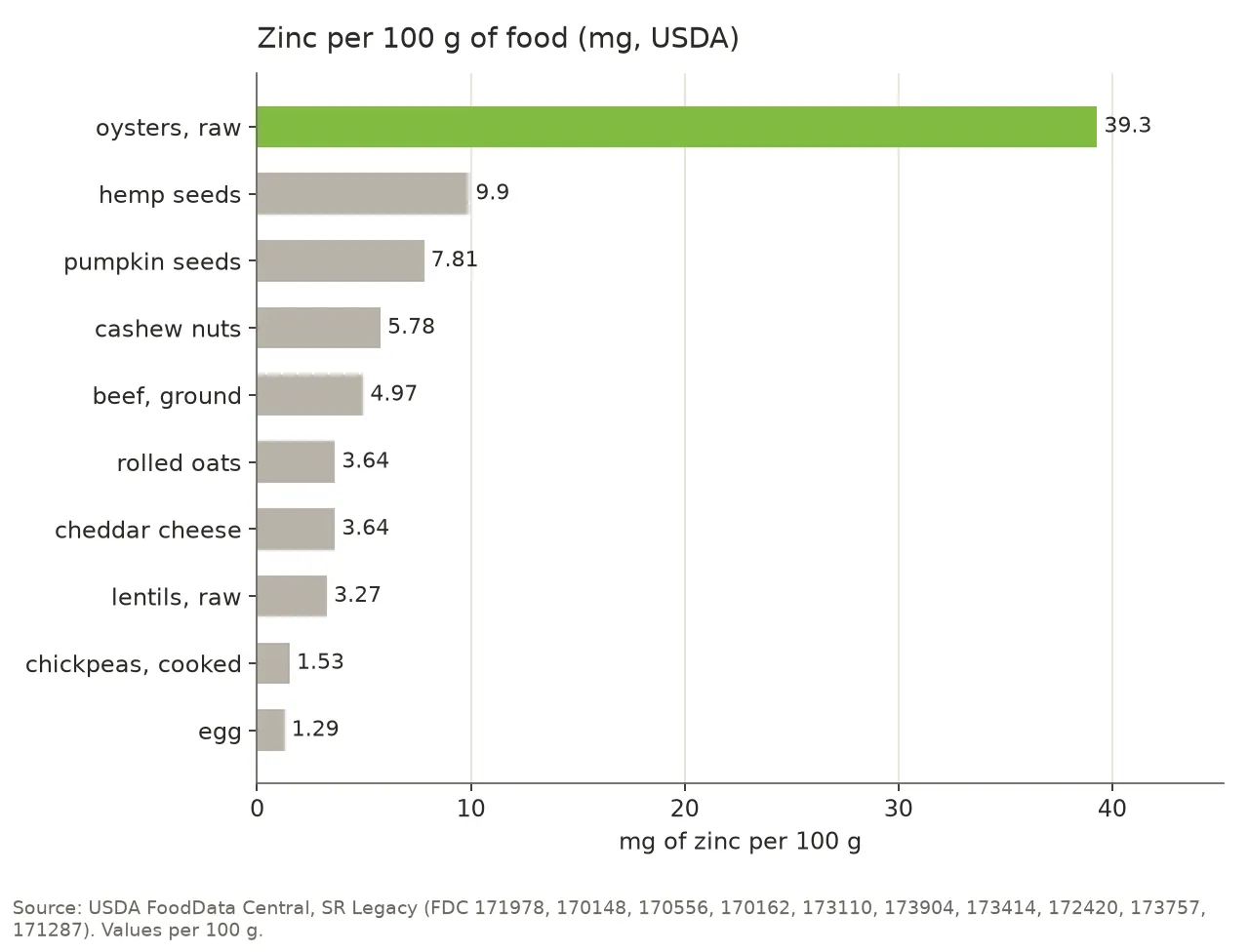
The USDA FoodData Central database gives 39.3 mg of zinc per 100 g for raw wild eastern oysters, 9.9 mg for hulled hemp seeds, 7.81 mg for dried pumpkin seed kernels and 5.78 mg for raw cashew nuts.[4]
| Food | Zinc (mg per 100 g) | % NRV per 100 g |
|---|---|---|
| oysters, eastern, wild, raw | 39.3 | 393 % |
| hemp seeds, hulled | 9.9 | 99 % |
| pumpkin seed kernels, dried | 7.81 | 78 % |
| cashew nuts, raw | 5.78 | 58 % |
| beef, ground, 7 % fat, raw | 4.97 | 50 % |
| rolled oats, dry | 3.64 | 36 % |
| cheddar cheese | 3.64 | 36 % |
| lentils, raw | 3.27 | 33 % |
| chickpeas, cooked | 1.53 | 15 % |
| egg, whole, raw | 1.29 | 13 % |
| lentils, cooked | 1.27 | 13 % |
Phytate, the EFSA requirement and the 25 mg upper limit
Phytate is a natural component of plants that severely decreases the intestinal availability of zinc and is regarded as the main dietary inhibitor of its absorption. Plant-based diets generally contain more phytate than mixed diets and therefore provide less available zinc than diets containing meat. Changes in absorption are observed from a molar phytate to zinc ratio of 5. The share of absorbed zinc falls from 21 % without phytate to 11 to 16 % at a ratio of 5 to 15 and to 4 to 11 % at a ratio above 15.[1]
Phytases present in plants, particularly in grains, can be activated during fermentation and food processing, which increases zinc absorption. Dietary protein correlates positively with zinc uptake, and absorption is higher in the presence of animal protein than plant protein. According to the authors of the review, the literature attributes this favourable effect to the amount of protein itself counteracting the effect of phytate, not to its animal origin.[1]
The average requirement (AR) and the population reference intake (PRI) are given for phytate intakes of 300, 600, 900 and 1,200 mg per day, which covers the range of average phytate intakes in European populations. The AR is 6.2 to 10.2 mg per day for women with a reference body weight of 58.5 kg and 7.5 to 12.7 mg per day for men with a body weight of 68.1 kg.[3]
| Phytate intake (mg per day) | PRI men (mg per day) | PRI women (mg per day) |
|---|---|---|
| 300 | 9.4 | 7.5 |
| 600 | 11.7 | 9.3 |
| 900 | 14.0 | 11.0 |
| 1,200 | 16.3 | 12.7 |
For infants from 7 months and for children, EFSA assumed an absorption of zinc from mixed diets of 30 %. Their PRI ranges from 2.9 to 14.2 mg per day. For pregnant women 1.6 mg per day is added to the PRI, and for breastfeeding women 2.9 mg per day.[3]
The Scientific Committee on Food (SCF) set the tolerable upper intake level (UL) of zinc at 25 mg per day for adults. It was based on an intake of 50 mg per day at which no adverse changes in indicators of copper status were found. This value was divided by an uncertainty factor of 2 for the small number of subjects and the short duration of the studies. The same UL applies to pregnant and breastfeeding women. According to the SCF (2002), the average intake of adults and children in the EU was below the UL. The 97.5th percentile of total intake was close to the UL in all age groups, which the Committee did not consider a matter of concern.[2]
| Group | UL (mg per day) |
|---|---|
| children 1 to 3 years | 7 |
| children 4 to 6 years | 10 |
| children 7 to 10 years | 13 |
| adolescents 11 to 14 years | 18 |
| adolescents 15 to 17 years | 22 |
| adults including pregnant and breastfeeding women | 25 |
Eighteen authorised health claims on zinc
Regulation (EU) No 432/2012 lists eighteen authorised health claims for zinc; the table gives their official English wording. All of them may be used only for food which is at least a source of zinc as referred to in the Annex to Regulation (EC) No 1924/2006.[6]
Under the Annex to Regulation (EC) No 1924/2006, a claim that a food is a source of a mineral may only be made where the product contains at least a significant amount. Annex XIII of Regulation (EU) No 1169/2011 sets an NRV of 10 mg for zinc. As a rule, a significant amount is 15 % of the NRV per 100 g or 100 ml. For zinc this is 1.5 mg per 100 g (calculation: 0.15 × 10 mg).[7][5]
The same annex also sets NRVs for other nutrients, for example 375 mg for magnesium, 80 mg for vitamin C, 14 mg for iron and 1 mg for copper.[5]
| Claim | Condition of use |
|---|---|
| Zinc contributes to normal acid-base metabolism. | food is at least a source of zinc |
| Zinc contributes to normal carbohydrate metabolism. | food is at least a source of zinc |
| Zinc contributes to normal cognitive function. | food is at least a source of zinc |
| Zinc contributes to normal DNA synthesis. | food is at least a source of zinc |
| Zinc contributes to normal fertility and reproduction. | food is at least a source of zinc |
| Zinc contributes to normal macronutrient metabolism. | food is at least a source of zinc |
| Zinc contributes to normal metabolism of fatty acids. | food is at least a source of zinc |
| Zinc contributes to normal metabolism of vitamin A. | food is at least a source of zinc |
| Zinc contributes to normal protein synthesis. | food is at least a source of zinc |
| Zinc contributes to the maintenance of normal bones. | food is at least a source of zinc |
| Zinc contributes to the maintenance of normal hair. | food is at least a source of zinc |
| Zinc contributes to the maintenance of normal nails. | food is at least a source of zinc |
| Zinc contributes to the maintenance of normal skin. | food is at least a source of zinc |
| Zinc contributes to the maintenance of normal testosterone levels in the blood. | food is at least a source of zinc |
| Zinc contributes to the maintenance of normal vision. | food is at least a source of zinc |
| Zinc contributes to the normal function of the immune system. | food is at least a source of zinc |
| Zinc contributes to the protection of cells from oxidative stress. | food is at least a source of zinc |
| Zinc has a role in the process of cell division. | food is at least a source of zinc |
Absorption of zinc forms: citrate, gluconate, oxide, picolinate and bisglycinate
Food supplements with zinc contain zinc in the form of salts or complexes. In 2002 the SCF listed zinc acetate, chloride, citrate, gluconate, lactate, oxide, carbonate and sulphate among the substances that can be used in food supplements. The legal measure on food supplements was at that time still being prepared. The chemical forms of minerals that may be used in food supplements are now listed in Annex II to Directive 2002/46/EC as amended.[2][8]
The share of dietary zinc absorbed in humans is typically 16 to 50 % and falls as intake rises. Absorption also depends on the form of administration: more zinc is absorbed from an aqueous solution than from the same amount included in a meal.[1]
A randomised crossover study in 15 healthy adults compared supplements with 10 mg of zinc given without food. Median fractional absorption was 61.3 % for citrate, 60.9 % for gluconate and 49.9 % for oxide. Citrate and gluconate did not differ significantly, while oxide was absorbed significantly less.[9]
A 1987 study with 15 volunteers compared zinc picolinate, citrate and gluconate at 50 mg of zinc per day with placebo, each for four weeks. The study measured zinc concentrations in hair, urine, erythrocytes and serum before and after each period, that is indirect markers, not the absorbed share of zinc directly. With picolinate, zinc concentrations in hair, urine and erythrocytes rose; with gluconate, citrate and placebo these parameters did not change significantly. The dose of 50 mg per day is twice the UL (calculation).[10][2]
In a randomised crossover study with 12 women that measured serum zinc concentration after a single dose of 15 mg, zinc bisglycinate showed a 43.4 % higher bioavailability than gluconate. The data on picolinate and bisglycinate therefore come from single studies with 15 and 12 participants.[11][10]
Zinc lozenges and the common cold: the 2024 Cochrane review
A 2024 Cochrane systematic review included randomised trials that compared any form of zinc with placebo. It covered 34 studies with 8,526 participants; 15 assessed regular use before illness and 19 use during a cold. Half of the studies (17 of 34) used lozenges containing zinc acetate, gluconate or orotate. Most studies were at unclear or high risk of bias in at least one domain.[12]
With regular use, the risk of developing a cold may be reduced only slightly or not at all compared with placebo. The risk ratio was 0.93 (95 % confidence interval 0.85 to 1.01; 9 studies, 1,449 participants; low certainty of evidence). When a cold occurred during regular use, its duration probably hardly differed: the mean difference was 0.63 days (95 % confidence interval from 1.29 days shorter to 0.04 days longer; 3 studies, 740 participants; moderate certainty of evidence). With use during a cold, the mean duration may be 2.37 days shorter (95 % confidence interval 0.53 to 4.21 days; 8 studies, 972 participants; low certainty of evidence). The results of the individual studies, however, varied widely (heterogeneity I² 97 %). Whether use during a cold reduces the share of people still ill at the end of follow-up is uncertain (very low certainty of evidence). Non-serious adverse events were probably more frequent with this use: risk ratio 1.34 (95 % confidence interval 1.15 to 1.55; 16 studies, 2,084 participants; moderate certainty of evidence).[12]
The authors conclude that zinc may have little or no effect on the incidence of colds but may reduce the duration of ongoing colds, with an increase in non-serious adverse events. They point to wide variation in interventions and outcomes across the studies and to incomplete reporting, which should be considered in the conclusions.[12]
Excess zinc, copper deficiency and the effect of iron
Acute zinc toxicity presents with nausea, vomiting, epigastric pain, abdominal cramps and diarrhoea. The emetic dose is estimated at 225 to 450 mg of zinc. Prolonged intake of supplements with 50 to 300 mg of zinc per day has been associated with biochemical and physiological changes. These include low blood copper, a reduction in white blood cells and sideroblastic anaemia.[2]
According to a 2020 review, zinc excess is mainly associated with disturbed copper homeostasis. Copper has no impact on zinc absorption, whereas supra-physiological doses of zinc critically impair intestinal copper absorption. According to a 2015 paper, zinc in high doses may cause copper deficiency. This diagnosis is often missed and results in anaemia, neutropenia and irreversible neurological symptoms.[1][13]
The authors of this paper retrospectively reviewed the case notes of 70 patients prescribed zinc. In 62 % the prescribed doses were sufficient to cause copper deficiency. Unexplained anaemia developed in 9 % and neurological symptoms typical of copper deficiency in 7 %. Plasma copper was measured in only two of these patients, so in most cases copper deficiency was not confirmed by laboratory tests. The authors conclude that a significant minority of patients prescribed high doses of zinc probably develop iatrogenic copper deficiency.[13]
Both heme iron and inorganic iron reduced zinc absorption in several in vivo studies. The effect was greater when iron was given as an aqueous solution than with a meal.[1]
Related products
Browse the products in the category: Zinc.
Sources
- Maares M, Haase H (2020). A Guide to Human Zinc Absorption: General Overview and Recent Advances of In Vitro Intestinal Models. Nutrients 12(3):762. https://doi.org/10.3390/nu12030762
- EFSA, Scientific Committee on Food (2006). Tolerable upper intake levels for vitamins and minerals (chapter Zinc, opinion of the SCF of 5 March 2002). EFSA. https://www.efsa.europa.eu/sites/default/files/efsa_rep/blobserver_assets/ndatolerableuil.pdf
- EFSA (2017). Dietary Reference Values for nutrients: Summary report (chapter 4.13 Zinc and Tables 5 and 7, summary of the opinion EFSA Journal 2014;12(10):3844). EFSA Supporting Publication 2017:e15121. https://www.efsa.europa.eu/sites/default/files/2017_09_DRVs_summary_report.pdf
- U.S. Department of Agriculture (2019). FoodData Central, SR Legacy: Oyster eastern wild raw (171978); Hemp seed hulled (170148); Pumpkin and squash seed kernels dried (170556); Cashew nuts raw (170162); Beef ground 93% lean raw (173110); Oats regular and quick dry (173904); Cheese cheddar (173414); Lentils raw (172420); Lentils cooked boiled (172421); Chickpeas cooked boiled (173757); Egg whole raw (171287). USDA Agricultural Research Service. https://fdc.nal.usda.gov/
- European Parliament and Council (2011). Regulation (EU) No 1169/2011 on the provision of food information to consumers, Annex XIII Part A and Article 53. Official Journal of the European Union L 304. https://eur-lex.europa.eu/legal-content/EN/TXT/?uri=CELEX:32011R1169
- European Commission (2012). Commission Regulation (EU) No 432/2012 establishing a list of permitted health claims made on foods (consolidated version of 20 August 2025), Annex, entries Zinc. Official Journal of the European Union L 136. https://eur-lex.europa.eu/legal-content/EN/TXT/?uri=CELEX:02012R0432-20250820
- European Parliament and Council (2006). Regulation (EC) No 1924/2006 on nutrition and health claims made on foods, Annex (claims SOURCE OF and HIGH for vitamins). Official Journal of the European Union L 404. https://eur-lex.europa.eu/legal-content/EN/TXT/?uri=CELEX:32006R1924
- EFSA NDA Panel (2023). Scientific opinion on the tolerable upper intake level for vitamin D, including the derivation of a conversion factor for calcidiol monohydrate. EFSA Journal 21(8):8145. https://doi.org/10.2903/j.efsa.2023.8145
- Wegmüller R, Tay F, Zeder C, Brnic M, Hurrell RF (2014). Zinc absorption by young adults from supplemental zinc citrate is comparable with that from zinc gluconate and higher than from zinc oxide. J Nutr 144(2):132. https://doi.org/10.3945/jn.113.181487
- Barrie SA, Wright JV, Pizzorno JE, Kutter E, Barron PC (1987). Comparative absorption of zinc picolinate, zinc citrate and zinc gluconate in humans. Agents Actions 21(1-2):223. https://doi.org/10.1007/BF01974946
- Gandia P, Bour D, Maurette JM et al. (2007). A bioavailability study comparing two oral formulations containing zinc (Zn bis-glycinate vs. Zn gluconate) after a single administration to twelve healthy female volunteers. Int J Vitam Nutr Res 77(4):243. https://doi.org/10.1024/0300-9831.77.4.243
- Nault D, Machingo TA, Shipper AG et al. (2024). Zinc for prevention and treatment of the common cold. Cochrane Database Syst Rev 2024;5(5):CD014914. https://doi.org/10.1002/14651858.CD014914.pub2
- Duncan A, Yacoubian C, Watson N, Morrison I (2015). The risk of copper deficiency in patients prescribed zinc supplements. J Clin Pathol 68(9):723. https://doi.org/10.1136/jclinpath-2014-202837