
In the terminology of food supplements, protein is a powder with a high protein content, usually a concentrate or isolate of milk, egg, beef or plant protein; the word is also used for dietary protein in general. Dietary proteins are the source of nitrogen and of the indispensable amino acids the body needs for the growth and maintenance of tissues. For the phrase protein for women, the relevant point is that EFSA expresses the protein requirement per kilogram of body weight and gives a single value for women and men from the age of 18.[1][2]
At a glance
- In the terminology of food supplements, protein is a powder with a high protein content; dietary proteins are the source of nitrogen and of indispensable amino acids.
- EFSA has set a population reference intake for adults of 0.83 g of protein per kilogram of body weight per day, the same for women and men.
- Foods with a high protein content are meat, fish, eggs, milk and dairy products and, among plant foods, bread and cereal products, legumes and nuts.
- A 2018 meta-analysis of 49 studies found that protein supplementation during resistance training increased the gain in maximal strength by an average of 2.49 kg.
- The data are insufficient to set a tolerable upper intake level for protein; for adults EFSA considers twice the PRI, that is 1.66 g/kg per day, to be safe.
Protein in the diet: amino acids, quality and sources
Dietary proteins are the source of nitrogen and of indispensable amino acids. Protein quality is assessed by the quantity and availability of indispensable amino acids, usually with the PDCAAS, the protein digestibility corrected amino acid score.[2]
In muscle, the variable measured is muscle protein synthesis. According to the 2017 position stand of the International Society of Sports Nutrition (ISSN), both resistance exercise and protein intake stimulate it, and the two stimuli act synergistically when protein is consumed before or after exercise. Not every protein is complete: collagen lacks the indispensable amino acid tryptophan and is therefore categorised as an incomplete protein source.[1][3]
Animal foods with a high protein content are meat, fish, eggs, milk and dairy products. Among plant foods they are bread and cereal products, legumes and nuts. Most animal sources have an indispensable amino acid composition that matches human requirements and a high digestibility. Plant proteins usually have a lower indispensable amino acid content or a lower digestibility. According to EFSA, meat, legumes, eggs, fish and grain products are also rich sources of zinc. Meat, fish, cereals, beans and nuts are among the foods with a relatively high iron content. Whole grain cereals and pulses, together with fruit, vegetables and potatoes, are the main sources of dietary fibre.[2]
The average protein intake of adults in European countries is 67 to 114 g per day in men and 59 to 102 g per day in women. In both sexes this corresponds to approximately 12 to 20 % of energy intake. Besides protein, red meat and seafood also contain creatine, a nitrogenous compound that is not a protein amino acid.[2][4]
EFSA protein requirement and protein for women
For adults EFSA has set an average requirement (AR) of 0.66 g of protein per kilogram of body weight per day and a population reference intake (PRI) of 0.83 g/kg per day. The requirement of older adults is considered to be the same as that of other adults. At a body weight of 60 kg the PRI corresponds to approximately 50 g of protein per day, at 80 kg to approximately 66 g (calculation: 60 × 0.83 and 80 × 0.83).[2]
| Group | Population reference intake (PRI) |
|---|---|
| adults from 18 years, women and men | 0.83 g/kg body weight per day |
| pregnancy, 1st trimester | PRI + 1 g per day |
| pregnancy, 2nd trimester | PRI + 9 g per day |
| pregnancy, 3rd trimester | PRI + 28 g per day |
| lactation, first 6 months | PRI + 19 g per day |
| lactation, after 6 months | PRI + 13 g per day |
The mean protein intake of adults in Europe reaches the PRI of 0.83 g/kg per day or, more often, exceeds it.[2]
EFSA expresses the protein requirement in grams per kilogram of body weight. For children up to 10 years it gives, for each age, a common value for boys and girls. For ages 11 to 17 it gives separate values for boys and girls, for example at 17 years a PRI of 0.86 and 0.83 g/kg. For adults from 18 years it gives a single value of 0.83 g/kg for women and men. The term protein for women thus denotes a commercial category, not a separate reference value.[2]
The 2018 meta-analysis included 14 groups made up only of women. With the limited data, the authors observed no apparent differences between the sexes and state that far less research has been conducted in women than in men. The ISSN position stand summarises that protein supplementation has a small to modest effect on strength development in both men and women.[5][1]
Strength training: amount, dose and timing of protein
The ISSN position stand gives a daily intake of 1.4 to 2.0 g of protein per kilogram of body weight as sufficient for building and maintaining muscle mass in most exercising individuals.[1]
A 2018 systematic review with meta-analysis included 49 studies with 1,863 participants. Protein supplementation during prolonged resistance training increased the gain in maximal strength (1RM) by an average of 2.49 kg and the gain in fat-free mass by 0.30 kg. The effect of protein supplementation on the gain in fat-free mass decreased with increasing age and was greater in people with resistance training experience. According to the authors’ estimate, protein supplementation beyond a total intake of about 1.62 g/kg per day brought no further gain in fat-free mass with resistance training. The estimate is uncertain: the 95 % confidence interval was 1.03 to 2.20 g/kg per day, and the breakpoint in the regression was not statistically significant (p = 0.079). The authors therefore state that it may be prudent to recommend about 2.2 g/kg per day for maximising the gain in fat-free mass with resistance training.[5]
In setting the reference values, EFSA stated that data on protein intakes above the PRI in relation to muscle mass and function or to body weight regulation are not a criterion for deriving reference values. The ISSN values concern exercising individuals and the results of the meta-analysis people doing resistance training; the EFSA reference values concern the healthy population.[2][1][5]
A 2013 meta-analysis assessed protein timing around exercise in an analysis of strength (478 subjects, 20 studies) and of muscle hypertrophy (525 subjects, 23 studies). After all variables were accounted for, it found no difference between the groups with timed intake and the control groups. For hypertrophy, total protein intake was the main predictor.[6]
As a general recommendation, the ISSN position stand gives 0.25 g of high-quality protein per kilogram of body weight, or 20 to 40 g, per dose. A dose should, where possible, contain 700 to 3,000 mg of leucine or a higher relative proportion of leucine. Doses should optimally be spread evenly, every 3 to 4 hours. According to the position stand, an intake of 30 to 40 g of casein before sleep increases overnight muscle protein synthesis.[1]
In one study, young healthy men and women took 54 g of casein for 8 weeks either in the morning (before 12 noon) or in the evening (no more than 90 minutes before sleep). Body composition and performance did not differ between the groups.[1]
Types of protein: whey, casein, beef and plant protein
Milk protein powders are made by separating the protein from lactose and fat. A concentrate is a product with 29 to 80 % protein in dry matter; sports nutrition usually uses concentrates with 70 to 80 % protein. A product with more than 90 % protein is called an isolate.[1]
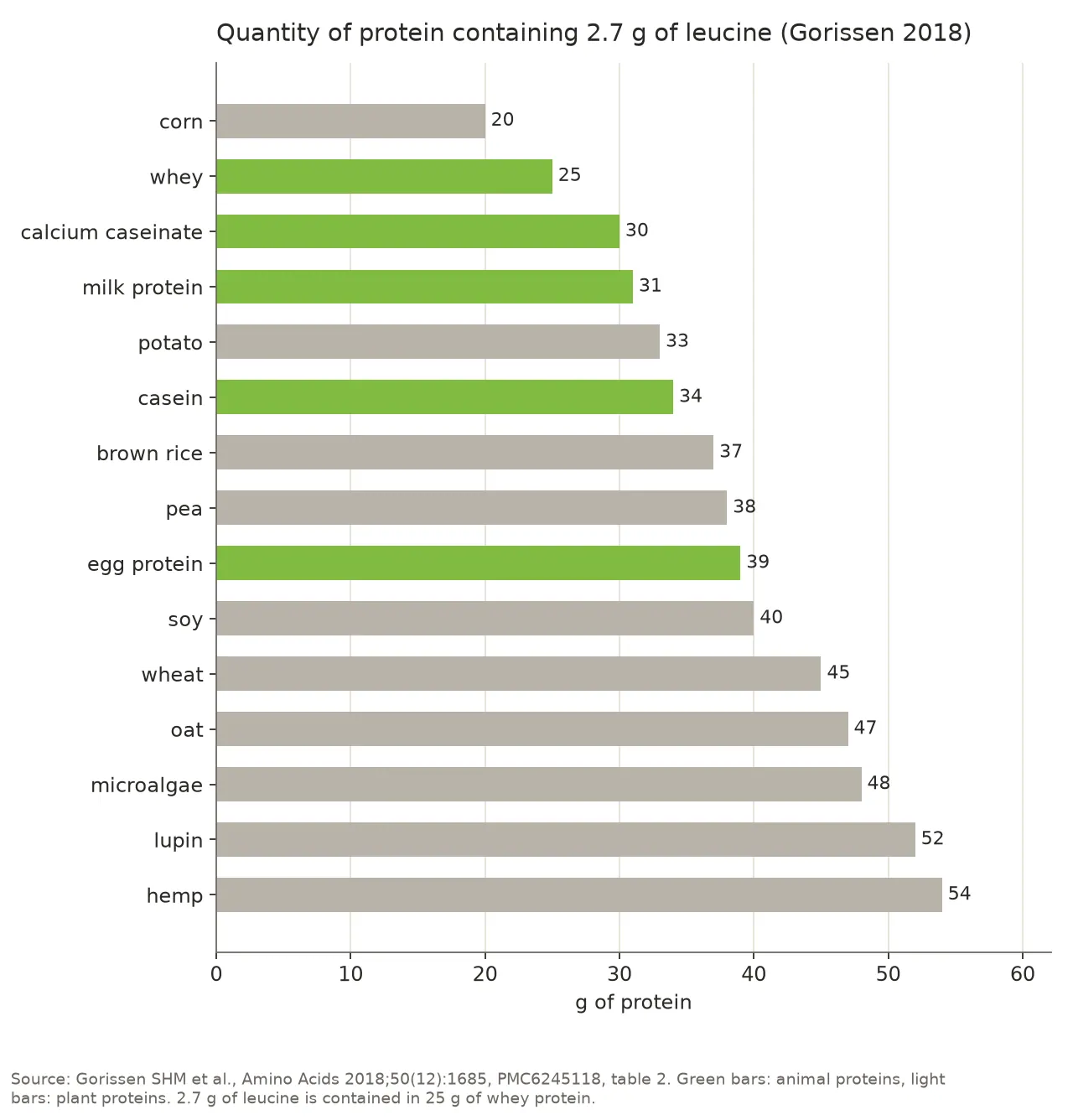
Whey protein is soluble in water and is digested quickly. Casein is insoluble in water, clots in the digestive tract and is digested more slowly. Both milk proteins have a high leucine content: whey 11 % and casein 9.3 %.[1]
A 2018 analysis of commercial protein isolates found differences in protein content even between suppliers of the same kind.[7]
| Type | Protein in powder | EAA in protein | Protein with 2.7 g of leucine |
|---|---|---|---|
| whey | 72 to 84 % | 43 % | 25 g |
| casein | 67 to 78 % | 34 % | 34 g |
| soy | 61 to 91 % | 27 % | 40 g |
| pea | 77 to 81 % | 30 % | 38 g |
One study compared 41 men and women who, during 8 weeks of resistance training, took 46 g per day of hydrolysed chicken protein, beef protein isolate or whey concentrate, with a control group. Strength rose similarly in all groups, and all protein groups recorded a gain in lean mass.[1]
Plant-based vegan protein contains on average less lysine and methionine (3.6 and 1.0 % of protein) than animal protein (7.0 and 2.5 %). With the exception of potato protein, plant proteins also contain less isoleucine and valine, two of the three branched-chain amino acids (BCAA). The average content of the third, leucine, is also lower in plant proteins (7.1 compared with 8.8 % of protein), although corn and potato protein are high in leucine. Oat, wheat and hemp protein do not meet the WHO/FAO/UNU requirements for total indispensable amino acid content. Soy, brown rice and pea protein meet this requirement for total content. However, brown rice has a lysine content below the WHO/FAO/UNU requirements, and pea and soy are low in methionine. Blends of plant isolates or mixtures of plant and animal proteins can have a composition close to that of animal proteins.[7]
Authorised health claims on protein in the EU
The EU register lists three authorised health claims for protein under Regulation (EU) No 432/2012. They are based on EFSA opinions 2010;8(10):1811 and 2011;9(6):2203: “Protein contributes to a growth in muscle mass”, “Protein contributes to the maintenance of muscle mass” and “Protein contributes to the maintenance of normal bones”.[8]
Each of the claims may be used only for food which is at least a source of protein as referred to in the claim SOURCE OF PROTEIN in the Annex to Regulation (EC) No 1924/2006. Under this Annex a food is a source of protein when at least 12 % of its energy value is provided by protein. The claim HIGH PROTEIN requires at least 20 %.[8][9]
| Claim | Entries | Condition of use |
|---|---|---|
| Protein contributes to a growth in muscle mass. | 415, 417, 593, 594, 595, 715, 1398 | food is at least a source of protein (SOURCE OF PROTEIN, at least 12 % of energy from protein) |
| Protein contributes to the maintenance of muscle mass. | 415, 417, 593, 594, 595, 715, 1398 | food is at least a source of protein (SOURCE OF PROTEIN, at least 12 % of energy from protein) |
| Protein contributes to the maintenance of normal bones. | 416, 4704 | food is at least a source of protein (SOURCE OF PROTEIN, at least 12 % of energy from protein) |
Protein for weight loss: satiety and body weight
The phrase protein for weight loss is used in commercial practice. The EU register holds no authorised claim for protein about satiety or body weight. The claim about protein, a satiety feeling and the control of hunger (entry 730) is listed as non-authorised. Equally non-authorised is the claim that foods rich in protein prolong the feeling of fullness and help to manage weight (entry 414). The basis is EFSA opinion 2010;8(10):1811. The claim about whey protein and the loss of body fat with exercise and a hypocaloric diet (entry 420) is also non-authorised.[8]
A 2015 review states that several meta-analyses of short-term, tightly controlled trials compared reduced energy diets higher and lower in protein. With more protein they found greater weight loss and fat mass loss and better preservation of fat-free mass. Acute studies showed a modest increase in satiety, but not a lower energy intake at the next meal. Longer studies gave limited and conflicting results; a more recent meta-analysis, however, showed a sustained favourable effect of higher-protein weight-loss diets on body weight and fat mass. The review concludes that diets with 1.2 to 1.6 g of protein per kilogram per day, potentially with at least about 25 to 30 g of protein per meal, provide improvements in appetite, body weight management or cardiometabolic risk factors. According to the authors, further strategies are needed for long-term adherence to such diets.[10]
The ISSN position stand states that an intake of 2.3 to 3.1 g/kg per day may be needed to maximise the retention of lean mass in resistance-trained individuals during a period of energy deficit. These findings concern the diet as a whole, not the properties of a specific product.[1][10]
Safe intake and assessing a protein powder
The data are insufficient to set a tolerable upper intake level for protein. For adults EFSA considers an intake of twice the PRI, that is 1.66 g/kg per day, to be safe (calculation: 2 × 0.83).[2]
- Protein share of the powder: concentrate 29 to 80 %, in sports nutrition usually 70 to 80 %, isolate more than 90 %.[1]
- Protein source and share of indispensable amino acids; for plant proteins, a combination of several sources.[7]
- Leucine content per dose compared with the range of 700 to 3,000 mg in the ISSN position stand.[1]
- Labelling as SOURCE OF PROTEIN or HIGH PROTEIN according to the share of energy from protein (at least 12 % and 20 %).[9]
Related products
Browse the products in the category: Protein.
Sources
- Jäger R, Kerksick CM, Campbell BI et al. (2017). International Society of Sports Nutrition Position Stand: protein and exercise. J Int Soc Sports Nutr 14:20. https://doi.org/10.1186/s12970-017-0177-8
- EFSA (2017). Dietary Reference Values for nutrients: Summary report (mainly chapter 3.4 Protein, summary of the opinion EFSA Journal 2012;10(2):2557; also the introduction and the chapters on dietary fibre, iron and zinc). EFSA Supporting Publication 2017:e15121. https://www.efsa.europa.eu/sites/default/files/2017_09_DRVs_summary_report.pdf
- Paul C, Leser S, Oesser S (2019). Significant Amounts of Functional Collagen Peptides Can Be Incorporated in the Diet While Maintaining Indispensable Amino Acid Balance. Nutrients 11(5):1079. https://doi.org/10.3390/nu11051079
- Kreider RB, Kalman DS, Antonio J et al. (2017). International Society of Sports Nutrition position stand: safety and efficacy of creatine supplementation in exercise, sport, and medicine. J Int Soc Sports Nutr 14:18. https://doi.org/10.1186/s12970-017-0173-z
- Morton RW, Murphy KT, McKellar SR et al. (2018). A systematic review, meta-analysis and meta-regression of the effect of protein supplementation on resistance training-induced gains in muscle mass and strength in healthy adults. Br J Sports Med 52(6):376. https://doi.org/10.1136/bjsports-2017-097608
- Schoenfeld BJ, Aragon AA, Krieger JW (2013). The effect of protein timing on muscle strength and hypertrophy: a meta-analysis. J Int Soc Sports Nutr 10:53. https://doi.org/10.1186/1550-2783-10-53
- Gorissen SHM, Crombag JJR, Senden JMG et al. (2018). Protein content and amino acid composition of commercially available plant-based protein isolates. Amino Acids 50(12):1685. https://doi.org/10.1007/s00726-018-2640-5
- European Commission (2012). EU Register on nutrition and health claims (Regulation (EU) No 432/2012). Food and Feed Information Portal. https://ec.europa.eu/food/food-feed-portal/backend/claims/files/euregister.pdf
- European Parliament and Council (2006). Regulation (EC) No 1924/2006 on nutrition and health claims made on foods, Annex (nutrition claims and conditions applying to them). Official Journal of the European Union L 404. https://eur-lex.europa.eu/legal-content/EN/TXT/?uri=CELEX:32006R1924
- Leidy HJ, Clifton PM, Astrup A et al. (2015). The role of protein in weight loss and maintenance. Am J Clin Nutr 101(6):1320S. https://doi.org/10.3945/ajcn.114.084038