
Creatine is a naturally occurring nitrogenous compound. It is not one of the protein amino acids and is found mainly in red meat and seafood. Roughly 95 % of the creatine in the human body is stored in skeletal muscle. The body needs to replace roughly 1 to 3 g of creatine per day. About half comes from the diet. The rest is synthesised in the liver and kidneys from the amino acids arginine and glycine.[1]
At a glance
- Creatine is a nitrogenous compound found mainly in red meat and seafood; roughly 95 % of the creatine in the human body is stored in skeletal muscle.
- The body needs to replace roughly 1 to 3 g of creatine per day; about half comes from the diet and the rest is synthesised in the liver and kidneys.
- According to ISSN, 3 to 5 g per day maintains the stores once they are saturated, and a 2021 review concludes that a loading phase is not necessary.
- The EU register authorises the claim “Creatine increases physical performance in successive bursts of short-term, high intensity exercise” for foods targeting adults performing high intensity exercise that provide a daily intake of 3 g of creatine.
- A 2021 review reports that in healthy individuals no adverse effects on kidney function are observed at the recommended doses; its authors have ties to industry.
Creatine monohydrate is among the dietary supplements with an extensive body of studies. In the European Union two health claims are authorised for it. One concerns physical performance in successive bursts of short-term, high intensity exercise, the other the effect of resistance training on muscle strength in adults over 55 years of age.[2][3]
Creatine in muscle and in the diet
Creatine occurs in the body in free form and as phosphocreatine. About two thirds of muscle creatine is phosphocreatine, the rest free creatine. The total muscle store in a 70 kg person averages roughly 120 mmol per kg of dry muscle mass. The upper limit of storage is roughly 160 mmol/kg. The daily turnover of creatine to creatinine in a 70 kg man is estimated at roughly 2 g. Phosphocreatine serves as a rapidly available store of phosphate groups for regenerating adenosine triphosphate (ATP) during short, intense muscular work. Examples are a sprint or a set of repetitions with a load.[1][4]
Half a kilogram of raw beef or salmon provides roughly 1 to 2 g of creatine. On an ordinary diet supplying 1 to 2 g of creatine per day, muscle stores are 60 to 80 % saturated. Creatine supplementation raises the creatine and phosphocreatine content of muscle by 20 to 40 %. According to ISSN, vegetarians have lower muscle creatine stores, roughly 90 to 110 mmol/kg of dry muscle against an average of 120 mmol/kg, and may therefore observe a greater increase in muscle creatine content after supplementation.[1]
Raising the stores by 20 to 40 % with a supplement means that the muscle has more phosphocreatine available for regenerating ATP during repeated exertion. According to a review from 1994, neither endurance performance nor maximal oxygen uptake appears to improve after creatine intake. A 2021 review reports a growing body of evidence that creatine may also have effects in activities other than resistance and power activities.[1][4][5]
Health claims authorised in the European Union
Regulation (EU) No 432/2012 authorises the claim that creatine increases physical performance in successive bursts of short-term, high intensity exercise. The claim may be used only for a food that provides a daily intake of 3 g of creatine. The consumer must be informed that the beneficial effect is obtained with this daily intake. The claim may be used only for foods targeting adults performing high intensity exercise.[6]
The second claim was authorised by Commission Implementing Regulation (EU) 2017/672: “Daily creatine consumption can enhance the effect of resistance training on muscle strength in adults over the age of 55”. It is based on a 2016 EFSA opinion on an application from AlzChem AG, a company that manufactures creatine. Of the 21 intervention studies submitted, EFSA could draw no conclusions from 11. Overall, according to EFSA, the studies submitted provided evidence for an effect of creatine at a dose of at least 3 g per day. The dose was combined with regular resistance training of moderate intensity three times a week for several weeks. No effect was observed when a similar weekly dose was given on training days only. Other claims, for example on endurance, are not authorised.[3][7][5]
| Claim | Legal basis | Condition |
|---|---|---|
| Increases physical performance in successive bursts of short-term, high intensity exercise | Regulation (EU) No 432/2012 | daily intake of 3 g of creatine; the consumer must be informed that the beneficial effect is obtained with this daily intake; only foods targeting adults performing high intensity exercise |
| Daily consumption can enhance the effect of resistance training on muscle strength in adults over the age of 55 | Commission Implementing Regulation (EU) 2017/672, amending Regulation (EU) No 432/2012 | daily intake of 3 g of creatine in conjunction with resistance training that allows an increase in the workload over time, at least three times per week for several weeks, at an intensity of at least 65 to 75 % of one repetition maximum load; only foods targeting adults over the age of 55 who are engaged in regular resistance training; the consumer must be informed of these conditions |
Monohydrate and other forms
According to the 2017 position stand of the International Society of Sports Nutrition (ISSN), creatine monohydrate is the form of creatine that has been studied in dietary supplements to an extent no other form has reached. It is also clinically effective in terms of uptake into muscle. Other forms, such as creatine salts (for example the hydrochloride), buffered creatine, creatine ethyl ester or creatine nitrate, are marketed as more effective. According to a 2021 review, however, there are no peer-reviewed studies showing that the same amount of these forms raises muscle stores more than monohydrate. Most studies show a smaller physiological effect of these forms on muscle stores or on performance.[1][5]
Dosing: loading phase, maintenance dose and combinations
In a study from 1996 in 31 men, total muscle creatine concentration rose by roughly 20 % after 6 days of taking 20 g per day. The same 20 % increase was reached more slowly, in 28 days, at a dose of 3 g per day. Without a further maintenance dose of 2 g per day, the concentration 30 days after intake was discontinued did not differ from baseline.[8]
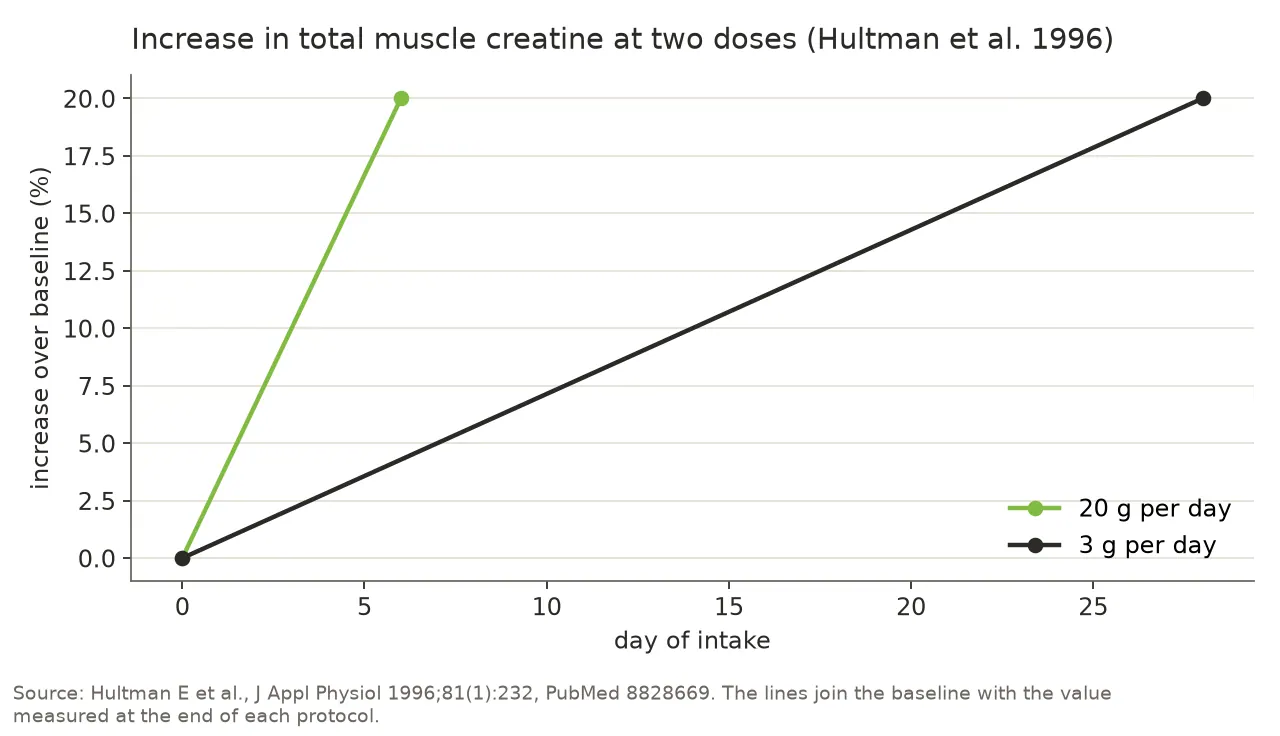
According to ISSN, muscle stores rise within 5 to 7 days when 5 g of monohydrate is taken four times a day, in total roughly 0.3 g/kg of body mass per day. Once the stores are saturated, 3 to 5 g per day maintains them. A 2021 review concludes that smaller daily doses of 3 to 5 g, or 0.1 g/kg of body mass, are effective, and that a loading phase is therefore not necessary.[1][5]
| Protocol | Dose | Time to a roughly 20 % increase in stores | Subsequent dose |
|---|---|---|---|
| With loading phase | 20 g per day (4 × 5 g) | 5 to 7 days | 3 to 5 g per day |
| Without loading phase | 3 g per day | roughly 28 days | 3 g per day |
According to ISSN, larger athletes need 5 to 10 g per day to maintain their stores instead of 3 to 5 g. These differences explain why studies state dosing per kilogram of body mass (0.1 g/kg per day) rather than one dose for everyone.[1][5]
Creatine is commonly combined with protein products and with carbohydrates. According to ISSN, taking creatine with carbohydrates or with carbohydrates and protein more consistently promotes its retention in muscle, although the effect on performance may not be greater than with creatine monohydrate alone.[1]
Women, adults over 55 and memory
According to one 2021 review, women have lower endogenous creatine stores than men; the authors give a figure of 70 to 80 %. In premenopausal women, creatine intake appears to be effective for improving strength and exercise performance. The general recommendation of 0.1 g/kg of body mass per day is given without distinction by sex.[9][5]
In adults over 55 the effect is tied to the combination with regular resistance training. This is the only age group for which the EU authorises a claim on muscle strength.[3]
A 2023 meta-analysis that included 8 randomised trials found a small improvement in memory after creatine intake compared with placebo (standardised mean difference 0.29). A significant improvement appeared in older adults aged 66 to 76 years, but not in younger people aged 11 to 31 years. A 2024 meta-analysis of 16 randomised trials with 492 participants rates the certainty of the evidence as moderate for memory. For processing speed, overall cognitive function, executive function and attention it rates the certainty as low. The evidence for an effect on the brain is therefore weaker than for physical performance. The EU authorises no health claim for creatine on cognitive function.[10][11][2][3]
Safety: kidneys, water retention, hair, children
According to the ISSN position stand, both short-term and long-term creatine intake (up to 30 g per day for 5 years) is safe and well tolerated in healthy individuals. The lead author of the position stand reports industry grants for creatine research and advisory work for Nutrabolt, and support for preparing the position stand was provided by the Council for Responsible Nutrition. A 2021 review reports that in healthy individuals no adverse effects on kidney function are observed at the recommended doses. The first author of that review heads ISSN, which receives support from manufacturers and sellers of creatine, and another author receives industry grants and creatine for studies. According to the same review, case reports of impaired kidney function during creatine intake were confounded by, among other things, medications, pre-existing kidney disease and inappropriate doses. In kidney disease the decision on use rests with a doctor.[1][5]
Water retention: in the short term creatine intake increases the volume of water inside cells. In the long term, several studies found no change in total body water relative to muscle mass. According to the same review, creatine does not cause dehydration or muscle cramps and does not increase fat mass. In children and adolescents intake appears to be generally safe, but there are fewer studies than in adults.[5]
The question of hair loss stems from a small hormone study from 2009 in 20 rugby players. After 7 days of taking 25 g per day, the level of dihydrotestosterone (DHT) rose by 56 %. After 14 days of a maintenance dose it remained 40 % above baseline, and the testosterone level did not change. That study did not measure hair itself. The first study to assess the condition of hair follicles directly after creatine intake was a randomised trial from 2025. In it, 45 resistance-trained men aged 18 to 40 took 5 g of creatine monohydrate per day or a placebo for 12 weeks, and 38 of them completed it. No significant difference was found between the groups in DHT level, in the ratio of DHT to testosterone, or in hair density, follicular unit count and hair thickness. It is a single small study lasting 12 weeks. According to the 2021 review, the DHT increase from the 2009 study has not been replicated, and according to that review most of the available evidence does not support a link between creatine and hair loss.[12][13][5]
| Question | State of the evidence |
|---|---|
| Kidney damage in healthy individuals | not observed at recommended doses |
| Water retention | yes in the short term (inside cells), no change relative to muscle mass in the long term |
| Hair loss | the 2009 study measured hormones only; in one small 2025 randomised trial (38 men, 12 weeks) no difference from placebo in DHT or in hair; most evidence does not support a link |
| Dehydration and cramps | not confirmed |
| Increase in fat mass | not confirmed |
Related products
Browse the products in the category: Creatine.
Sources
- Kreider RB, Kalman DS, Antonio J et al. (2017). International Society of Sports Nutrition position stand: safety and efficacy of creatine supplementation in exercise, sport, and medicine. J Int Soc Sports Nutr 14:18. https://doi.org/10.1186/s12970-017-0173-z
- European Commission. EU Register on nutrition and health claims (Regulation (EU) No 432/2012, as amended). Food and Feed Information Portal. https://ec.europa.eu/food/food-feed-portal/backend/claims/files/euregister.pdf
- European Commission (2017). Commission Implementing Regulation (EU) 2017/672 of 7 April 2017 authorising a health claim made on foods, other than those referring to the reduction of disease risk and to children's development and health and amending Regulation (EU) No 432/2012. Official Journal of the European Union L 97, 8.4.2017, p. 24. https://eur-lex.europa.eu/legal-content/EN/TXT/?uri=CELEX:32017R0672
- Balsom PD, Söderlund K, Ekblom B (1994). Creatine in humans with special reference to creatine supplementation. Sports Med 18(4):268. https://pubmed.ncbi.nlm.nih.gov/7817065/
- Antonio J, Candow DG, Forbes SC et al. (2021). Common questions and misconceptions about creatine supplementation: what does the scientific evidence really show? J Int Soc Sports Nutr 18:13. https://doi.org/10.1186/s12970-021-00412-w
- European Commission (2012). Commission Regulation (EU) No 432/2012 of 16 May 2012 establishing a list of permitted health claims made on foods, other than those referring to the reduction of disease risk and to children’s development and health (consolidated version of 20 August 2025), Annex, entries Creatine. Official Journal of the European Union L 136. https://eur-lex.europa.eu/legal-content/EN/TXT/?uri=CELEX:02012R0432-20250820
- EFSA NDA Panel (2016). Creatine in combination with resistance training and improvement in muscle strength: evaluation of a health claim pursuant to Article 13(5). EFSA Journal 14(2):4400. https://doi.org/10.2903/j.efsa.2016.4400
- Hultman E, Söderlund K, Timmons JA, Cederblad G, Greenhaff PL (1996). Muscle creatine loading in men. J Appl Physiol 81(1):232. https://pubmed.ncbi.nlm.nih.gov/8828669/
- Smith-Ryan AE, Cabre HE, Eckerson JM, Candow DG (2021). Creatine Supplementation in Women's Health: A Lifespan Perspective. Nutrients 13(3):877. https://doi.org/10.3390/nu13030877
- Prokopidis K, Giannos P, Triantafyllidis KK, Kechagias KS, Forbes SC, Candow DG (2023). Effects of creatine supplementation on memory in healthy individuals: a systematic review and meta-analysis of randomized controlled trials. Nutr Rev 81(4):416. https://doi.org/10.1093/nutrit/nuac064
- Xu C, Bi S, Zhang W, Luo L (2024). The effects of creatine supplementation on cognitive function in adults: a systematic review and meta-analysis. Front Nutr 11:1424972. https://doi.org/10.3389/fnut.2024.1424972
- van der Merwe J, Brooks NE, Myburgh KH (2009). Three weeks of creatine monohydrate supplementation affects dihydrotestosterone to testosterone ratio in college-aged rugby players. Clin J Sport Med 19(5):399. https://pubmed.ncbi.nlm.nih.gov/19741313/
- Lak M, Forbes SC, Ashtary-Larky D et al. (2025). Does creatine cause hair loss? A 12-week randomized controlled trial. J Int Soc Sports Nutr 22(Suppl 1):2495229. https://doi.org/10.1080/15502783.2025.2495229