
Electrolytes are mineral substances that dissociate in water into ions carrying an electric charge. In the human body the principal ones are sodium, potassium, magnesium, calcium and chloride. Potassium is the predominant osmotically active element inside cells. It takes part in the distribution of water in the body, in the regulation of acid-base balance and in the generation of the membrane potential of nerve and muscle cells. Sodium has the same role in the fluid outside cells.[1]
At a glance
- Potassium is the predominant osmotically active element inside cells and takes part in the distribution of water in the body and in the regulation of acid-base balance.
- In athletes the volume of sweat under exertion typically ranges from 0.5 to 2 litres per hour, with an estimated content of roughly 10 to 70 mmol of sodium per litre.
- EFSA has set 2.0 g of sodium per day as the safe and adequate intake for adults and an adequate intake of 3,500 mg per day for potassium.
- According to the FoodData Central database, 100 g of raw spinach contains 558 mg of potassium and banana 358 mg.
- According to ACSM, drinks with electrolytes and carbohydrates can under certain circumstances offer an advantage over water alone during exercise.
The body loses electrolytes in sweat, urine and stool. An electrolyte drink or electrolyte powder is a food that replaces these losses with water, sodium and, in some cases, carbohydrates.
Sodium, potassium, magnesium and calcium in the body
Potassium is found mainly inside cells. The EU register lists authorised claims for potassium: it contributes to normal muscle function, to normal functioning of the nervous system and to the maintenance of normal blood pressure. The claims apply when the food is at least a source of potassium.[2]
For magnesium the EU register lists authorised claims that it contributes to electrolyte balance, to a reduction of tiredness and fatigue and to normal muscle function. Calcium has, among others, authorised claims that it contributes to normal muscle function and to normal neurotransmission. For sodium as a nutrient the EU register contains no claim of a benefit. For foods low or reduced in sodium it authorises the claim “Reducing consumption of sodium contributes to the maintenance of normal blood pressure”.[2][3]
According to EFSA, potassium deficiency (hypokalaemia) usually arises from increased losses, for example in diarrhoea, vomiting or excessive renal losses. Hypokalaemia caused solely by a low dietary intake is rare.[1]
Sodium and potassium losses in sweat
Sweat is the main route of sodium loss during physical exertion. A 2017 review, which also draws on the testing of roughly 500 athletes, reports that whole-body sweating rates in athletes typically range from 0.5 to 2.0 litres per hour. Sweat sodium concentration measured locally ranges from roughly 10 to 90 mmol/l. The whole-body value is estimated at roughly 10 to 70 mmol/l. The author of the review is employed by the Gatorade Sports Science Institute, a division of PepsiCo, and the journal supplement in which the review appeared was supported by that institute. Potassium in sweat has a concentration similar to that of blood plasma, roughly 2 to 8 mmol/l.[4]
It follows from these ranges that the hourly sodium loss of two people under the same load can differ several-fold. The American College of Sports Medicine (ACSM) therefore recommends an individually adjusted fluid intake. The aim of drinking during exercise is to prevent a loss of more than 2 % of body mass from water and excessive changes in electrolyte balance. An individual sweating rate can be estimated by weighing before and after exertion.[5]
According to ACSM, drinks with electrolytes and carbohydrates can under certain circumstances offer an advantage over water alone during exercise. After exercise the goal is to replace any fluid and electrolyte deficit.[5]
EFSA reference values for adults, children and pregnancy
EFSA has set 2.0 g per day as the safe and adequate intake of sodium for adults. The same value applies to pregnant and lactating women. EFSA did not set an upper intake level for sodium because of insufficient data. It derived the value of 2.0 g per day from the risk of cardiovascular disease and from the maintenance of sodium balance. For potassium the adequate intake (AI) is 3,500 mg per day for adult men and women alike, and the same value applies in pregnancy. For calcium the population reference intake (PRI) is 950 mg per day for adults from 25 years of age.[6][1]
| Electrolyte | EFSA value | Type of value |
|---|---|---|
| Sodium | 2.0 g per day | safe and adequate intake (2019) |
| Potassium | 3,500 mg per day | adequate intake, AI (2016) |
| Magnesium | 350 mg (men), 300 mg (women) per day | adequate intake, AI (2015) |
| Calcium | 950 mg per day (from 25 years) | population reference intake, PRI (2015) |
According to EFSA, the sodium value allows most of the general adult population to maintain sodium balance. The sodium lost in sweat varies widely with environmental conditions and the level of physical activity. By calculation, one hour of intense sweating with a volume of 1 litre and a sodium concentration of 50 mmol/l removes roughly 1.15 g of sodium from the body. That is more than half of the EFSA daily value.[6][4]
EFSA derived the safe and adequate sodium intakes for children from the adult value. They are 1.1 g per day at 1 to 3 years, 1.3 g at 4 to 6 years, 1.7 g at 7 to 10 years and 2.0 g at 11 to 17 years. For magnesium the AI is 170 mg per day at 1 to 3 years, 230 mg at 3 to 10 years, and 300 mg for boys and 250 mg for girls at 10 to 18 years.[6][7]
Manufacturers state on the label whether a product is intended for children and for pregnant and lactating women. The decision on use in these groups rests with a doctor or pharmacist.
Electrolyte drinks and powders under Regulation 432/2012
The term electrolyte drink, also sold as an isotonic or sports drink, has no legal definition. Regulation (EU) No 432/2012 does, however, define carbohydrate-electrolyte solutions. These may carry two authorised claims: that they contribute to the maintenance of endurance performance during prolonged endurance exercise and that they enhance the absorption of water during physical exercise. The conditions are an energy content of 80 to 350 kcal per litre from carbohydrates. At least 75 % of that energy must come from carbohydrates that induce a high glycaemic response, such as glucose, glucose polymers and sucrose. The drink must further contain 20 to 50 mmol of sodium per litre (460 to 1,150 mg/l) and have an osmolality of 200 to 330 mOsm/kg of water.[2]
An electrolyte powder is a concentrate intended to be mixed with water. It differs from a ready-made drink in one respect. The manufacturer sets the sodium, potassium and magnesium content of one serving, and the consumer sets the amount of water. The resulting concentration is therefore calculated from the serving and the volume of water. Powders without carbohydrates do not meet the condition of 80 to 350 kcal per litre, so the claims for carbohydrate-electrolyte solutions cannot be made on them.[2]
- Sodium per serving and the recommended volume of water (resulting concentration in mg/l).[2]
- Carbohydrates and energy per litre of prepared drink.[2]
- Potassium and magnesium per serving compared with the EFSA daily values (3,500 mg and 300 to 350 mg).[1][7]
- Osmolality, if stated by the manufacturer; for carbohydrate-electrolyte solutions the range is 200 to 330 mOsm/kg.[2]
WHO oral rehydration solution and home solution
The oral rehydration salts (ORS) solution of WHO and UNICEF is intended to replace the water and salts lost in diarrhoea and contains 75 mmol of sodium and 75 mmol of glucose per litre. When glucose is absorbed in the small intestine, sodium and water are absorbed along with it. A carbohydrate-electrolyte drink under Regulation 432/2012 contains less sodium and more energy. The ORS solution also contains potassium, because diarrhoea leads to increased potassium losses. The conversion from mmol to mg uses a molar mass of 23 g/mol for sodium and 39.1 g/mol for potassium.[8][1][2]
| Drink (500 ml) | Sodium | Potassium | Energy from carbohydrates |
|---|---|---|---|
| Carbohydrate-electrolyte solution, lower limit | 230 mg (10 mmol) | not specified | 40 kcal |
| Carbohydrate-electrolyte solution, upper limit | 575 mg (25 mmol) | not specified | 175 kcal |
| WHO ORS | 863 mg (37.5 mmol) | 391 mg (10 mmol) | roughly 27 kcal (6.75 g of glucose, calculated at 4 kcal/g) |
For magnesium, Regulation 432/2012 specifies no amount in carbohydrate-electrolyte solutions, and the WHO ORS solution contains no magnesium.[2][8]
The WHO manual for physicians on diarrhoea describes a home solution of 3 g of table salt (one level teaspoon) and 18 g of sugar (sucrose) per litre of water. According to the same manual the solution is effective but is not generally recommended, because the recipe is often forgotten, the ingredients may not be available or too little is given.[8]
- 1 litre of drinking water
- 3 g of table salt, which corresponds to one level teaspoon[8]
- 18 g of sugar (sucrose)[8]
By calculation, the home solution of sugar and salt contains roughly 1.2 g of sodium per litre, slightly above the upper limit for carbohydrate-electrolyte solutions (1,150 mg/l) and less than ORS (1,725 mg/l). By calculation at 4 kcal/g, 18 g of sucrose corresponds to roughly 72 kcal per litre, less than the 80 kcal/l that Regulation 432/2012 requires for these solutions. The home solution contains neither potassium nor magnesium.[8][2]
Potassium and sodium in foods
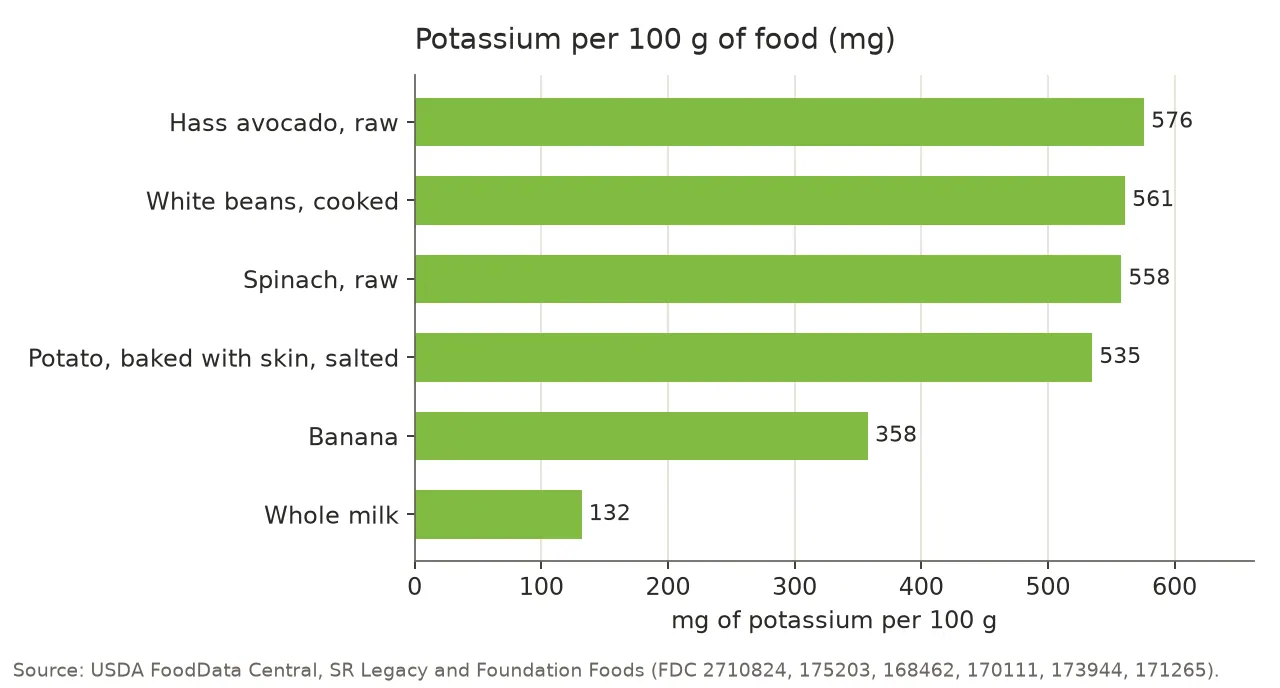
Potassium is present in all natural foods, notably in starchy tubers, vegetables, fruit, whole grains and dairy products. According to the FoodData Central database of the United States Department of Agriculture (USDA), 100 g of raw spinach contains 558 mg of potassium and a baked salted potato with skin 535 mg. Hass avocado contains 576 mg, cooked white beans 561 mg, banana 358 mg and whole milk 132 mg. Banana, raw spinach and milk contain little sodium: banana 1 mg, spinach 79 mg and milk 43 mg per 100 g.[1][9]
According to 13 dietary surveys from nine EU countries, average potassium intake in adults ranged from 2,463 to 3,991 mg per day, and in part of the surveys it was therefore below the AI of 3,500 mg.[1]
Related products
Browse the products in the category: Electrolytes.
Sources
- EFSA (2017). Dietary Reference Values for nutrients: Summary report. EFSA Supporting Publication 2017:e15121. https://www.efsa.europa.eu/sites/default/files/2017_09_DRVs_summary_report.pdf
- European Commission. EU Register on nutrition and health claims (Regulation (EU) No 432/2012, as amended). Food and Feed Information Portal. https://ec.europa.eu/food/food-feed-portal/backend/claims/files/euregister.pdf
- European Commission (2012). Commission Regulation (EU) No 432/2012 of 16 May 2012 establishing a list of permitted health claims made on foods, other than those referring to the reduction of disease risk and to children’s development and health (consolidated version of 20 August 2025), Annex, entry Foods with a low or reduced content of sodium. Official Journal of the European Union L 136. https://eur-lex.europa.eu/legal-content/EN/TXT/?uri=CELEX:02012R0432-20250820
- Baker LB (2017). Sweating Rate and Sweat Sodium Concentration in Athletes: A Review of Methodology and Intra/Interindividual Variability. Sports Medicine 47(Suppl 1):111. https://doi.org/10.1007/s40279-017-0691-5
- Sawka MN et al. (American College of Sports Medicine) (2007). ACSM position stand: Exercise and fluid replacement. Med Sci Sports Exerc 39(2):377. https://pubmed.ncbi.nlm.nih.gov/17277604/
- EFSA NDA Panel (2019). Dietary reference values for sodium. EFSA Journal 17(9):5778. https://doi.org/10.2903/j.efsa.2019.5778
- EFSA NDA Panel (2015). Scientific Opinion on Dietary Reference Values for magnesium. EFSA Journal 13(7):4186. https://doi.org/10.2903/j.efsa.2015.4186
- World Health Organization (2005). The treatment of diarrhoea: a manual for physicians and other senior health workers (4th rev.). WHO, Geneva. https://iris.who.int/server/api/core/bitstreams/df59ceab-2498-4a64-bd93-ad7566addb4e/content
- U.S. Department of Agriculture. FoodData Central: Bananas raw (173944); Potatoes baked flesh and skin, with salt (170111); Spinach raw (168462); Avocado Hass raw (2710824); Beans white cooked (175203); Milk whole (171265). USDA Agricultural Research Service. https://fdc.nal.usda.gov/