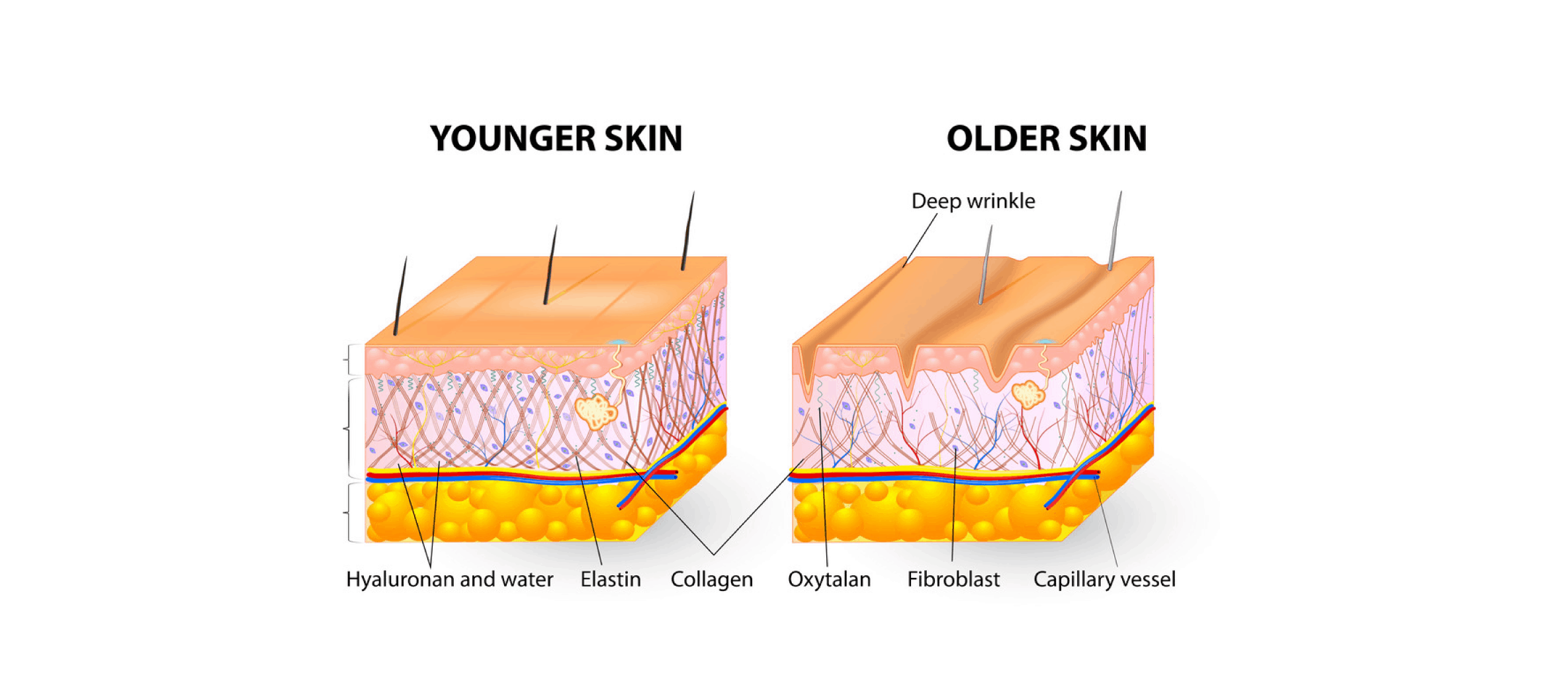
Collagen is the structural protein of connective tissues and is more abundant in mammals than any other protein. The collagen family has 28 members, each of which contains at least one triple-helical domain. Collagens play a structural role and determine the mechanical properties, organisation and shape of tissues. The phrase collagen for joints is used for food supplements containing collagen. In four of the five joint studies included in a 2021 systematic review, collagen peptides or collagen hydrolysate were given at 5 or 10 g per day, and in one, undenatured type II collagen at 40 mg per day.[1][2]
At a glance
- Collagen is the structural protein of connective tissues; reviews list only animal sources of raw material, for example bovine, porcine and fish.
- In four of the five joint studies in a 2021 systematic review, collagen peptides or collagen hydrolysate were given at 5 or 10 g per day.
- In the European Union no health claim is authorised for collagen or for collagen hydrolysate; the EU register lists the assessed claims about joints as non-authorised.
- The authors of the 2021 review consider the evidence on joint discomfort and joint function to be strong and add that further research is required; 13 of the 15 studies were commercially funded.
- In the 2021 review none of the 15 studies reported adverse effects, but no study lasted longer than 6 months.
In the European Union no health claim is authorised for collagen or for collagen hydrolysate; the EU register lists three assessed claims about joints as non-authorised.[3][4]
Molecular structure and collagen types I, II and III
Collagen consists of about 33 % of the amino acid glycine and 22 % of proline and hydroxyproline. The molecule has the shape of a triple helix of three alpha chains. Glycine, proline and hydroxyproline are the major components of body collagens, which make up 25 to 30 % of all proteins in the body.[5][6]
Type I predominates and makes up over 90 % of the collagen in the human body, because it occurs in almost all connective tissues. Type I is the main collagen of skin, bone, teeth, tendons and ligaments. Type II is found in cartilage. Type III is present in skin, muscle and blood vessels.[7][5]
| Type | Structure and share | Tissues |
|---|---|---|
| I | fibrillar, over 90 % of the collagen in the body | skin, bone, teeth, tendons, ligaments |
| II | fibrillar, main matrix molecule of cartilage | cartilage |
| III | fibrillar homotrimer of alpha1(III) chains | skin, muscle, blood vessels, ligaments, tendons |
Raw material: animal sources of collagen
The main source of native type I collagen is bovine raw material, owing to its availability and biocompatibility. Hydrolysed collagen can be obtained, for example, from bovine or porcine sources. Alternative sources are fish bones, skin and scales or fish processing by-products, and the skin of chickens, ducks and rabbits.[5]
A 2019 review notes limitations in obtaining collagen from bovine and porcine raw material related to diseases (BSE, swine flu) and to religious rules; it does not address the risk of finished products for consumers. Research therefore concentrates on marine sources such as fish and invertebrates (jellyfish, sponges). Collagen is a protein of the connective tissues of animals; reviews of sources list only animal raw material (bovine, porcine, fish, poultry, rabbit and marine invertebrates) and no plant source.[5][1]
Hydrolysed peptides and their absorption
Enzymatic hydrolysis produces a mixture of peptides weighing 3 to 6 kDa, a fraction of the weight of the original molecule of approximately 300 kDa. The triple-helical structure breaks down in the process. On labels it is also called collagen peptides or collagen hydrolysate; a 2021 review of studies uses both terms for the same kind of raw material.[5][2]
According to a 2021 review, native (non-hydrolysed) collagen may be poorly absorbed and may act through a different mechanism, oral induction, whereas hydrolysed collagen can reach the site where collagen synthesis takes place.[7]
In a 2005 study, volunteers took 9.4 to 23 g of gelatin hydrolysate. Before ingestion the peptide forms of hydroxyproline in the blood were negligible. After ingestion their level rose to 20 to 60 nmol/ml of plasma within 1 to 2 hours and fell by half at 4 hours.[8]
A 2007 study of five men compared gelatin hydrolysates from fish scales, fish skin and porcine skin. The area under the concentration curve was higher for fish scales than for porcine skin. Both the quantity and the structure of the peptides in the blood depend on the gelatin source.[9]
| Study | Subjects and dose | Finding |
|---|---|---|
| Iwai et al. 2005 | healthy volunteers, 9.4 to 23 g of gelatin hydrolysate (porcine skin, chicken feet, cartilage) | peak of 20 to 60 nmol/ml of plasma at 1 to 2 h, half at 4 h; main peptide Pro-Hyp |
| Ohara et al. 2007 | 5 men, hydrolysates from fish scales, fish skin and porcine skin | peptides approximately 30 % of the hydroxyproline detected; fish scales higher area under the curve than porcine skin |
These data show that after a single dose collagen peptides are measurable in the blood for several hours. The joint studies in the 2021 review gave collagen daily for 3 to 6 months.[8][2]
Health claims: none for collagen, six for vitamin C
The EU register of nutrition and health claims (PDF version of February 2013) contains no authorised health claim for collagen or for collagen hydrolysate. Entry 659, the claim that collagen can contribute to the maintenance of the healthy function of joints, is listed as non-authorised. So is entry 1513, the claim about collagen hydrolysate, the functioning of cartilage building cells and the renewal of joint cartilage. The basis is EFSA opinion 2011;9(6):2247: on the basis of the scientific evidence assessed, the claimed effect was not substantiated.[3]
A separate application under Article 13(5) concerned a characteristic collagen peptide mixture (collagen hydrolysate) and the maintenance of joint health in physically active people (question Q-2011-00201). It was refused by Commission Regulation (EU) No 379/2012 of 3 May 2012 with the same reasoning. The current list of authorised claims in Regulation (EU) No 432/2012 (consolidated version of 20 August 2025) contains the word collagen only in claims for vitamin C.[3][4]
The authorised claims that concern collagen belong to vitamin C. Regulation (EU) No 432/2012 contains six authorised claims for vitamin C on collagen formation, which differ by tissue: blood vessels, bones, cartilage, gums, skin and teeth (EFSA opinion 2009;7(9):1226); the table gives their full wording. The condition is that the food is at least a source of vitamin C. The claim is tied to vitamin C, not to the collagen in the product.[4]
| Entry | Substance | Claim | Status |
|---|---|---|---|
| 659 | collagen | can contribute to the maintenance of the healthy function of joints | non-authorised (EFSA 2011;9(6):2247) |
| 1513 | collagen hydrolysate | functioning of cartilage building cells, renewal of joint cartilage | non-authorised (EFSA 2011;9(6):2247) |
| Art. 13(5), Q-2011-00201 | characteristic collagen peptide mixture | maintenance of joint health in physically active people | non-authorised, Regulation (EU) No 379/2012 |
| 130, 131, 149 | vitamin C | Vitamin C contributes to normal collagen formation for the normal function of blood vessels | authorised, Regulation (EU) No 432/2012 |
| 131, 149 | vitamin C | Vitamin C contributes to normal collagen formation for the normal function of bones | authorised, Regulation (EU) No 432/2012 |
| 131, 149 | vitamin C | Vitamin C contributes to normal collagen formation for the normal function of cartilage | authorised, Regulation (EU) No 432/2012 |
| 131, 136, 149 | vitamin C | Vitamin C contributes to normal collagen formation for the normal function of gums | authorised, Regulation (EU) No 432/2012 |
| 131, 137, 149 | vitamin C | Vitamin C contributes to normal collagen formation for the normal function of skin | authorised, Regulation (EU) No 432/2012 |
| 131, 149 | vitamin C | Vitamin C contributes to normal collagen formation for the normal function of teeth | authorised, Regulation (EU) No 432/2012 |
Joints and skin: doses in studies and the state of the evidence
A 2021 systematic review included 15 studies; 8 of them gave collagen peptides or hydrolysate at 5 to 15 g per day. One study used 20 g per day, one 30 g, one 60 g and two gave gelatin at 5 g and 15 g per day. The remaining two studies used products at 40 mg and 3 g per day; the 40 mg product was undenatured type II collagen.[2]
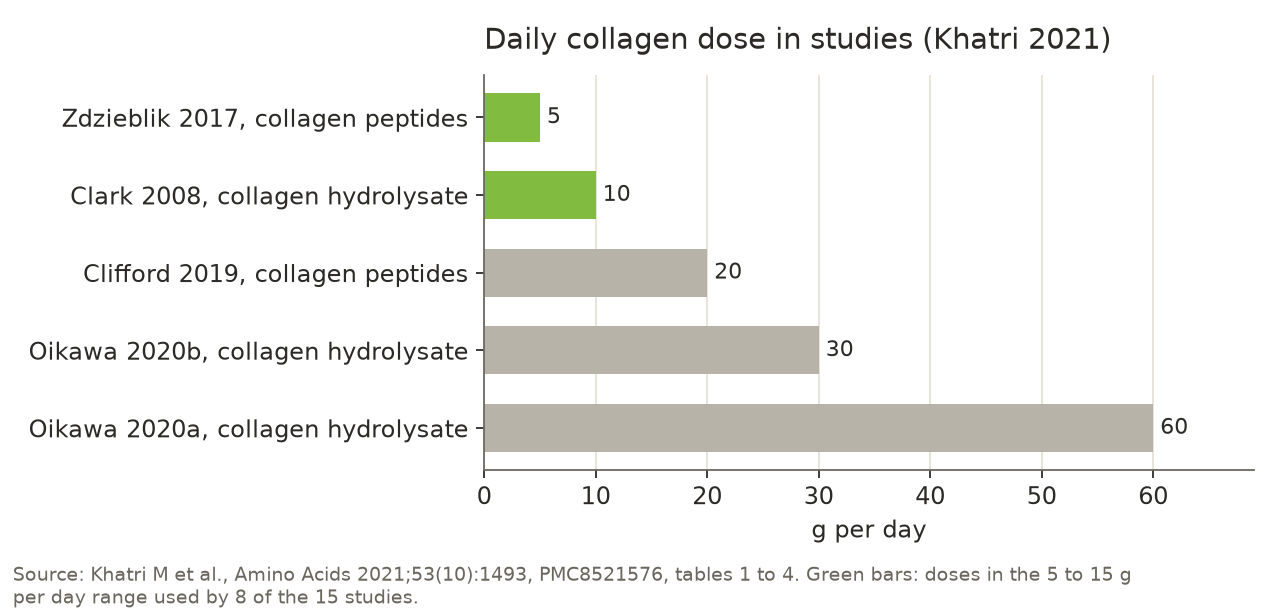
A 2008 study gave 97 athletes from university or club teams with activity-related pain in the joints 10 g of collagen hydrolysate per day for 24 weeks. A 2017 study gave 139 athletic participants 5 g of collagen peptides per day for 12 weeks alongside regular exercise of at least 3 hours per week. Knee pain decreased in both groups, more markedly in the collagen group (by 38.4 % against 27.9 % with placebo). The authors of the review consider the evidence for a dose of 5 to 15 g per day in the area of joint discomfort and joint function to be strong. They add that further research is required. They also state that 13 of the 15 studies were commercially funded, which raises the possibility of publication bias.[2]
According to the summary of the review, the rate of collagen synthesis increased at 15 g per day, and compared with the same amount of nitrogen from higher-quality protein, collagen had no significant effect on muscle protein synthesis. These were small studies, for example with 10 recreationally active men.[2]
A 2021 systematic review with meta-analysis selected 19 randomised trials with 1,125 participants aged 20 to 70 (95 % women). The pooled analysis showed favourable results for hydrolysed collagen compared with placebo for skin hydration, elasticity and wrinkles. This is the result of a meta-analysis, not an authorised claim.[10][3][4]
Collagen as a dietary protein
Under the PDCAAS protein quality assessment, collagen lacks one indispensable amino acid, tryptophan, and is therefore categorised as an incomplete protein source. A 2019 model calculation for the protein mix of a typical American diet showed that collagen peptides can make up to 36 % of daily protein intake without the intake of indispensable amino acids falling below requirements. According to the conflict of interest statement, one of the authors provides research services to a manufacturer of food supplements with collagen peptides. The other two authors are from GELITA AG and the Collagen Research Institute and declared no conflict of interest. EFSA has set a population reference intake of protein for adults of 0.83 g per kg of body weight per day. The average requirement is 0.66 g/kg. A 10 g dose of collagen corresponds at a body weight of 70 kg to approximately 17 % of the reference protein intake (calculation: 70 × 0.83 = 58 g). The protein requirement of 0.83 g/kg can also be met from other protein sources.[6][11][2]
Safety, allergies and choosing a product
In the 2021 systematic review none of the 15 studies reported adverse effects, even at a dose of 60 g per day or with other forms of the product, and the authors describe the use of collagen as safe. However, no study in the review lasted longer than 6 months. A 2021 review of clinical studies notes allergic reactions: people with a shellfish allergy may experience anaphylaxis after marine collagen.[2][7]
- Form: hydrolysed collagen (collagen peptides) with a molecular weight of 3 to 6 kDa; native collagen may be poorly absorbed.[5][7]
- Origin of the raw material: bovine, porcine, fish or poultry; this matters for allergies and for dietary restrictions.[5][7]
- Collagen content per daily serving in the range of 5 to 15 g used by 8 of the 15 studies in the 2021 review.[2]
- Vitamin C in the product, if the product is to carry the authorised claim about collagen formation; the claim belongs to vitamin C, and the food must be at least a source of vitamin C.[4]
Related products
Browse the products in the category: Collagen.
Sources
- Ricard-Blum S (2011). The collagen family. Cold Spring Harb Perspect Biol 3(1):a004978. https://doi.org/10.1101/cshperspect.a004978
- Khatri M, Naughton RJ, Clifford T, Harper LD, Corr L (2021). The effects of collagen peptide supplementation on body composition, collagen synthesis, and recovery from joint injury and exercise: a systematic review. Amino Acids 53(10):1493. https://doi.org/10.1007/s00726-021-03072-x
- European Commission (2013). EU Register on nutrition and health claims (PDF generated 14 February 2013; entries 659, 1513, Q-2011-00201 and vitamin C). Food and Feed Information Portal. https://ec.europa.eu/food/food-feed-portal/backend/claims/files/euregister.pdf
- European Commission (2012). Commission Regulation (EU) No 432/2012 of 16 May 2012 establishing a list of permitted health claims made on foods, other than those referring to the reduction of disease risk and to children’s development and health (consolidated version of 20 August 2025), Annex, entries Vitamin C (collagen formation). Official Journal of the European Union L 136. https://eur-lex.europa.eu/legal-content/EN/TXT/?uri=CELEX:02012R0432-20250820
- León-López A, Morales-Peñaloza A, Martínez-Juárez VM, Vargas-Torres A, Zeugolis DI, Aguirre-Álvarez G (2019). Hydrolyzed Collagen: Sources and Applications. Molecules 24(22):4031. https://doi.org/10.3390/molecules24224031
- Paul C, Leser S, Oesser S (2019). Significant Amounts of Functional Collagen Peptides Can Be Incorporated in the Diet While Maintaining Indispensable Amino Acid Balance. Nutrients 11(5):1079. https://doi.org/10.3390/nu11051079
- Wang H (2021). A Review of the Effects of Collagen Treatment in Clinical Studies. Polymers 13(22):3868. https://doi.org/10.3390/polym13223868
- Iwai K, Hasegawa T, Taguchi Y et al. (2005). Identification of food-derived collagen peptides in human blood after oral ingestion of gelatin hydrolysates. J Agric Food Chem 53(16):6531. https://doi.org/10.1021/jf050206p
- Ohara H, Matsumoto H, Ito K, Iwai K, Sato K (2007). Comparison of quantity and structures of hydroxyproline-containing peptides in human blood after oral ingestion of gelatin hydrolysates from different sources. J Agric Food Chem 55(4):1532. https://doi.org/10.1021/jf062834s
- de Miranda RB, Weimer P, Rossi RC (2021). Effects of hydrolyzed collagen supplementation on skin aging: a systematic review and meta-analysis. Int J Dermatol 60(12):1449. https://doi.org/10.1111/ijd.15518
- EFSA (2017). Dietary Reference Values for nutrients: Summary report. EFSA Supporting Publication 2017:e15121. https://www.efsa.europa.eu/sites/default/files/2017_09_DRVs_summary_report.pdf