
Magnesium is a mineral and a divalent cation which acts as a cofactor of more than 300 enzymatic reactions, especially reactions involving adenosine triphosphate (ATP). It is therefore essential for the synthesis of carbohydrates, lipids, nucleic acids and proteins. The chemical symbol is Mg. An adult weighing 70 kg has about 24 g of magnesium in the body. About 60 % of it is in bone and about 25 % in muscle.[1][2]
At a glance
- Magnesium is a mineral that acts as a cofactor of more than 300 enzymatic reactions, especially reactions involving adenosine triphosphate (ATP).
- EFSA has set the adequate intake of magnesium at 350 mg per day for men and 300 mg per day for women, and the same values apply in pregnancy and during lactation.
- According to EFSA, foods rich in magnesium are nuts, whole grains, fish and seafood, legumes and several kinds of vegetables.
- According to a 2021 systematic review, inorganic forms of magnesium appear to be less bioavailable than organic ones; according to a 2017 review, the differences tend to be small.
- For readily dissociable magnesium salts in food supplements an upper limit of 250 mg per day applies, which does not include the magnesium naturally present in foods.
The European Food Safety Authority (EFSA) has set the adequate intake of magnesium at 350 mg per day for men and 300 mg per day for women. For readily dissociable magnesium salts in food supplements the Scientific Committee on Food set an upper limit of 250 mg per day. It does not include the magnesium naturally present in foods.[3][4]
Adequate intake according to EFSA: children, adults, pregnancy and breastfeeding
In its 2015 opinion EFSA concluded that an average requirement and a population reference intake for magnesium cannot be derived. It therefore set an adequate intake (AI) on the basis of observed intakes in the healthy population of nine EU countries. Observed mean intakes of adults in the EU ranged from 264 to 439 mg per day in men. In women they ranged from 232 to 357 mg per day.[3][1]
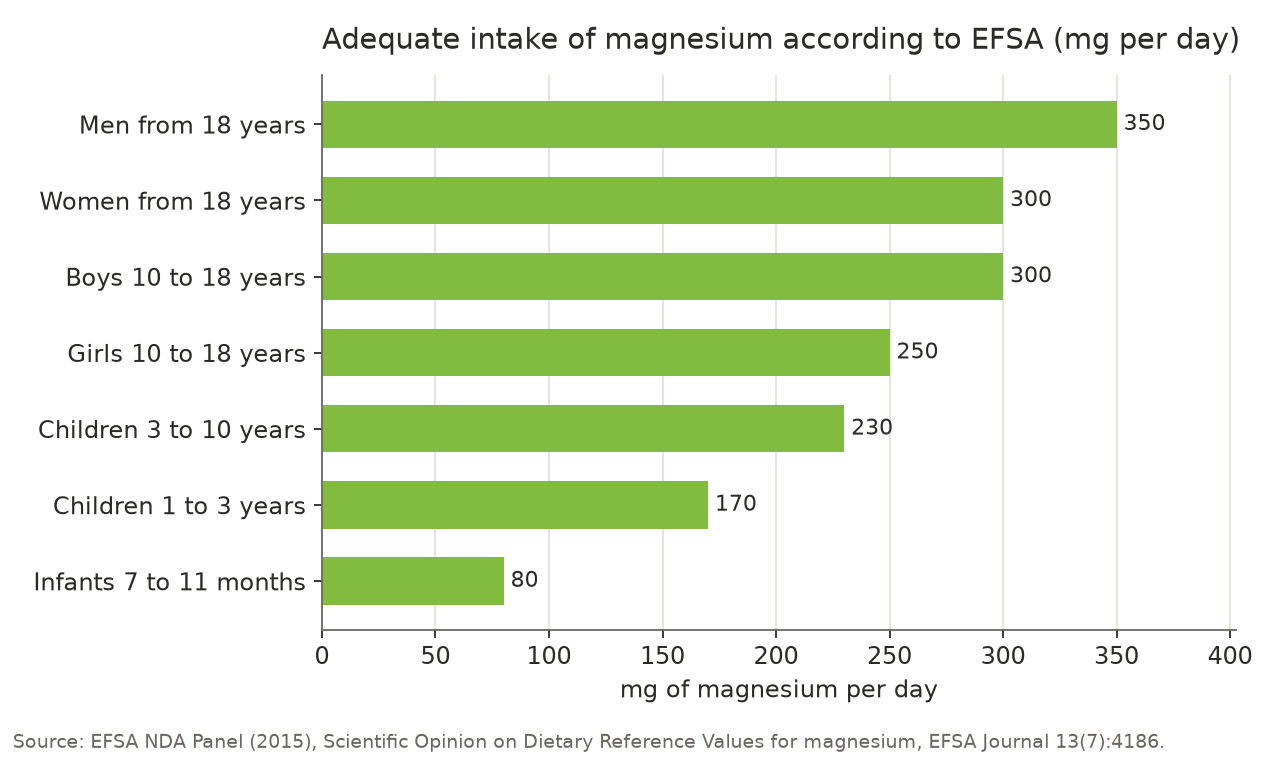
| Group | Adequate intake |
|---|---|
| Infants 7 to 11 months | 80 mg |
| Children 1 to 3 years | 170 mg |
| Children 3 to 10 years | 230 mg |
| Boys 10 to 18 years | 300 mg |
| Girls 10 to 18 years | 250 mg |
| Men from 18 years | 350 mg |
| Women from 18 years | 300 mg |
| Pregnant and lactating women | 300 mg (the same as other women) |
For pregnant and lactating women EFSA found no evidence of an increased requirement and set the same adequate intake as for other women. During the first six months, when breast milk is the only food, about 25 mg of magnesium per day is secreted in it. EFSA took into account that magnesium metabolism can adapt and did not set a higher intake.[3][1]
The 250 mg upper limit from supplements and the laxative effect
In 2001 the Scientific Committee on Food set a tolerable upper intake level (UL) of 250 mg of magnesium per day. It applies to readily dissociable magnesium salts, for example chloride, sulphate, aspartate and lactate. It also applies to compounds such as magnesium oxide in food supplements, in water or in fortified foods. This limit does not include the magnesium naturally present in foods and beverages.[4]
The basis is mild diarrhoea, the adverse effect which appears before any other. It occurred in a small percentage of adults at doses of about 360 to 365 mg per day. At doses up to 250 mg per day no laxative effect was observed, not even in pregnant and lactating women. The limit applies to adults, including pregnant and lactating women, and to children from 4 years. For children from 1 to 3 years data were lacking and no limit was set.[4]
For magnesium from plant and animal foods, neither diarrhoea nor other adverse effects have been shown in healthy persons. This is probably because it is bound in the food matrix and mostly dissociates poorly. According to the same opinion, a daily dose of a magnesium salt is better tolerated when it is divided into several portions. The dosage form may also play a part.[4]
A product is assessed by the content of elemental magnesium in one serving, not by the weight of the salt; the upper limit from supplements is 250 mg per day.[4]
Absorption and forms: oxide, citrate, bisglycinate, malate and taurate
Magnesium is absorbed in the distal part of the intestine, mostly in the ionised form. The absorbed fraction is generally given as 40 to 50 %, but published values range from 10 to 70 %. A 2017 review reports absorption of 30 to 50 % at a daily intake of 370 mg.[1][5]
The decisive factor is the dose: relative absorption is higher when magnesium is taken in several small doses over the day than in one large dose. According to the same review, the type of salt matters less than is often assumed. Absorption can be inhibited by phytic acid and phosphate and enhanced by the fermentation of soluble fibre. According to EFSA, the physiological relevance of these effects at adequate intakes has not yet been established. Other factors that lower it include high doses of other minerals, non-fermentable fibre and oxalate; proteins, medium-chain triglycerides, resistant starch, oligosaccharides and inulin raise it.[5][1]
Food supplements contain magnesium as inorganic compounds (oxide, chloride, sulphate, carbonate) or as organic salts and chelates. The organic group includes citrate, malate, lactate, taurate and bisglycinate, which belongs to the amino acid chelates. A 2021 systematic review of 14 studies concludes that inorganic forms appear to be less bioavailable than organic ones. The percentage absorbed depends on the dose. It also states that all magnesium supplements can maintain physiological levels in healthy people without a prior deficit. According to the authors, this is not assured in older people, in people with an illness or in people with previously low levels.[6]
A randomised, double-blind, placebo-controlled study from 2003 included 46 healthy participants. Over 60 days it compared 300 mg of elemental magnesium per day as an amino acid chelate, citrate or oxide with placebo. Taken together, the organic forms (citrate and amino acid chelate) showed greater absorption than the oxide after 60 days, assessed by 24-hour urinary excretion. The oxide group did not differ from placebo. The citrate group had a higher mean serum magnesium concentration than the other groups. The authors conclude that citrate had a higher bioavailability than the other preparations studied, including the chelate. A 1990 study found a higher bioavailability of citrate than of oxide, possibly because of its better solubility.[7][5]
The 2017 review points out that the differences tend to be small. In a 2017 study the difference in urinary excretion between citrate (7.2 mmol) and oxide (6.7 mmol) was statistically significant but marginal. Balance studies in humans found no significant differences between the various salts, including comparisons of organic with inorganic ones. This suggests that all types are suitable for maintaining or restoring magnesium status. The results of comparisons between organic and inorganic salts are inconsistent.[5]
| Form | Type of compound | Absorption data |
|---|---|---|
| Magnesium oxide | inorganic | lower absorption than citrate (1990, 2003); in the 2003 study no difference from placebo |
| Magnesium citrate | organic salt | higher absorption than oxide in the 1990 and 2003 studies; in 2003 a higher serum level than with the other forms; the difference from oxide in 2017 marginal |
| Magnesium bisglycinate | chelate with the amino acid glycine | no direct study of bisglycinate in the cited sources; in the 2003 study amino acid chelate and citrate together showed higher absorption than oxide, and citrate gave a higher serum level than the other forms |
| Magnesium malate | organic salt | no comparative absorption study in humans in the cited sources; whether the conclusion on organic forms applies was not examined directly |
| Magnesium taurate | organic salt | no comparative absorption study in humans in the cited sources; whether the conclusion on organic forms applies was not examined directly |
Stores in bone, deficiency and assessment of status
About 99 % of the total magnesium in the body is found in bone, muscle and soft tissue. In bone it is bound to the surface of the mineral hydroxyapatite. Only a small amount is in blood serum, mostly as the free cation, and the serum concentration is maintained primarily by the kidneys. Bone thus serves as a reserve which buffers short-term changes in the serum concentration.[2][1]
The 2017 EFSA summary states that magnesium deficiency can lead to lowered levels of calcium and potassium in the blood. In marked hypomagnesaemia it can lead to neurological or cardiac signs.[1]
According to a 2012 review, the manifestations of hypomagnesaemia can include tremor, agitation, muscle fasciculation, depressed mood, cardiac arrhythmia and a low potassium level. As the deficiency deepens, numbness, tingling, muscle contractions, cramps, seizures and changes in behaviour can follow. The clinical signs of deficiency and of excess often overlap and are non-specific.[2]
Deficiency can arise through increased excretion in diabetes, renal tubular disorders, hypercalcaemia, hyperthyroidism, aldosteronism or during the use of diuretics. A 2015 meta-analysis of nine observational studies with 109,798 patients found that the use of proton pump inhibitors was associated with a 1.43-fold higher risk of hypomagnesaemia. The 95 % confidence interval was 1.08 to 1.88; the finding is an association from observational studies.[2][8]
In practice, the serum magnesium concentration is used to assess status. EFSA, however, regards its value as an indicator of intake or status as questionable and states that no appropriate biomarker of magnesium status is yet available.[1]
The ten authorised magnesium claims in Regulation 432/2012
Regulation (EU) No 432/2012, in the consolidated version of 20 August 2025, lists ten authorised claims for magnesium. The condition of use is that the food is at least a source of magnesium within the meaning of Regulation (EC) No 1924/2006.[9]
| Claim or claimed effect | EFSA opinion | Status |
|---|---|---|
| Magnesium contributes to a reduction of tiredness and fatigue | 2010;8(10):1807 | authorised |
| Magnesium contributes to electrolyte balance | 2009;7(9):1216 | authorised |
| Magnesium contributes to normal energy-yielding metabolism | 2009;7(9):1216 | authorised |
| Magnesium contributes to normal functioning of the nervous system | 2009;7(9):1216 | authorised |
| Magnesium contributes to normal muscle function | 2009;7(9):1216, 2010;8(10):1807 | authorised |
| Magnesium contributes to normal protein synthesis | 2009;7(9):1216 | authorised |
| Magnesium contributes to normal psychological function | 2010;8(10):1807 | authorised |
| Magnesium contributes to the maintenance of normal bones | 2009;7(9):1216 | authorised |
| Magnesium contributes to the maintenance of normal teeth | 2009;7(9):1216 | authorised |
| Magnesium has a role in the process of cell division | 2009;7(9):1216 | authorised |
| maintenance of hormonal health | 2010;8(10):1807 | non-authorised, claimed effect not sufficiently defined to be assessed |
| increased requirement in pregnancy, normal blood pressure in pregnancy | 2010;8(10):1807 | non-authorised, effect not substantiated |
| maintenance of normal blood pressure | 2010;8(10):1807 | non-authorised, insufficient evidence |
| maintenance of normal blood glucose concentrations | 2010;8(10):1807 | non-authorised, effect not substantiated |
| normal function of the immune system | 2010;8(10):1807 | non-authorised, effect not substantiated |
| antioxidant properties, protection from oxidative damage | 2010;8(10):1807 | non-authorised, effect not substantiated |
| normal blood clotting | 2009;7(9):1216 | non-authorised, effect not substantiated |
None of the ten authorised claims concerns sleep, stress or sporting performance.[9]
Magnesium in nuts, seeds, cereals and water
According to EFSA, foods rich in magnesium are nuts, whole grains and whole-grain products, fish and seafood, several kinds of vegetables, legumes, berries and bananas. Some coffee and cocoa beverages also belong here; tap water or bottled water can make a significant contribution. In surveys in EU countries the main contributors to magnesium intake were grains and grain products, milk and dairy products, and coffee, cocoa, tea and infusions.[1]
| Food | Magnesium per 100 g |
|---|---|
| Pumpkin seeds, dried | 592 mg |
| Almonds, raw | 270 mg |
| Cashew nuts, roasted | 260 mg |
| Oats (grain) | 177 mg |
| Walnuts | 158 mg |
| Spinach, cooked | 87 mg |
| Kidney beans, cooked | 45 mg |
| Potato, baked with skin | 43 mg |
| Whole milk | 13 mg |
The adequate intake of 350 mg for men corresponds, for example, to 60 g of pumpkin seeds or 130 g of almonds. This is a calculation from the values in the table and from the EFSA AI.[3][11]
Interactions with iron and medicines, and the risk of hypermagnesaemia
According to the opinion of the Scientific Committee on Food, calcium does not inhibit magnesium absorption under physiological conditions. The claim of mutual inhibition was not confirmed in volunteers. The opinion reports clinically significant interactions between iron and magnesium, magnesium hydroxide or magnesium trisilicate. In a crossover study in 13 healthy men, the participants received 5 mg of iron per kilogram of body weight and one hour later 4.5 g of magnesium hydroxide per gram of iron. Iron absorption fell by 46 %, while a water-soluble magnesium salt did not interfere with iron gluconate. The opinion also mentions a possible effect on zinc absorption and interactions with medicines such as tetracycline, penicillin and digoxin.[4]
Toxic hypermagnesaemia has been described in only a small number of cases. Most followed single doses above 100 mmol (about 2,500 mg) of magnesium from laxatives or antacids. Symptomatic hypermagnesaemia can arise after excessive oral intake of magnesium salts or of medicines containing magnesium, such as some laxatives and antacids. As the kidneys play a key role in maintaining magnesium balance, hypermagnesaemia can develop in advanced chronic kidney disease. The risk with magnesium salts and magnesium-containing medicines rises in particular in older people with declining kidney function.[4][2]
| Substance or medicine | Relationship described |
|---|---|
| Calcium | does not inhibit magnesium absorption under physiological conditions |
| Iron | magnesium hydroxide at a high dose (4.5 g per gram of iron) reduced iron absorption by 46 % (13 men) |
| Zinc | possible reduction in absorption through suppression of gastric acid |
| Tetracycline, penicillin, digoxin | interactions listed in the opinion |
| Diuretics | increased excretion of magnesium |
| Proton pump inhibitors | associated with a 1.43-fold higher risk of hypomagnesaemia in a meta-analysis of observational studies |
Related products
Browse the products in the category: Magnesium.
Sources
- EFSA (2017). Dietary Reference Values for nutrients: Summary report. EFSA Supporting Publication 2017:e15121. https://www.efsa.europa.eu/sites/default/files/2017_09_DRVs_summary_report.pdf
- Jahnen-Dechent W, Ketteler M (2012). Magnesium basics. Clin Kidney J 5(Suppl 1):i3. https://doi.org/10.1093/ndtplus/sfr163
- EFSA NDA Panel (2015). Scientific Opinion on Dietary Reference Values for magnesium. EFSA Journal 13(7):4186. https://doi.org/10.2903/j.efsa.2015.4186
- Scientific Committee on Food / EFSA (2006). Tolerable upper intake levels for vitamins and minerals: Opinion on the tolerable upper intake level of magnesium (expressed 26 September 2001). EFSA, Parma. https://www.efsa.europa.eu/sites/default/files/efsa_rep/blobserver_assets/ndatolerableuil.pdf
- Schuchardt JP, Hahn A (2017). Intestinal Absorption and Factors Influencing Bioavailability of Magnesium: An Update. Curr Nutr Food Sci 13(4):260. https://doi.org/10.2174/1573401313666170427162740
- Pardo MR, Garicano Vilar E, San Mauro Martín I, Camina Martín MA (2021). Bioavailability of magnesium food supplements: A systematic review. Nutrition 89:111294. https://pubmed.ncbi.nlm.nih.gov/34111673/
- Walker AF, Marakis G, Christie S, Byng M (2003). Mg citrate found more bioavailable than other Mg preparations in a randomised, double-blind study. Magnes Res 16(3):183. https://pubmed.ncbi.nlm.nih.gov/14596323/
- Cheungpasitporn W, Thongprayoon C, Kittanamongkolchai W et al. (2015). Proton pump inhibitors linked to hypomagnesemia: a systematic review and meta-analysis of observational studies. Ren Fail 37(7):1237. https://pubmed.ncbi.nlm.nih.gov/26108134/
- European Commission (2012). Commission Regulation (EU) No 432/2012 of 16 May 2012 establishing a list of permitted health claims made on foods, other than those referring to the reduction of disease risk and to children’s development and health (consolidated version of 20 August 2025), Annex, entries Magnesium. Official Journal of the European Union L 136. https://eur-lex.europa.eu/legal-content/EN/TXT/?uri=CELEX:02012R0432-20250820
- European Commission (2013). EU Register on nutrition and health claims, snapshot generated 14 February 2013 (non-authorised claims). Food and Feed Information Portal. https://ec.europa.eu/food/food-feed-portal/backend/claims/files/euregister.pdf
- Rosique-Esteban N, Guasch-Ferré M, Hernández-Alonso P, Salas-Salvadó J (2018). Dietary Magnesium and Cardiovascular Disease: A Review with Emphasis in Epidemiological Studies. Nutrients 10(2):168. https://doi.org/10.3390/nu10020168