
Fibre is, under European Union law, the collective term for carbohydrate polymers with three or more monomeric units that are neither digested nor absorbed in the human small intestine. These polymers pass into the large intestine, where bacteria break them down to varying degrees: some types rapidly and completely, others, such as cellulose, only poorly. The main sources of fibre in the diet are whole grain cereals, pulses, fruit, vegetables and potatoes.[1][2][3][4]
At a glance
- Under European Union law, fibre is the collective term for carbohydrate polymers with three or more monomeric units that are neither digested nor absorbed in the small intestine.
- EFSA considers 25 g of fibre a day an adequate intake for adults; average intakes of adults in European countries were 16 to 29 g a day.
- The main sources of fibre in the diet are whole grain cereals, pulses, fruit, vegetables and potatoes.
- A 2018 meta-analysis of 64 studies found a higher faecal abundance of Bifidobacterium with fibre interventions, but no difference in alpha diversity.
- According to a 2015 review, an increase in fibre intake may be accompanied by cramping pain; the author describes introducing a fibre supplement at no more than 3 to 4 g a day in the first week.
Fibre in EU law: definition, chemical groups and energy value
Regulation (EU) No 1169/2011 on the provision of food information to consumers assigns three categories of carbohydrate polymers to fibre. The first are edible polymers naturally occurring in the food as consumed. The second are edible polymers obtained from food raw material by physical, enzymatic or chemical means. The third are edible synthetic polymers. For the second and third categories the regulation requires a beneficial physiological effect demonstrated by generally accepted scientific evidence.[1]
Annex XIV of the same regulation assigns fibre a conversion factor of 8 kJ, that is 2 kcal per gram, for the calculation of energy. For carbohydrate other than polyols and for protein it gives 17 kJ, that is 4 kcal per gram.[1]
The 2010 EFSA opinion defines dietary fibre as non-digestible carbohydrates plus lignin. This includes non-starch polysaccharides (cellulose, hemicelluloses, pectins and hydrocolloids, that is gums, mucilages and beta-glucans), resistant oligosaccharides such as fructo-oligosaccharides (FOS) and galacto-oligosaccharides (GOS), and resistant starch.[2]
Soluble and insoluble fibre: viscosity and gel formation
A 2015 review of fibre supplements describes four characteristics that according to the author determine their clinical effects: solubility, degree and rate of fermentation, viscosity and gel formation. According to the disclosure in the article, the author is an employee of Procter & Gamble, which markets a fibre product. Solubility determines whether a fibre supplement dissolves in water or remains as discrete insoluble particles. Most types of fibre are neither entirely soluble nor entirely insoluble.[3]
| Group | Examples | Properties |
|---|---|---|
| insoluble, poorly fermented | wheat bran | insoluble in water; only slightly broken down by bacteria |
| soluble, non-viscous, readily fermented | inulin, wheat dextrin, oligosaccharides, resistant starches | dissolves without an increase in viscosity, is fermented rapidly and completely, gas forms rapidly during fermentation |
| soluble, viscous, gel-forming, fermented | beta-glucans from oats and barley, raw guar gum | dissolves and forms a viscous gel, for example in oat porridge |
| soluble, viscous, gel-forming, non-fermented | psyllium | forms a viscous gel, is not fermented, produces no gas, the gel persists throughout the large intestine |
Viscosity also depends on processing. Hydrolysis turns guar gum into a non-viscous form that is sold as partially hydrolysed guar gum.[3]
Fibre in cereals, legumes, seeds and fruit, and the adequate intake of 25 g a day
The USDA FoodData Central database lists 10.1 g of fibre in 100 g of dry oats, from which oat porridge is prepared, and 17.3 g in 100 g of hulled barley (hull removed).[5]
Chia seeds contain 34.4 g of fibre and 17.8 g of alpha-linolenic acid, an omega-3 fatty acid. Almonds have 12.5 g and hazelnuts 9.7 g of fibre per 100 g. Raspberries also contain 26.2 mg of vitamin C per 100 g.[5]
| Food | Fibre (g per 100 g) | Share of 25 g |
|---|---|---|
| wheat bran, crude | 42.8 | 171 % |
| chia seeds, dried | 34.4 | 138 % |
| barley, hulled (hull removed) | 17.3 | 69 % |
| almonds | 12.5 | 50 % |
| chickpeas, raw | 12.2 | 49 % |
| lentils, raw | 10.7 | 43 % |
| oats, dry | 10.1 | 40 % |
| hazelnuts | 9.7 | 39 % |
| raspberries | 6.5 | 26 % |
| whole-wheat bread | 6.0 | 24 % |
| rye bread | 5.8 | 23 % |
| pears | 3.1 | 12 % |
| broccoli, raw | 2.6 | 10 % |
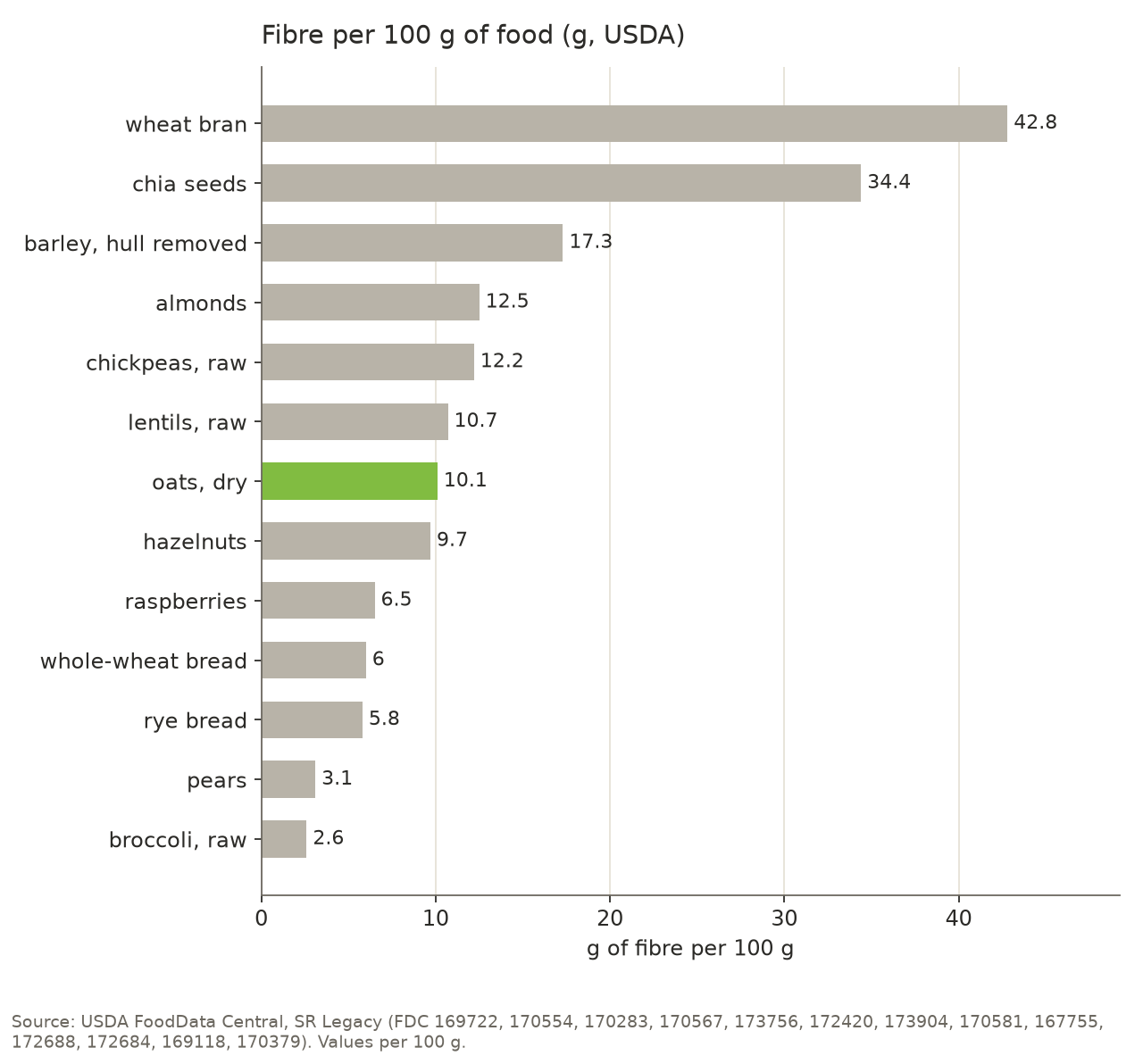
EFSA set an adequate intake (AI) for dietary fibre. It chose bowel function as the criterion and considers an intake of 25 g of fibre a day adequate for normal laxation in adults. For children from the age of one year it derived an adequate intake of 2 g of fibre per megajoule (MJ) of energy intake.[2]
According to dietary surveys, average fibre intakes in European countries were 16 to 29 g a day in adults and 15 to 30 g a day in adolescents. In children younger than 10 to 12 years they were 10 to 20 g a day. In adults this corresponded to 1.8 to 2.9 g per MJ.[2]
Fermentation of fibre in the large intestine and the gut microbiota
Fibre polysaccharides that humans do not digest are metabolised by gut microbes. This generates short-chain fatty acids (SCFA): acetate, propionate and butyrate. According to a 2017 review, butyrate is the key energy source for the cells lining the gut. Between 90 and 99 % of SCFA are absorbed in the gut or used by the microbiota. The acidic products of fermentation lower the pH in the large intestine, which affects the composition of the microbial communities.[4]
According to a 2017 review, bacteria break down soluble types such as short-chain FOS and pectin already in the terminal part of the small intestine (ileum) and in the ascending colon. Less soluble types such as cellulose can be partially fermented only in the distal colon. Insoluble types such as cellulose are poorly fermented by gut microbes, and their presence in the diet increases the rate of gut transit. Short-chain FOS is fermented within 4 hours, while chicory inulin, a long linear fructan, reaches peak fermentation 8 hours after a meal.[4]
The 2017 review gives the definition of prebiotics as selectively fermented ingredients that result in specific changes in the composition or activity of the gastrointestinal microbiota; the definition adds a benefit to the health of the host. The response of the microbiota depends on the dose. In the studies cited in the review, 2.5 g of short-chain FOS or GOS a day did not increase bifidobacteria, while 10 g a day did. Results on microbial metabolism were highly variable, and the same type of fibre changed SCFA concentrations depending on the population studied.[4]
A 2018 systematic review with meta-analysis included 64 studies with 2 099 healthy adults. Compared with placebo or a low-fibre diet, fibre interventions led to a higher faecal abundance of Bifidobacterium (standardised mean difference 0.64) and Lactobacillus (0.22). The higher faecal butyrate concentration (0.24; 95 % confidence interval 0.00 to 0.47; P = 0.05) was at the limit of statistical significance. No difference was found in alpha diversity, in the other bacteria examined or in the other SCFA. The authors state that the role of individual types of fibre requires further research.[6]
Gas and digestive complaints when fibre intake increases
A 2009 review evaluated 68 studies and six review articles. It reports that low-digestible carbohydrates may affect laxation and cause abdominal discomfort, flatus and diarrhoea, especially at higher or excessive intakes. These responses are transient. According to the authors, recommendations for fibre intake do not take into account the total intake of low-digestible carbohydrates and set no upper limit for it based on digestive effects.[7]
A 2024 review focused on children names the gases formed during fermentation, hydrogen, carbon dioxide and methane, as the cause of digestive discomfort.[8]
According to a 2015 review, an increase in fibre intake may be accompanied by sensations ranging from slight discomfort to cramping pain, particularly in constipation or when a fibre supplement is started at a relatively high dose. For people without constipation the author therefore describes introducing a fibre supplement gradually. The first week starts with no more than 3 to 4 g a day, followed by a slow increase over the following weeks towards a goal of about 10 to 15 g a day. In constipation, according to the author, introducing a new fibre supplement carries a significant risk of cramping pain unless the hard stool is eliminated first.[9]
Fibre labelling: nutrition claims and authorised EU health claims
The Annex to Regulation (EC) No 1924/2006 sets out two nutrition claims on fibre. The same conditions apply to any claim likely to have the same meaning for the consumer.[10]
| Claim | At least per 100 g | Or at least per 100 kcal |
|---|---|---|
| SOURCE OF FIBRE | 3 g | 1.5 g |
| HIGH FIBRE | 6 g | 3 g |
Dry oats, with 10.1 g of fibre and an energy value of 379 kcal per 100 g, contain 2.7 g of fibre per 100 kcal (calculation: 10.1 / 3.79), which is below the threshold of 3 g per 100 kcal. They do, however, exceed the threshold of 6 g per 100 g and so meet the high fibre condition through their content per 100 g.[5][10]
For cereal mixes such as granola and muesli, the fibre value is read from the nutrition declaration per 100 g and per portion and compared with the thresholds of 3 g and 6 g per 100 g.[10]
Regulation (EU) No 432/2012 ties the authorised health claims to a specific type of fibre and often to its origin, for example to oat grain fibre, rye fibre or chicory inulin. For individual types of fibre the register lists 20 authorised health claims; the table is a selection and gives 19 of them in the official English wording with their conditions of use. The register also contains a general claim on non-digestible carbohydrates used instead of sugars, which is not tied to a specific type of fibre and is not listed in the table.[11]
The claims on oat grain fibre, barley grain fibre, wheat bran fibre and rye fibre require a food that is high in that fibre. The regulation sets the same condition for sugar beet fibre.[11]
The claim on beta-glucans and cholesterol requires at least 1 g of beta-glucans from oats, oat bran, barley, barley bran or mixtures of these sources per quantified portion. The consumer must be informed that the beneficial effect is obtained with a daily intake of 3 g of beta-glucans. For pectins, glucomannan, guar gum and hydroxypropyl methylcellulose (HPMC) the regulation requires a warning of choking for people with swallowing difficulties or when ingesting with inadequate fluid intake. The warning includes advice on taking these substances with plenty of water to ensure that they reach the stomach.[11]
| Ingredient | Claim | Condition of use |
|---|---|---|
| beta-glucans from oats, oat bran, barley, barley bran | Beta-glucans contribute to the maintenance of normal blood cholesterol levels. | at least 1 g of beta-glucans per quantified portion; information on a daily intake of 3 g |
| beta-glucans from oats and barley | Consumption of beta-glucans from oats or barley as part of a meal contributes to the reduction of the blood glucose rise after that meal. | at least 4 g of beta-glucans for each 30 g of available carbohydrates in a quantified portion |
| oat grain fibre | Oat grain fibre contributes to an increase in faecal bulk. | food high in that fibre |
| barley grain fibre | Barley grain fibre contributes to an increase in faecal bulk. | food high in that fibre |
| wheat bran fibre | Wheat bran fibre contributes to an acceleration of intestinal transit. | food high in that fibre; information on a daily intake of at least 10 g of wheat bran fibre |
| wheat bran fibre | Wheat bran fibre contributes to an increase in faecal bulk. | food high in that fibre |
| rye fibre | Rye fibre contributes to normal bowel function. | food high in that fibre |
| sugar beet fibre | Sugar beet fibre contributes to an increase in faecal bulk. | food high in that fibre |
| arabinoxylan produced from wheat endosperm | Consumption of arabinoxylan as part of a meal contributes to a reduction of the blood glucose rise after that meal. | at least 8 g of arabinoxylan-rich fibre (at least 60 % AX by weight) per 100 g of available carbohydrates in a quantified portion |
| native chicory inulin | Chicory inulin contributes to normal bowel function by increasing stool frequency. | daily intake of at least 12 g of native chicory inulin |
| pectins | Pectins contribute to the maintenance of normal blood cholesterol levels. | daily intake of 6 g of pectins; warning of choking |
| pectins | Consumption of pectins with a meal contributes to the reduction of the blood glucose rise after that meal. | 10 g of pectins per quantified portion; warning of choking |
| glucomannan (konjac mannan) | Glucomannan contributes to the maintenance of normal blood cholesterol levels. | daily intake of 4 g of glucomannan; warning of choking |
| guar gum | Guar gum contributes to the maintenance of normal blood cholesterol levels. | daily intake of 10 g of guar gum; warning of choking |
| hydroxypropyl methylcellulose (HPMC) | Hydroxypropyl methylcellulose contributes to the maintenance of normal blood cholesterol levels. | daily intake of 5 g of HPMC; warning of choking |
| hydroxypropyl methylcellulose (HPMC) | Consumption of Hydroxypropyl methylcellulose with a meal contributes to a reduction in the blood glucose rise after that meal. | 4 g of HPMC per quantified portion as part of the meal; warning of choking |
| chitosan | Chitosan contributes to the maintenance of normal blood cholesterol levels. | daily intake of 3 g of chitosan |
| resistant starch | Replacing digestible starches with resistant starch in a meal contributes to a reduction in the blood glucose rise after that meal. | digestible starch replaced by resistant starch so that resistant starch is at least 14 % of total starch |
| alpha-cyclodextrin | Consumption of alpha-cyclodextrin as part of a starch-containing meal contributes to the reduction of the blood glucose rise after that meal. | at least 5 g of alpha-cyclodextrin per 50 g of starch in a quantified portion as part of the meal |
Related products
Browse the products in the category: Fibre.
Sources
- European Parliament and Council (2011). Regulation (EU) No 1169/2011 on the provision of food information to consumers, Annex I point 12 (fibre) and Annex XIV (conversion factors). Official Journal of the European Union L 304. https://eur-lex.europa.eu/legal-content/EN/TXT/?uri=CELEX:32011R1169
- EFSA (2017). Dietary Reference Values for nutrients: Summary report (chapter 3.2 Carbohydrates and dietary fibre, summary of the opinion EFSA Journal 2010;8(3):1462). EFSA Supporting Publication 2017:e15121. https://www.efsa.europa.eu/sites/default/files/2017_09_DRVs_summary_report.pdf
- McRorie JW (2015). Evidence-Based Approach to Fiber Supplements and Clinically Meaningful Health Benefits, Part 1: What to Look for and How to Recommend an Effective Fiber Therapy. Nutr Today 50(2):82. https://doi.org/10.1097/NT.0000000000000082
- Holscher HD (2017). Dietary fiber and prebiotics and the gastrointestinal microbiota. Gut Microbes 8(2):172. https://doi.org/10.1080/19490976.2017.1290756
- U.S. Department of Agriculture (2019). FoodData Central, SR Legacy: Oats regular and quick, dry (173904); Barley hulled (170283); Bread rye (172684); Bread whole-wheat (172688); Wheat bran crude (169722); Lentils raw (172420); Chickpeas mature seeds raw (173756); Chia seeds dried (170554); Almonds (170567); Hazelnuts (170581); Raspberries raw (167755); Pears raw (169118); Broccoli raw (170379). USDA Agricultural Research Service. https://fdc.nal.usda.gov/
- So D, Whelan K, Rossi M et al. (2018). Dietary fiber intervention on gut microbiota composition in healthy adults: a systematic review and meta-analysis. Am J Clin Nutr 107(6):965. https://doi.org/10.1093/ajcn/nqy041
- Grabitske HA, Slavin JL (2009). Gastrointestinal effects of low-digestible carbohydrates. Crit Rev Food Sci Nutr 49(4):327. https://doi.org/10.1080/10408390802067126
- Basuray N, Deehan EC, Vieira FT et al. (2024). Dichotomous effect of dietary fiber in pediatrics: a narrative review of the health benefits and tolerance of fiber. Eur J Clin Nutr 78(7):557. https://doi.org/10.1038/s41430-024-01429-5
- McRorie JW (2015). Evidence-Based Approach to Fiber Supplements and Clinically Meaningful Health Benefits, Part 2: What to Look for and How to Recommend an Effective Fiber Therapy. Nutr Today 50(2):90. https://doi.org/10.1097/NT.0000000000000089
- European Parliament and Council (2006). Regulation (EC) No 1924/2006 on nutrition and health claims made on foods, Annex (claims SOURCE OF FIBRE and HIGH FIBRE). Official Journal of the European Union L 404. https://eur-lex.europa.eu/legal-content/EN/TXT/?uri=CELEX:32006R1924
- European Commission (2012). Commission Regulation (EU) No 432/2012 establishing a list of permitted health claims made on foods (consolidated version of 20 August 2025), Annex, entries on fibre and individual types of fibre, alpha-cyclodextrin and non-digestible carbohydrates. Official Journal of the European Union L 136. https://eur-lex.europa.eu/legal-content/EN/TXT/?uri=CELEX:02012R0432-20250820