
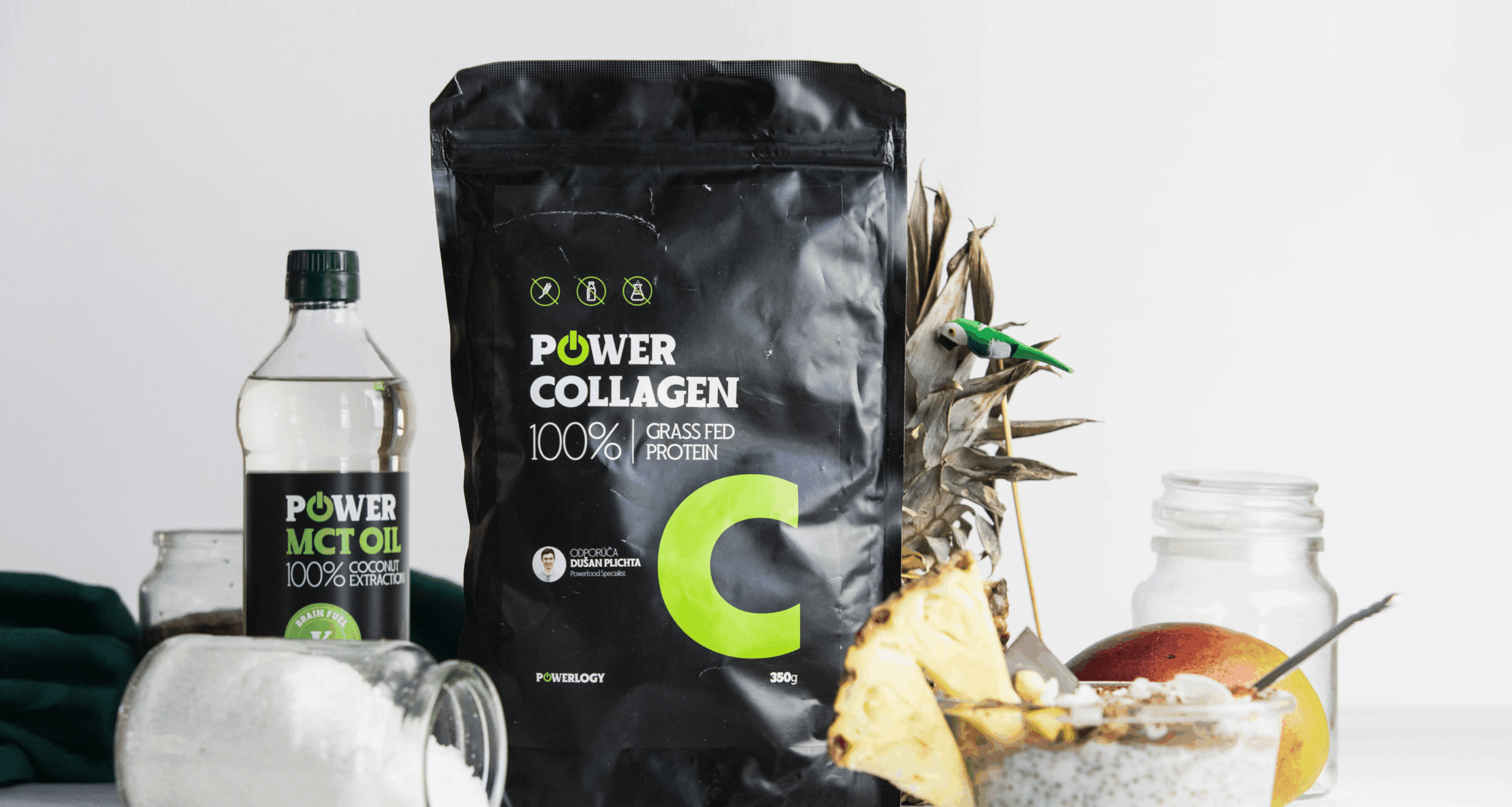
Do you know how to choose a protein for the everyday nutrition of tissues, skin, tendons and ligaments? Have you ever considered that, besides training your muscles, you can also train your metabolism to burn fat efficiently?
7 things a serious daily dose of Powerlogy Natural Collagen brings
At Powerlogy we picked a protein that meets the most demanding quality criteria: source, biological value, absorption, usability, taste and a wide range of ways to consume it. In the lines below we will introduce Powerlogy Natural Collagen 300 g in more detail — a single serious daily dose brings as many as 7 things worth knowing:
- Tissue nutrition: the protein supplies the body with the amino acids that are the building blocks of connective tissue, including fascia.
- Bones and joints: it contains 2 of the building blocks of cartilage, which are worth replenishing after every workout or sporting effort.
- Skin and hair: it contains the amino acids proline and glycine, which are among the building blocks of skin and hair.
- Muscle mass: it contributes to your daily protein intake, and it supplies the amino acids the body uses to synthesise creatine.
- Ageing: Powerlogy collagen protein helps replace the protein that the body produces less of as it gets older.
- Before sleep: taken in the evening, the protein supplies arginine and the nutrients the body uses for tissue renewal overnight.
- Glycine for the brain: the protein supplies the body with glycine, a neurotransmitter involved in motor and sensory pathways and in ATP synthesis.
The optimal dose of a quality protein, in the right combination and at the right time.
As with everything, the amount of protein depends on you individually — on your goals and on how much sport or other activity you do. Your daily intake should be between a minimum of 15 % and a maximum of 30 % of your total daily macronutrient intake. Simply put, 1.5–2 g of protein per kilogram of muscle mass.
CAREFUL! Muscle mass and your total body weight are not the same thing, so for an average person deduct roughly 20 % for fat.
What does MCT actually mean and what is it good for?
Coconut is rich in saturated healthy fats, and especially in the fats known as medium-chain triglycerides (MCT). MCTs are unique fats that are quickly converted into ketones, an extra source of energy when burning fat. More ketones means more available energy. Really, the brain loves ketones! People who eat plenty of MCTs often report better concentration. A great deal of research into ketones is still under way; the most recent work suggests that, besides their role in energy, ketones may also act as hormonal signalling molecules.
Every fat, whether coconut oil, butter or a special MCT oil, is made up of fatty acids of various chain lengths. The chain length of the fatty acids determines how long and how “easily” the oil digests and how quickly you get valuable energy for your body and above all your brain. The main difference between MCT oil and classic coconut oil is the composition of the acids — MCT oil is 99 % made up of only the most easily digestible fatty acids C6, C8 and C10 and contains almost no lauric acid C12. It is also tasteless and odourless, and it is produced by extraction from coconut oil.
Coconut oil, on the other hand, has a characteristic taste and contains 40–60 % lauric acid, which digests a little more slowly but has also been studied for antiviral and antibacterial properties. So each oil has its use. Coconut oil is suitable primarily for cooking and baking, and MCT oil is used cold in coffee, smoothies and shakes for its energising effect. MCT is easy on digestion, and in the right protocol it supports the direct formation of ketones, which give your brain extra energy. How strongly you feel it depends very much on the individual state of your metabolism.
In any case, more than 80 % of the people who have added MCT oil to their routine report noticeable improvements, especially in mental performance, ability to concentrate and in cutting out unsuitable carbohydrates.
Why is it a good idea to drink coffee with fat?
Taste the energising breakfast that switches your brain on! Coffee with MCT oil is no weight-loss miracle, but if you fit it correctly into your overall protocol it can bring you plenty of metabolic benefit. Adding MCT to coffee gives the body quick access to ketones without having to wait for fats to be converted first. Coconut oil contains only 15 % of the MCT fats that produce ketones.
Fortunately, it is possible to obtain concentrated MCT oils that contain up to 15 times more MCT than ordinary coconut oil! On top of that, thanks to Power Coffee with butter and MCT fat you can get through the pitfalls of “fasting” more easily and, essentially with no preparation period, train your metabolism straight away. Put simply, you are teaching the body to burn fat better. In scientific terms, this is an application of so-called cyclical ketosis, which you activate precisely thanks to the special MCT fats.


Comments
There are no comments yet.