

MCT oil consists of MCTs (medium-chain triglycerides), fats in which three medium-chain fatty acids are bound to glycerol. MCT oil contains mainly caprylic acid (C8) and capric acid (C10). At room temperature it is nearly colourless, transparent and low in viscosity, without a distinctive odour or taste. It is made from coconut oil and palm kernel oil, in which the fatty acids C8 and C10 make up a smaller part of the fat.[1][2]
At a glance
- MCT oil contains mainly caprylic acid (C8) and capric acid (C10) and is made from coconut oil and palm kernel oil.
- In coconut oil lauric acid makes up approximately half of the fatty acids, while C8 and C10 make up a smaller part of the fat.
- The EU register contains no authorised health claim for MCTs; claims about satiety, energy expenditure and body weight are listed as non-authorised.
- A 2015 meta-analysis found on average a 0.51 kg lower body weight with MCTs than with long-chain triglycerides, but the authors detected commercial bias.
- A large quantity of MCTs taken at once can cause diarrhoea and abdominal pain; in German clinical nutrition intake starts, for example, at 5 g per day and the dose is increased gradually.
Composition: caprylic acid C8, capric acid C10 and lauric acid C12
Medium-chain fatty acids (MCFAs) are, in a broad definition, the saturated fatty acids from hexanoic acid (C6:0) to dodecanoic acid (C12:0). The number after the letter C gives the number of carbon atoms in the chain. Pure C8 oils are also produced; the C8 oil tested in a 2017 study had a purity of approximately 95 %.[2][1][3]
| Fatty acid | Abbreviation | Systematic name | Coconut oil, g/100 g |
|---|---|---|---|
| caproic acid | C6:0 | hexanoic acid | 0.48 |
| caprylic acid | C8:0 | octanoic acid | 6.80 |
| capric acid | C10:0 | decanoic acid | 5.39 |
| lauric acid | C12:0 | dodecanoic acid | 41.84 |
Compared with saturated long-chain triglycerides, MCTs have a lower energy value of 8.4 kcal/g and are liquid at ambient temperature. Dietary fats provide 9 kcal/g. The difference of 0.6 kcal/g corresponds to approximately 7 % (calculation: 0.6 / 9).[1]
Production of MCT oil and the difference from coconut oil
Natural oils contain MCTs only in combination with long-chain fatty acids, so pure MCTs are produced by targeted synthesis. The main raw materials are coconut oil and palm kernel oil. The oils are first split into free fatty acids and glycerol. The fatty acids are separated by chain length, and the fraction with C8 and C10 is bound to glycerol again.[2]
According to a 2023 review, coconut oil contains approximately 46 to 54 % lauric acid, 5 to 10 % caprylic acid and 5 to 8 % capric acid. The USDA database gives 41.8 g of lauric acid, 6.8 g of caprylic acid and 5.4 g of capric acid in 100 g of coconut oil. Together, the fatty acids C8 and C10 make up 12.2 g of every 100 g (calculation: 6.8 + 5.4).[1][4]
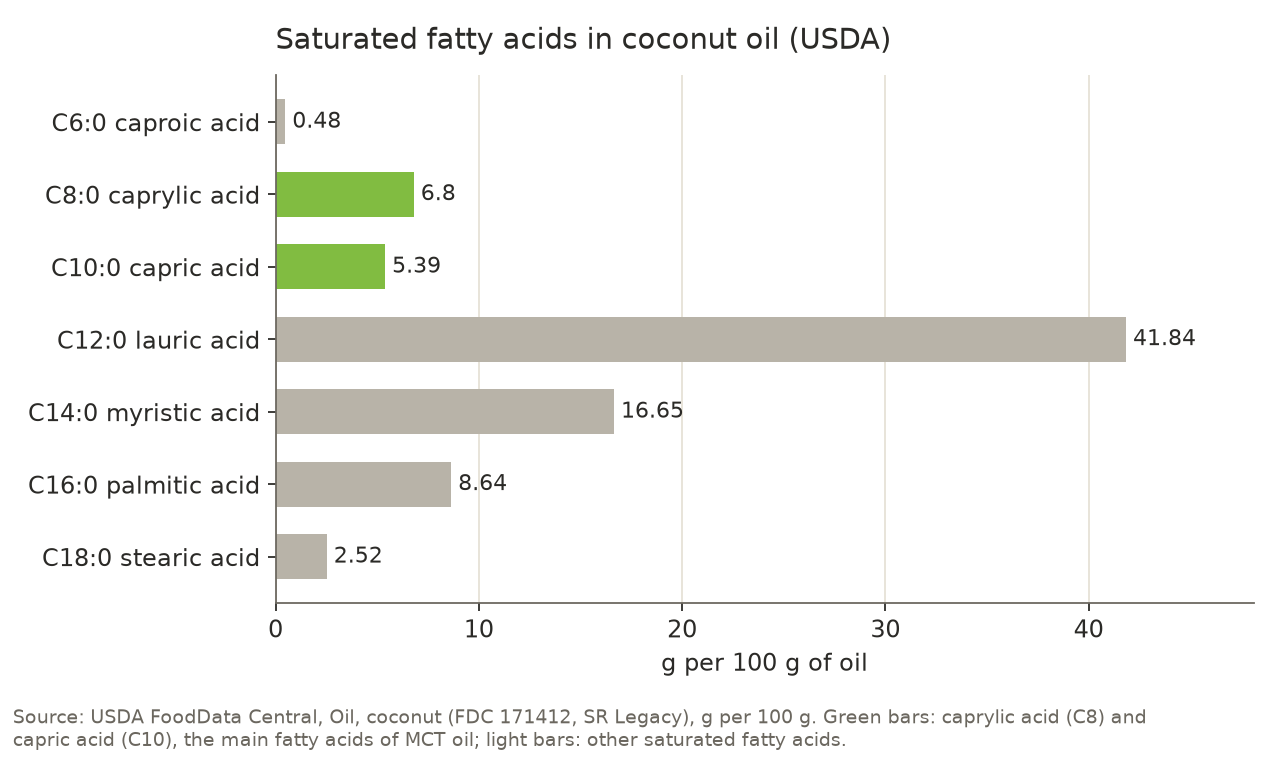
Lauric acid behaves differently from C8 and C10 during digestion. The fatty acids C8 and C10 are transported mainly as free fatty acids via the portal vein, while with increasing chain length, particularly with C12, the share transported by the lymph in chylomicrons can increase. MCT oil made of C8 and C10 therefore differs in both composition and absorption from coconut oil, which contains approximately 50 % lauric acid.[2]
Digestion and ketone bodies: C8 versus C10
In the digestive tract, MCTs are hydrolysed and absorbed rapidly, independently of bile acids and pancreatic lipase. Most of them are transported via the portal vein directly to the liver. Long-chain triglycerides are reassembled after absorption, incorporated into chylomicrons and distributed throughout the body by the lymph.[2]
In liver cells, the β-oxidation of MCFAs takes place without the carnitine-dependent transport that long-chain fatty acids require. It produces acetyl-CoA, from which the liver forms ketone bodies. The rise in ketone bodies depends on chain length: it is greater with C8 than with C10 or C12.[2][3]
A 2017 study in 9 healthy adults with a mean age of 34 years compared coconut oil, a conventional MCT oil with a blend of C8 and C10, pure C8, pure C10 and blends with coconut oil. Each oil was given in two doses of 20 ml. The first dose was given with breakfast, the second at noon without a meal.[3]
| Oil | Composition | Ketone bodies compared with the control day |
|---|---|---|
| coconut oil | 3 % C8, 5 % C10 | no significant difference; peak at 25 % of the C8 peak |
| MCT oil C8 and C10 | 55 % C8, 35 % C10 | daily mean 4.3 times |
| C8 | approximately 95 % C8 | daily mean 5.3 times |
| C10 | approximately 95 % C10 | up to 2 times between hour 5 and hour 6.5 |
Pure C8 raised the ketone level more than the other oils. With C8 the area under the curve was 813 % higher in the first 4 hours and 870 % higher from hour 4 to hour 8 than on the control day, when the participants received only milk without oil. Coconut oil did not change the ketone level significantly compared with the control.[3]
A 50 : 50 blend of C8 with coconut oil reduced the net rise in ketone bodies by 75 % compared with C8 alone. With C8, the rise was greater after the dose taken without a meal. It was a single study lasting 8 hours. The authors state that a study lasting weeks to months would be useful to assess regular intake.[3]
Health claims on MCT: none authorised
The EU register of nutrition and health claims contains no authorised health claim for medium-chain triglycerides. The claim about increased satiety after a meal, increased energy expenditure and weight loss (entry 1614) is listed as non-authorised. Equally non-authorised are the claims about maintaining body weight and limiting fat deposition (entry 677) and about the regulation of body weight and body fat (entry 643). All three entries are based on EFSA opinion 2011;9(6):2240. The reason is that, on the basis of the scientific evidence assessed, the claimed relationship was not established.[5]
Ketogenic diet, body weight and performance
A ketogenic diet is a diet high in fat and restricted in carbohydrates that induces nutritional ketosis. In this state the liver forms ketone bodies during the oxidation of fatty acids, mainly acetoacetate and β-hydroxybutyrate. The MCT ketogenic diet, described in 1971, uses the higher ketogenic efficiency of MCTs compared with long-chain triglycerides. MCTs yield more ketone bodies per unit of energy, so this diet allows a higher intake of carbohydrates and protein. In Germany and throughout the EU, MCTs are used mainly in foods for special medical purposes.[2]
A 2015 meta-analysis included 13 randomised trials with 749 participants that compared MCTs (C8 and C10) with long-chain triglycerides in adults. The MCT groups had on average a 0.51 kg lower body weight and a 1.46 cm smaller waist circumference. The authors detected commercial bias and, in many trials, incomplete information for assessing quality. The trials differed in duration, dose and control of energy intake. According to the authors, large studies by independent groups are needed to confirm the result and determine the dose.[6]
Earlier studies with a single intake of MCTs before exercise reported limited or inconsistent effects on performance. A 2026 review cites two newer Japanese studies in physically active people with a dose of 6 g per day that examined endurance performance. Three of the authors of the review work for an MCT producer.[2]
Dosing, digestive tolerance and use in cooking
According to a 2026 review, a large quantity of MCTs taken at once can cause digestive symptoms such as diarrhoea and abdominal pain. A gradual increase of the dose is recommended for better tolerance. The doses used in clinical and nutritional studies vary considerably.[2]
In German clinical nutrition, MCTs are introduced stepwise. With a target intake of approximately 15 g per day, intake starts at a low dose, for example 5 g per day. The dose is increased according to individual digestive tolerance, and the daily quantity is divided over three to five meals. In the same practice, mixing MCTs into food is recommended over taking the pure oil. Thorough mixing into semi-solid or liquid foods can improve the dispersion of the oil and reduce digestive symptoms.[2]
A 2026 crossover study enrolled 88 healthy Japanese adults prone to constipation, with 3 to 5 bowel movements per week. The participants took 2 g of MCTs per day for two weeks and 2 g of long-chain triglycerides per day for two weeks. No adverse events such as diarrhoea or loose stools attributable to the test supplement were observed; the authors note that MCTs sometimes cause these symptoms. Five authors of this study are employees of an MCT producer, which also funded the study. In the 2017 study with 9 participants and two doses of 20 ml, no significant digestive symptoms were reported.[7][3]
According to a 2023 review, MCT oil is used in salad dressings and added to yogurts, milkshakes and smoothies. It is not used as a standalone substitute for cooking oil. For cooking and frying it is blended with other edible oils, because it produces more smoke when heated and foams easily. Powdered MCTs are made by spray drying, which makes them easier to use in foods.[1]
Safety and choosing an MCT oil
MCTs contain neither essential nor polyunsaturated fatty acids, so a diet containing only MCTs can lead to a deficiency of them. In German clinical nutrition, with long-term MCT administration lasting longer than 3 weeks, an adequate intake of essential fatty acids is to be ensured. A 2023 review states that knowledge about the dosage and adverse effects of MCTs is limited. A 1982 review discusses contraindications to MCTs in ketosis, acidosis and cirrhosis.[1][2][8]
- Share of C8 and C10 in the oil: the conventional MCT oil in the 2017 study had 55 % C8 and 35 % C10, pure C8 approximately 95 % C8.[3]
- Content of lauric acid (C12), which makes up approximately half of the fatty acids in coconut oil.[2]
- For a powder, the share of MCTs in the powder and the other ingredients stated on the label.[1]
Related products
Browse the products in the category: MCT oil.
Sources
- Jadhav HB, Annapure US (2023). Triglycerides of medium-chain fatty acids: a concise review. J Food Sci Technol 60(8):2143. https://doi.org/10.1007/s13197-022-05499-w
- Heidt C, Oertling H, Abramowicz M, Otsubo Y, Tokunaga S, Tsujino S (2026). Medium-Chain Triglycerides: Scientific and Regulatory Perspectives from Germany and Japan with a US Context. A Concise Review. Nutrients 18(7):1027. https://doi.org/10.3390/nu18071027
- Vandenberghe C, St-Pierre V, Pierotti T, Fortier M, Castellano CA, Cunnane SC (2017). Tricaprylin Alone Increases Plasma Ketone Response More Than Coconut Oil or Other Medium-Chain Triglycerides: An Acute Crossover Study in Healthy Adults. Curr Dev Nutr 1(4):e000257. https://doi.org/10.3945/cdn.116.000257
- U.S. Department of Agriculture (2019). FoodData Central: Oil, coconut (FDC 171412, SR Legacy). USDA Agricultural Research Service. https://fdc.nal.usda.gov/food-details/171412/nutrients
- European Commission (2012). EU Register on nutrition and health claims (entries 643, 677 and 1614, medium-chain triglycerides). Food and Feed Information Portal. https://ec.europa.eu/food/food-feed-portal/backend/claims/files/euregister.pdf
- Mumme K, Stonehouse W (2015). Effects of medium-chain triglycerides on weight loss and body composition: a meta-analysis of randomized controlled trials. J Acad Nutr Diet 115(2):249. https://doi.org/10.1016/j.jand.2014.10.022
- Otsubo Y, Ishikawa H, Kojima K et al. (2026). Effects of low-dose medium-chain triglycerides on bowel habit outcomes in Japanese adults prone to constipation: a randomized, double-blind, LCT-controlled crossover trial. Front Nutr 13:1746245. https://doi.org/10.3389/fnut.2026.1746245
- Bach AC, Babayan VK (1982). Medium-chain triglycerides: an update. Am J Clin Nutr 36(5):950. https://doi.org/10.1093/ajcn/36.5.950



Comments
There are no comments yet.