

Coffee with butter and MCT oil? A great deal has already been written about coffee with butter. There are more than 2 million people in the world for whom this unconventional approach to breakfast has noticeably improved their routine, their daily energy and their overall productivity.
On the other hand, it is good when sceptics and conservative experts also look at an innovation, so that a person can form a critical and complete picture. And decide whether to try it or rather leave it alone.
Through the biohacking community, Powerlogy founder Dušan Plichta met another advocate of this unconventional approach to breakfast: the Dutch expert Dagmar Bouwer, a specialist in the visualisation of biomedical processes that helps make complex relationships easier to understand.
Read on to find out:
- Why coffee with butter works
- Whether individual predispositions can be a problem when drinking it
- What influences the desired effect of coffee with butter and its positive impact on metabolism
An interview and the most frequently asked questions about drinking coffee with butter and MCT oil
We have collected the most frequent questions about drinking coffee with butter and replacing a classic breakfast. The answers are given in translation in this article. You can also read them in the original article by Dagmar Bouwer. If you would like more information about this expert in the biomedical sciences, you will find it on her website.
Medical matters and science are very thin ice, and we say up front that drinking coffee with butter and MCT is everyone’s own responsibility and that you will find no promises of miracle “pills” in this article. This unconventional approach to breakfast is based on the principles of low-carb and keto nutrition. It calls for a responsible, individual approach. Our aim is to give you the most complete information possible, so that your decision is a considered one.
At the same time we are open to constructive criticism, to opinions backed by serious arguments and by your own measurable practice, without so-called tendentious “cherry picking”. We value the experience of those for whom this approach works, and equally of those who tried it but found a better alternative. The aim of the article and of any comments is to help readers find a routine tuned to them personally.
Let’s get to it — the interview follows.
What is Power Coffee with butter and MCT oil?
I would call it the Power Coffee kick-starter, and from my point of view it is several things at once. Power Coffee with butter and MCT oil is an effective replacement for breakfast. The recipe is also an advanced tool that combines ancient Eastern wisdom with advanced technology and new scientific findings. It is my breakfast, and it lets me start every day in the best possible way! I will briefly describe how it works based on my own experience and how you too could benefit from it.

What does Power Coffee make possible?
Power Coffee has something to offer anyone who is trying to get the most out of their day. It stands on the principles of low-carb eating, and therefore on optimising your own metabolism. In other words, Power Coffee also helps you lower your overall carbohydrate intake. Here are the main benefits:
- Fat burning. Power Coffee works because it allows the body to burn fat by activating cyclical ketosis. In this state your body has access to the energy contained in fat and produces ketones as an energy source. You use the fats from the food first and then from the stores on your body.
- No hunger. We feel hungry when we have little energy or when our blood sugar drops sharply. But the amount of energy stored in our body fat is more than we could burn in several weeks! When your body learns to burn fat, you will find that hunger arrives slowly and then gradually builds. That is the exact opposite of a high-carbohydrate diet, where hunger literally ambushes you within minutes and with high intensity.
- Stable, abundant energy. Since we do not eat during sleep, we automatically wake up in light ketosis. When we give the body fat for breakfast, it serves us as fuel. The ketones produced in the process of burning fat give us additional energy.
- Better concentration. Mental performance and concentration require a lot of energy. When your body burns fat and creates ketones, the amount of energy is high and stable. A high amount of energy means higher and easier concentration.
- Nutrition. Of course, this factor depends greatly on the quality of the ingredients used, but butter (or ghee) and coffee contain useful vitamins and antioxidants that are part of a varied diet.
Why does Power Coffee work?
Every ingredient in the Power Coffee recipe brings something unique. Many factors play a role in the effects of this drink. In the following paragraphs I will describe some of the most important benefits, and also what each ingredient contributes and why they work so well together.
What can coffee do?
Coffee is a wonderful drink, but a great deal depends on its quality and on how it is processed! It is rich in plant antioxidants (polyphenols) and minerals and is of course an excellent source of caffeine. Caffeine stimulates the brain and sharpens sight, memory and reaction time. It also stops us from being sleepy, which can be good and bad — depending on the time and on how you feel during the day. All of that makes coffee one of the most popular drinks in our modern society.
Many coffees on the market do not meet the quality standards a good coffee should have. That is why, through long-term research, development and testing, we created a coffee to our own strict standards. We follow the whole journey of the coffee bean in detail, from the plantation through the roastery to packing and distribution. In this way we try to create the highest-quality coffee we can, one that keeps all of its benefits. We select and process our coffee so that you can rely on it 100 %. Not only in taste, but also in how it works.
What can butter do?
Butter is derived from the first living drink every one of us had: mother’s milk. Honest unprocessed milk, or only gently processed milk, from grass-fed animals contains the most important nutrients that allow young mammals to survive.
What real butter brings:
- Butter contains vitamins A, B12 (cobalamin), D, E and K2. Most of these are fat-soluble vitamins found only in animal products.
- Butter contains a good ratio of omega-6 to omega-3 fatty acids. This ratio depends on how much natural food, grass, the cows were able to eat (more grass = more omega-3).
- Butter contains fats such as CLA (conjugated linoleic acid) and butyrate. CLA is a type of natural trans fat that has been associated with several health outcomes in research, such as cardioprotection, lower inflammation and immunomodulation. Butyrate has also been studied in connection with inflammation.
- Butter contains about 80 % fat, which is great if your body uses fat as a fuel source.
If you would like an even more concentrated version of butter (or if you are intolerant to lactose or casein), you should try ghee. Ghee is pure milk fat that still contains all the key fat-soluble vitamins. Our ghee butter is a sustainable food that we make from the milk of cows fed on grass only.
What can MCT oil do?
Coconut is rich above all in the fats known as medium-chain triglycerides (MCT). MCTs are unique fats that are quickly converted into ketones. What are ketones? They are a fast source of energy that our body creates in the liver from easily digestible fats. More ketones means more energy.
Really, the brain loves ketones! If you eat MCT fats, you will experience better concentration.
A great deal of research into the effects of ketones is still under way. New research also suggests that ketones may act as hormonal signalling molecules.[1] Adding MCT fat to coffee gives the body quick access to ketones without having to wait for fats to be digested step by step. Ordinary coconut oil contains only 15 % MCT fats, but it is possible to produce concentrated oils with a practically pure MCT content! We have one of those at Powerlogy too.
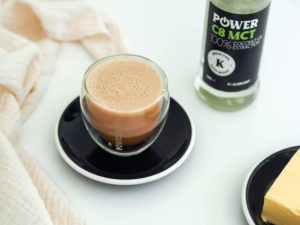
Coffee with butter + MCT oil = synergy
Synergy means 1 + 1 + 1 equals 9 instead of 3. The effects of these three ingredients reinforce one another, which brings you more benefit. Coffee is a great carrier for these lightly flavoured fats. Fats help your body take up soluble nutrients from the coffee and the butter. Coconut MCTs increase fat burning and increase the amount of ketones, which give the body a fast source of stable energy. Butter makes the coffee an even more filling drink and supplies further fats that your body will burn over the coming hours.
A morning cup of Power Coffee makes sure that the benefits of these 3 ingredients work in your favour.
So that you do not have to search the e-shop for long, we have created a special combo for you containing all three ingredients at a discounted price.
CAREFUL: Power Coffee with butter and MCT oil is not perfect
Like almost everything, Power Coffee with butter and MCT oil has its downsides. If you decide to try this alternative form of breakfast, it is good to keep all aspects in mind. The most important is that your body may not be used to taking in a larger amount of fat in a single meal. It may need time to adjust its production of digestive enzymes, stomach acid, bile and so on. Add the amounts of butter and MCT oil to your coffee gradually and increase them slowly over several weeks. And very important! Always blend the coffee properly, so that you get a drink that really is easy to digest.
There is a huge difference between a beautifully blended Power Coffee and a coffee with badly mixed-in fats.
Even though butter is a great source of vitamins A, D, E and K2, it is not nutritious enough to cover your body’s whole daily supply of all nutrients. So do not forget a good lunch and dinner during the day and a sufficient intake of fresh or cooked vegetables.
And finally, Power Coffee with butter and MCT oil is not for everyone. If you cannot stand the taste or the feel of fats in coffee, if your state of health does not allow it, or if you are particularly sensitive to one or more of the ingredients, you may need to adjust the recipe to your current situation. Or try something else. If you have any concerns, discuss them with a doctor or a nutrition specialist you trust.
So is it really a better replacement for a typical breakfast?
Is Power Coffee really better than what you normally have for breakfast? The most important differences lie in the macronutrient composition of the two options. A typical breakfast probably contains mainly carbohydrates, but not much fat. Power Coffee contains mainly fat, but practically no carbohydrates. I will compare the pros and cons of a typical breakfast (TB) with Power Coffee (PC).
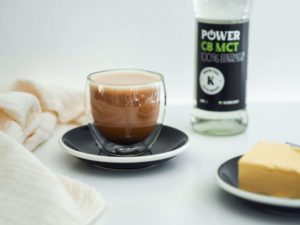
- Easy preparation
TB: Most of the time very easy. Breakfast cereal in a bowl with milk or yoghurt and you are done. Making sandwiches is a bit more demanding. Perhaps you like the idea of a breakfast with eggs, toast, a glass of fresh orange juice and so on, but preparing that will take longer.
PC: You make a coffee (most people just press a button on the coffee machine), add butter/ghee and MCT oil, blend for 30 seconds in a high-power blender and you are done! Time to drink. - Availability of ingredients
TB: Very easily available. Every shop has huge stocks of all kinds of standard breakfast foods.
PC: At the start it may take a while before you find a good-quality source of ingredients (above all butter or ghee). If you have decided on Power Coffee, we recommend looking through our range. In the Powerlogy portfolio you will find everything you need to make Power Coffee. - Portable
TB: That depends on what your typical breakfast is. Sandwiches are easy to carry; with a bowl of cereal you will struggle more. And a big tray with eggs/toast/fresh orange juice I would rather leave at home.
PC: Pour it into a thermos or a travel mug and you can take Power Coffee anywhere. - Energy and the feeling of hunger
TB: A big breakfast will bring you plenty of energy! …for about an hour. Then you get hungry and need more carbohydrate-rich food. Which will bring you wonderful energy again! …for about another hour. Then you get hungry and need more carbohydrate-rich food… I think you see my point.
PC: One cup of Power Coffee will give you enough energy for the whole morning! Really, no hidden tricks. - Enough energy all morning
TB: When I still ate in the classic way (high in carbohydrates, low in fat), my energy dropped after lunch to the point where I almost fell asleep. There is nothing great about that if you want to make the most of your day.
PC: After I switched to Power Coffee, I never felt a lack of energy during the day because of food. - One cup a day
TB: Most people will have several cups of coffee at regular intervals during the day to keep their attention up. Without coffee their concentration would collapse.
PC: You have your cup in the morning and the energy stays with you long after the caffeine has worn off. If you need more energy, a second dose of Power Coffee or even plain coffee will probably help you carry the day to a successful close.
Coffee with butter – let’s get over the fear of fat
Most people will associate fats, especially saturated fats, with weight gain, high LDL cholesterol, heart disease, stroke, cancer and so on. Yes, at first glance it can look that way, but the facts are often pulled out of context and the issues are simplified beyond accuracy.
So, very briefly, when it comes to the amount and the type of fats in Power Coffee, there is no need to be afraid. I also recommend studying the article by one of the leading Slovak scientists, prof. MUDr. Stanislav Oravec CSc, on how cholesterol is understood and how its real influence on cardiovascular disease is interpreted.
Saturated fats and cardiovascular disease
The relationship between dietary fat and cardiovascular disease is not as simple as “saturated fat causes heart disease” or “high LDL cholesterol causes heart disease”. There are many types of LDL particle with different effects on the risk of heart disease. Measuring total LDL cholesterol (how much total cholesterol the LDL bodies weigh) does not distinguish between the different types of LDL particle [2]. Total LDL cholesterol is therefore not the best indicator of cardiovascular disease. Risk assessments often include lipid levels (HDL-C, LDL-C, total cholesterol), triglycerides, blood sugar levels, insulin resistance and markers of inflammation [3]. Two patterns of blood markers are used for an initial assessment of cardiovascular risk:
- Pattern A: high HDL-C, low triglycerides, a low number of small, dense LDL particles.
- Pattern B: low HDL-C, high triglycerides, a high number of small, dense LDL particles.
Only pattern B is associated with an increased risk of cardiovascular disease [3]. Pattern B often occurs in individuals whose diet contains a high proportion of carbohydrates, especially with a high content of refined sugars such as white sugar and fructose.
If we take pattern A into account, eating a little more saturated fat probably does not increase the risk of cardiovascular disease. If you have pattern B and start eating a lot of saturated fat, you will most likely increase your risk of cardiovascular disease [4], so make sure you check your fat profile before you start consuming more fat in your diet.
Saturated fats and weight gain
You gain or lose weight depending on what you eat. Most people in the modern world gain weight mainly from an excessively high carbohydrate intake and from poor macronutrient combinations. Of course, they will gain even more if they add a larger amount of fat on top of that. But people who have their carbohydrates under control and take their energy from good fats tend to lose weight. Why? Very briefly, because of insulin. In the picture below you can see the effects of insulin, which is produced when you eat carbohydrates and thereby raise your blood sugar.
- Insulin stimulates the liver to store carbohydrates for later in the form of glycogen.
- Carbohydrates are the main source of energy your body uses.
- When the liver can no longer store any more glycogen, carbohydrates are converted into fats (lipogenesis).
- They are stored in fat tissue.
That is the main reason why carbohydrates can cause you to gain weight, and in combination with fats they will make you gain even faster.
On the other hand, the picture below shows what happens when you eat very few carbohydrates and produce almost no insulin.
- Fats are your main fuel source. Carbohydrates are used very little to make energy (but they are still needed for specific organs and tissues).
- The body makes ketones from fat.
- Ketones supply energy to organs that usually require carbohydrates (such as the brain, heart and muscles).
- Instead of storing fat, your body pulls fat out of fat tissue to burn for energy. If you have more fat than you need, you start to lose weight.
- Your body will use so few carbohydrates that the liver can make them or release them from glycogen as needed.
So, paradoxically, eating fat does not mean turning into fat. If you want to lose weight, it helps to lower the amount of carbohydrates in your diet and thereby lower your insulin levels.
Interesting and little-known nutrients in butter
Quality butter contains not only saturated fats but also some important fat-soluble vitamins such as vitamin K2 and vitamin E, and the fatty acid butyrate. A higher dietary intake of vitamin K2 was associated with a reduced risk of coronary heart disease in the Rotterdam Study. [5] Vitamin K2, which is found in butter, is involved in directing calcium in the body and in maintaining the right calcium balance together with vitamin D, which is also found in butter. Vitamin E and butyrate have been studied in relation to inflammation, which is discussed as a factor in the development of cardiovascular disease. [6-10]
That is only the tip of the iceberg when it comes to worries about fats. Some claims are well founded, but most require more detail and explanation. Clearly, going through every objection to fats goes far beyond the scope of this article. Thanks to the access to information we have, it is possible to look up all the evidence.
Coffee with butter – how to make it so that it really works?
If you have got this far in the article, you will probably want to try Power Coffee at least once a week. With the following instructions you will get the most out of drinking Power Coffee for breakfast. If you have any health problems with cardiovascular, digestive or metabolic symptoms, talk to your doctor about how and whether to use Power Coffee. Also check this article about the 10 most common mistakes people make and fail on.
But imagine this: for breakfast you have only coffee and nothing else. Although you may not feel “full”, you will not be hungry. Also, if you start your day by taking in fat, your body will stay in the fat-burning mode that began during sleep. The longer you can function without carbohydrates, the longer your energy will stay stable. If you want to eat something, have a meal without carbohydrates. You will find that eating fewer carbohydrates keeps how energetic you feel at higher and steadier levels.
Quality ingredients
It is very important to use quality ingredients from trustworthy sources. Power Coffee will not work as it should if you use ingredients of poor quality!
Coffee – can quickly become contaminated with toxic mould spores. Most producers do not check for them, but these mould spores really can destroy your energy! We dare to say that Powerlogy, with its high internal quality standards, is a source of reliable coffee. We often transparently publish the quality-control test results for our products. Surely none of you would want to risk your productive day every time you have a cup of coffee, would you?
Butter – as already mentioned, try to find butter from healthy, happy cows that graze on grass. The more grass they eat and the healthier they are, the more nutritious their butter is.
You can choose any butter you like (cow, goat, sheep and so on). The original recipe for butter in coffee was derived from yak butter tea, so you can play with the ingredients a little.
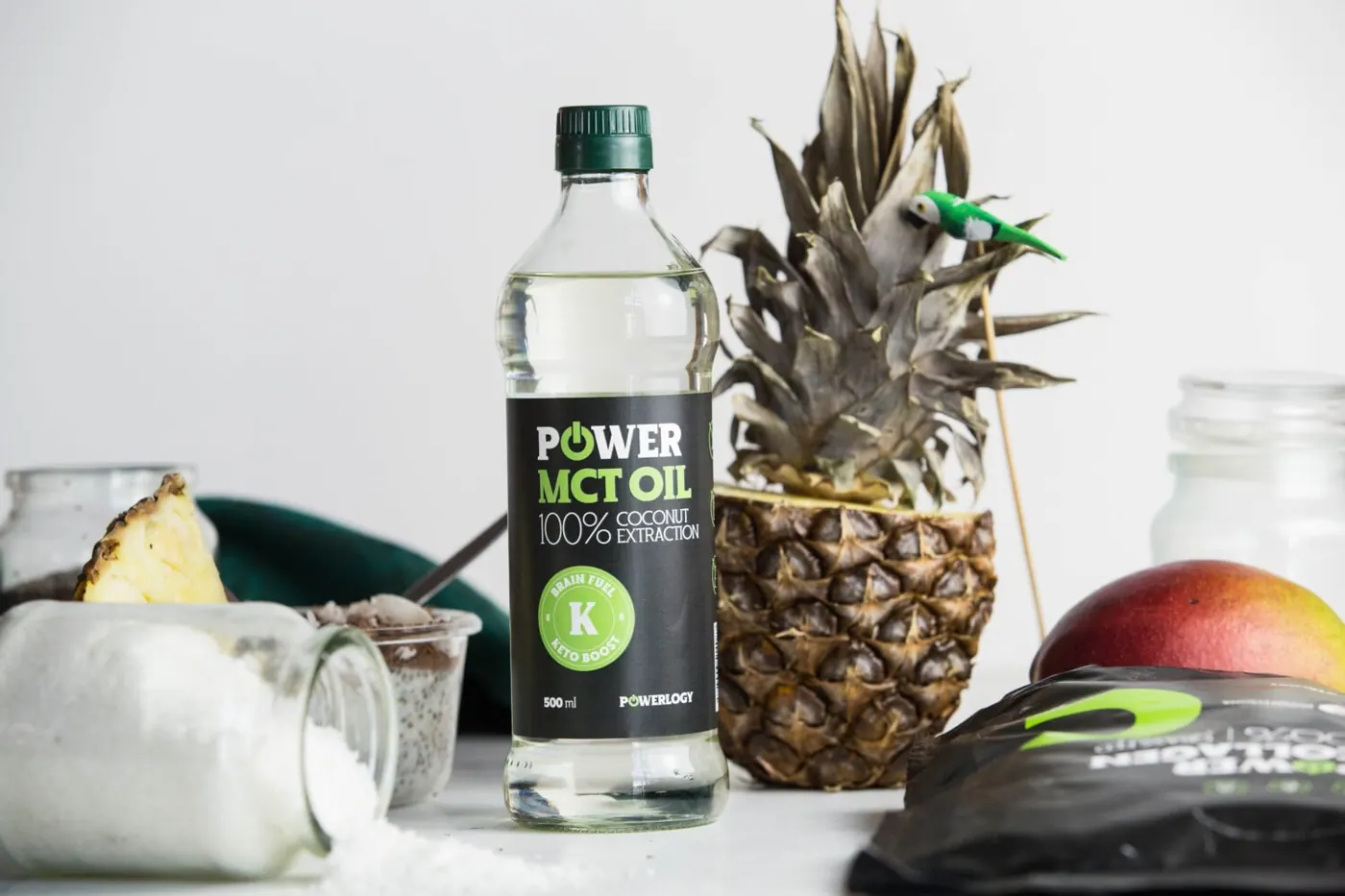
MCT oil – cheap MCT oils contain impurities or are damaged by processing. When it comes to MCT, the fatty acids C8 and C10 are the best MCTs for producing ketones. C12 is classified as a medium chain, but it behaves more like a normal fat in the body, so it is not useful in your precious MCT oil. C6 is a great source of ketones, but it tastes terrible and can make you feel sick! So look for an MCT oil with a high content of C8 and C10 for the best ketone production.
Is coffee with butter for you? Start slowly
When you replace a typical breakfast with Power Coffee, your body will have to adapt over the first few weeks. It will have to get used not only to digesting and absorbing fats properly, but also to transporting and burning them properly. Move to MCT fat gradually. Your gut may decide to get rid of this fat as quickly as possible if you take in too much at once without proper adaptation and preparation.
Start with a modest amount of butter and MCT oil (5–10 ml) in a well-blended cup of coffee. Increase the dose over the following days if you feel you are handling it comfortably. Once you reach the point where you can add as much butter and oil as you would like, you are adapted to this morning drink. And you can then be guided by your hunger and by how you feel after drinking Power Coffee.
If your tolerance of fat is really low and you cannot tolerate fat in coffee at all, consider a gentler transition. Have coffee as breakfast with whatever amount of butter and MCT oil you like. When you get hungry, have a standard brunch/lunch, but not before. Also try to have more fat and fewer carbohydrates in your meals. Use butter for cooking meat and vegetables and try adding MCT oil to salads, for example. This gradual transition may be the most comfortable for your body, but it will take patience and more time.
Experiment!
If you are comfortable with the basic recipe, you can start experimenting.
- Use different coffee beans and roast types to adjust your caffeine and taste preferences. You can even try different alternative brewing methods if you really want to play with the details.
- Experiment with new MCT oils (for example pure C8 MCT oil) and upgrade your recipes to suit you.
- Add heat-stable protein powders such as collagen hydrolysate for an even more nourishing drink. Fat and protein will make the drink more filling.
- Add flavourings such as vanilla, cacao, cinnamon or other spices to widen the range of aromas and flavours in your coffee.
References
- Newman, J.C. and E. Verdin, Ketone bodies as signaling metabolites. Trends Endocrinol Metab, 2014. 25(1): p. 42-52.
- http://eatingacademy.com/nutrition/the-straight-dope-on-cholesterol-part-iii
- Interview of Dr. Ronald Krauss, prominent researcher and clinical doctor in the field of cardiovascular disease: https://www.youtube.com/watch?v=7gZt9DQqtZI
- Chiu, S., P.T. Williams, and R.M. Krauss, Effects of a very high saturated fat diet on LDL particles in adults with atherogenic dyslipidemia: A randomized controlled trial. PLoS One, 2017. 12(2): p. e0170664.
- Geleijnse, J.M., et al., Dietary intake of menaquinone is associated with a reduced risk of coronary heart disease: the Rotterdam Study. J Nutr, 2004. 134(11): p. 3100-5.
- Tracy, R.P., Inflammation in cardiovascular disease: cart, horse, or both? Circulation, 1998. 97(20): p. 2000-2.
- Ross, R., Atherosclerosis is an inflammatory disease. Am Heart J, 1999. 138(5 Pt 2): p. S419-20.
- Pearson, T.A., et al., Markers of inflammation and cardiovascular disease: application to clinical and public health practice: A statement for healthcare professionals from the Centers for Disease Control and Prevention and the American Heart Association. Circulation, 2003. 107(3): p. 499-511.
- Saemann, M.D., et al., Anti-inflammatory effects of sodium butyrate on human monocytes: potent inhibition of IL-12 and up-regulation of IL-10 production. FASEB J, 2000. 14(15): p. 2380-2.
- Hamer, H.M., et al., Review article: the role of butyrate on colonic function. Aliment Pharmacol Ther, 2008. 27(2): p. 104-19.


Comments
There are no comments yet.